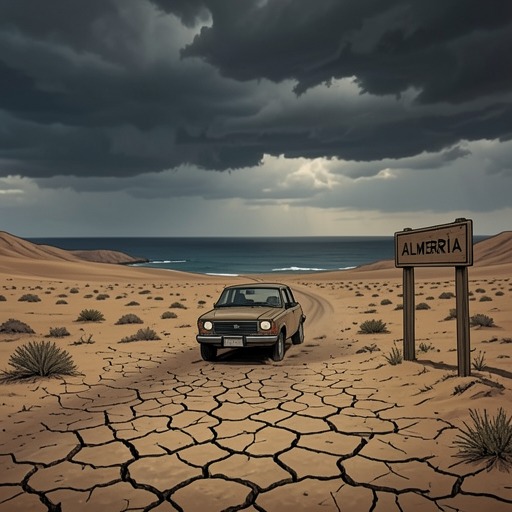
Drought and expanding greenhouse agriculture in Almería
Hot MilkDrought and expanding greenhouse agriculture in Almería shape both the region’s physical landscape and the novel’s account of how land, labor, and development are connected. White plastic structures cover the plains and valleys, making the desert appear less like untouched scenery than a place actively remade for production. Sofia Papastergiadis first sees that transformation from the road; later, its products and infrastructure recur in scenes that place her family’s private difficulties within a wider material world.
The desert and its coverings
Almería is presented as intensely dry. Sofia contrasts its barren hills with the gentle, damp parks of the United Kingdom, and notes that there is no green grass locally apart from the golf courses. The sun is also a bodily condition: her lips split, and the desert’s exposure shapes what she notices and how she moves through it. The landscape’s dryness is not an abstract backdrop. It is a persistent feature of daily life against which cultivation, recreation, and industrial development become especially visible.
The white plastic coverings are among the region’s most striking features. A student at the beach injury hut points them out as greenhouses spread across the land, and Sofia recognizes them later from a taxi window: they extend across a valley and seem to consume the terrain. Her description turns the coverings into a kind of skin laid over the desert. The image makes concealment central to the agricultural landscape: the structures hide the ground beneath them even as their vast extent makes the transformation impossible to ignore.
Greenhouse production and labor
The student explains that the covered farms grow tomatoes and peppers for supermarkets. He says temperatures inside can reach forty-five degrees and that the farms employ undocumented migrants to pick the crops, in conditions he characterizes as more or less slavery. The account therefore links the greenhouse landscape not only to food production but also to the workers who perform it under severe heat and with limited power. The neat commercial destination of produce in supermarkets stands in sharp contrast to the conditions described at the point of harvest.
The agricultural covering also becomes a recurring visual connection between labor and other forms of concealment. In a later reflection, Sofia associates the plastic over the tomato and pepper farms with a pharmaceutical company, placing commercial systems alongside the clinic’s marble wall, which has been marked with the words Sunshine is Sexy. The juxtaposition does not make the businesses identical; rather, it returns attention to the different institutions and surfaces through which power becomes visible, or is covered over. The greenhouses remain a material presence in Sofia’s field of observation, linking the region’s economy to her effort to understand what lies beneath appearances.
Industry, tourism, and a changing coast
Agriculture is only one part of the altered landscape. On the way to the Gómez Clinic near Carboneras, Sofia and Rose Papastergiadis travel through a region marked by the cement factory for which Carboneras is known. Their taxi driver tells them that the name means coal bunkers and that the mountains were once forested before trees were cut for charcoal. His account adds an earlier history of extraction to the contemporary scene: the terrain has been shaped by successive uses, not simply by its natural dryness.
At a beach opposite the cement factory, Sofia sees an industrial cargo ship near the horizon, cranes at a desalination plant, and deposits of cement powder beside unfinished hotels and apartments cut into the mountains. The setting brings together shipping, water infrastructure, cement production, and tourism construction within one view. A nearby child’s swing, made from a battered car tyre, is a small remnant of ordinary use amid this much larger development. The beach is neither an untouched natural refuge nor merely an industrial site; it is a place where these uses meet.
Landscape as lived experience
Sofia’s encounters with Almería’s environment are consistently connected to dependence and care. On the taxi journey to the clinic, the countryside passes beneath white plastic while Rose rests against her daughter. Sofia knows her mother is frightened and tries not to show her own fear. At the clinic entrance, she takes Rose’s arm and matches her pace, describing their shared movement as a way of going forward together. These moments do not make environmental change the cause of Rose’s mobility impairment. They show instead how the region is experienced through the practical demands of travel, heat, illness, and mutual dependence.
The landscape also enters Sofia’s memory of her own body. After walking with Rose, she sometimes finds herself limping, as if her body has retained the way they move together. That recollection complicates the idea of the desert as a view observed from a distance: its conditions and routes are lived through bodies, while family routines leave their own marks on how Sofia moves. The novels’ recurring attention to walking and travel thus gives the changing region a human scale without reducing it to scenery.
Narrative significance
The greenhouse system is presented through observations accumulated across separate scenes rather than through a single account of environmental change. Sofia hears about the farms from a student, sees their coverings from a taxi, encounters their products in references to tomatoes and peppers, and later watches a lorry carrying tomatoes grown under plastic on the desert farms. That final roadside image connects the vast covered fields to the movement of produce beyond them. It also keeps the labor and heat described earlier in view, even when the farms themselves are no longer present.
This structure makes agricultural expansion part of the novel’s wider attention to what is visible and what remains obscured. The white coverings transform the land and conceal the ground; the crops circulate, while the student’s account directs attention to the workers behind them. Alongside the cement factory, desalination plant, and unfinished hotels, the greenhouses reveal a region shaped by overlapping economic uses. Almería’s landscape is therefore not simply a backdrop for Sofia’s family story: it is a changing environment whose production, infrastructure, and costs enter the narrative through specific places, journeys, and bodily encounters.