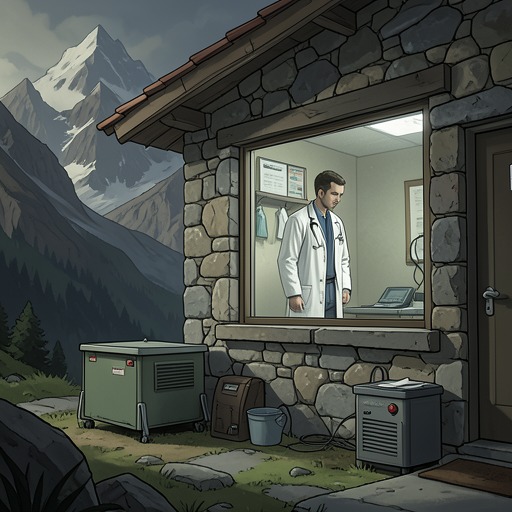
Gómez Clinic near Carboneras
Hot MilkGómez Clinic near Carboneras is a medical centre in the semi-desert of southern Spain where Rose Papastergiadis and her daughter, Sofia Papastergiadis, pursue answers to Rose’s unexplained problems with her legs. The clinic offers examinations and a review of Rose’s medication, but no settled diagnosis emerges. Its imposing architecture and costly treatment frame an encounter in which clinical explanations, family caregiving, and the patient’s own account of pain do not always align.
Setting and arrival
The clinic is near Carboneras, a town associated with a cement factory, and the journey there takes about thirty minutes by taxi. Rose and Sofia travel from Almería for an appointment arranged as part of a longer search for a healer. The visit has substantial financial stakes: they remortgage Rose’s London home to meet a treatment bill of twenty-five thousand euro. For Sofia, who has spent much of her life trying to understand her mother’s symptoms, the expense makes the clinic’s promised investigation especially consequential.
The grounds are described as a small oasis, with palm trees and gardens. The main building is a cream-coloured marble dome set into the mountain, with a glass entrance; flowering shrubs and cacti grow along its curve. A stationary shuttle bus stands near the entrance. The approach itself establishes a contrast between the exposed, semi-arid landscape and a purpose-built treatment environment. After a fourteen-minute walk from the taxi to the doors, Sofia and Rose enter together. At reception, Sofia supports her mother as they cross the marble floor, matching her pace to Rose’s. A nurse then takes over, pushing Rose in a wheelchair through the corridors to Dr Gómez’s consulting room.
Examination and medication review
The clinic’s work begins with concrete examination as well as uncertainty. Dr Gómez inspects Rose’s feet and identifies ulcers, including one area that is slightly infected, asking whether she has been tested for diabetes. He also plans to compare imaging in search of abnormalities. These findings do not, however, provide a complete explanation for the mobility problems that brought Rose and Sofia to the clinic.
Dr Gómez asks to review Rose’s medication and wants her to say which medicines she feels most attached to and which she might stop. Rose resists being separated from Sofia for this conversation: she says that her daughter is the person who knows the medication history and that she will not abandon her medicines in a foreign country. Their exchange shows how the treatment process depends not only on clinical judgement but also on the knowledge accumulated through daily care. Dr Gómez nevertheless sends Sofia away for the middle part of the appointment, asking her to return at two o’clock.
At the later consultation, Dr Gómez has taken Rose off three pills. Rose presents the change with mock distress and lists the absent medicines as though mourning a familiar ritual. The doctor also reports chronic iron deficiency, which may contribute to her lack of energy, and prescribes vitamin B12. He recommends a silver-lined dressing to help the foot ulcers heal. For Sofia, the modest and specific measures sit uneasily beside the large sum spent on treatment; her questions about value reflect the difference between expecting a definitive answer and receiving incremental care.
Uncertain findings and daily care
The clinic’s assessment continues without resolving Rose’s condition. At a later meeting, Dr Gómez discusses an X-ray showing some loss of bone density, while explaining that this degree of change is common in women over fifty and that Rose has not experienced a significant loss of bone material. He recommends that she walk home. The recommendation is striking in the context of the family’s reason for seeking care: Rose’s capacity to walk is itself uncertain, and the consultation does not produce a definitive account of why her mobility varies.
Medication and hydration also become linked practical problems. Rose has difficulty accepting water, and Sofia describes the challenge of finding the sort she will drink. During a later episode, Rose is dehydrated and spends two nights receiving care at the clinic; she is rehydrated with intravenous saline. Dr Gómez explains that difficulty swallowing water also makes it difficult for her to swallow medication. The clinic’s staff attend Rose on a rotating basis, and Dr Gómez reports that her morale is high after her medication has been discontinued, although the dehydration exposes a risk in the transition. The episode brings the treatment plan back to the ordinary tasks of care: water, medicines, and the question of how Rose can manage them.
Dr Gómez also interprets Sofia’s role in that routine. He suggests that administering her mother’s medication has become a ritual for Sofia as well as for Rose, and that she has used her mother as a shield against making a life of her own. He presents the end of the medication routine as requiring Sofia to invent another one. This interpretation shifts the consultation beyond Rose’s symptoms, making the clinic a place where the caregiver’s dependence and future are also examined, without establishing that the doctor’s account is the only valid one.
Scrutiny and institutional pressures
The clinic’s work attracts attention beyond the family. A pharmaceutical-company executive and a health official from Barcelona attend a meeting with Dr Gómez, Julieta Gómez, Rose, and Sofia. The discussion follows Rose’s dehydration and her return to medication after treatment at a hospital in Almería. Dr Gómez explains that the clinic had provided basic hydration care and points out that Rose’s difficulty swallowing water also affects her ability to take medicines.
In an earlier conversation with Sofia, Dr Gómez describes pressure from a pharmaceutical representative who, he says, seeks ways to expand a market by creating a disease and then offering a cure. The later meeting gives that criticism an institutional setting: Rose’s case is discussed in the presence of commercial and health authorities, while the clinic’s decisions and reputation are open to scrutiny. The scene does not settle every dispute about treatment. Instead, it places individual needs—Rose’s hydration, medication, and mobility—alongside questions about commercial influence and the authority to define illness.
Narrative significance and later encounters
The clinic recurs as more than a destination for examinations. Sofia has long approached her mother’s symptoms as a case to investigate, while also describing how Rose’s pain and changing complaints shape the household. At the clinic, that personal investigation meets professional routines: examinations, medication histories, imaging, and case-taking. Rose’s account does not resolve into a simple chronological story, and the number of complaints makes a single explanation difficult to secure. The clinic therefore provides a setting for inquiry without guaranteeing a final answer.
The building returns near the end of Sofia’s story, when she enters at night, uncertain why she has come. She finds Dr Gómez in his consulting room with Jodo and the cat’s three newborn kittens. After helping Sofia to her feet, he says he has refunded the treatment fee and must return to his garden and animals; he then turns the conversation from Rose’s condition to Sofia’s own. The encounter changes the clinic’s immediate meaning: alongside its formal medical rooms, it contains Dr Gómez’s garden and animal life, and becomes the setting for a direct challenge to the caregiver’s assumptions about responsibility.
Rose’s later walk along the shore in a sunflower-patterned dress supplies no retrospective diagnosis, but it complicates any simple picture of her as permanently unable to walk. The contrast between that independent movement and the wheelchair, examinations, and treatment at Gómez Clinic near Carboneras leaves the central question open. The clinic matters precisely because it is a place of serious effort and practical intervention, yet not a final authority capable of explaining every change in Rose’s body or deciding what her life must become.