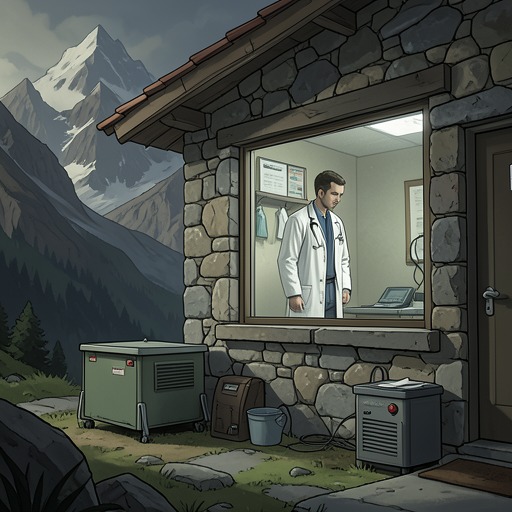
Gómez ends Rose’s treatment
Hot MilkDr Gómez’s decision to end Rose Papastergiadis’s treatment turns an already uncertain course of care into a rupture between clinician, patient, and daughter. He says he cannot treat Rose and doubts she will walk again; Sofia Papastergiadis, who has spent years reading her mother’s symptoms and walking in step with her, cannot accept that verdict. The scene’s force lies in the collision of three accounts: Rose’s wish to have her feet removed, Sofia’s insistence that this is dark humour, and Dr Gómez’s decision to take the wish seriously while withdrawing from the case.
Background: care without a settled explanation
Rose’s treatment at Dr Gómez’s clinic has been a major financial and emotional undertaking. Sofia says the family remortgaged Rose’s house to pay the clinic’s fee of twenty-five thousand euros. The expense weighs especially heavily because Sofia has been trying to make sense of her mother’s symptoms for much of her life. At four, she asked Rose what a headache meant and was told it felt like a door slamming in her head. Since then, Sofia has understood herself as an unwilling investigator, trying to identify causes and patterns as new symptoms and prescriptions arrive. Her own training as an anthropologist gives her a way to examine those accounts, but not a reliable solution: Rose’s complaints move across time, resist a neat chronology, and keep multiplying.
The clinic’s earlier encounters make clear that examination and interpretation have not brought certainty. Dr Gómez finds small ulcers on the sole of Rose’s right foot and asks about diabetes; later he reviews her medication by asking which drugs she is most attached to and which she can let go. He says her pain has not yielded its secrets. Rose describes a chronic degenerative condition, while her feet are numb rather than painful when Sofia asks about them. These details do not settle the cause of her changing mobility. They establish the uncertainty in which the eventual decision is made, rather than proving that one account of Rose’s condition is correct.
The decision to withdraw
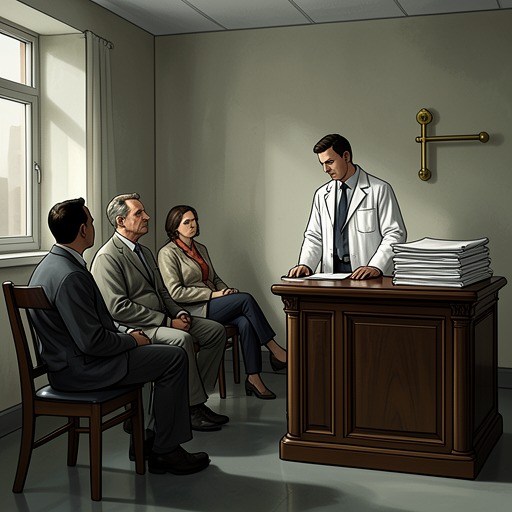
When Dr Gómez gives Sofia the news, she is eating a croissant. He tells her, “I cannot treat your mother. I doubt if she will walk again.” He describes Rose’s symptoms as spectral, coming and going without physiological substance, and explains that she had spoken to him about amputation while Sofia was in Athens. Rose wants surgery; according to Dr Gómez, she has asked for it. The report changes the meaning of her repeated remarks about her feet from a familiar figure of speech into a request he believes must be addressed as an intended course of action.
Sofia immediately rejects that interpretation. She laughs and says Rose is joking, invoking her Yorkshire humour and explaining that Rose often says, “Do away with these feet.” To Sofia, the phrase is not a literal request. Dr Gómez allows that it may be a joke, but calls it a threat as well, and says he has already told Rose that he can do nothing for her. He describes her as defeated. Their disagreement is not simply over whether Rose’s words are serious: it concerns who can interpret them, and whether Sofia’s familiarity with her mother clarifies or obscures what Rose wants.
Dr Gómez says it is not within his remit to undo Rose’s words or her wish to sever parts of her body. He will instead reimburse a large portion of his fee, with the money arranged to reach Rose’s bank the following day. Sofia protests that Rose is not speaking literally, but Dr Gómez repeats that there is nothing he can do for her. He also tells Sofia that Rose intends to pursue amputation with a consultant in London and has already made an appointment. The possibility is therefore not merely hypothetical within his account: a next consultation is planned, though the evidence does not establish that surgery takes place.
Sofia’s response and the break in care
Sofia’s response is shaped by the closeness she has described throughout the novel. At the clinic, she and Rose once limped together across the marble floor; Sofia says she walked beside her mother to keep pace, calling her own legs her mother’s legs. She also finds herself limping at other times, as if her body remembers their shared gait. That identification helps explain the shock of hearing that Rose may not walk again, but it also makes separation difficult: Dr Gómez’s directive to distinguish her own movement from her mother’s lands at a moment when Sofia experiences their bodies and pain as closely bound.
She is too shocked to stand and glares at the electrocuted vervet in its glass case in Dr Gómez’s consulting room. He tells her to free herself from the chair and walk to the door, warning her not to borrow Rose’s limp or step into her shoes. The instruction turns the consultation toward Sofia as well as Rose: the caregiver who has been interpreting symptoms and administering medication is told to move independently. Yet the scene offers no instant release from that role. Sofia’s fury and disbelief remain bound to the question of what Rose meant and what will happen to her.
Aftermath and significance
The end of Dr Gómez’s treatment does not mean Rose receives no further care. At a later review, Dr Gómez says Rose was admitted to hospital in Almería for two nights because she was dehydrated and received intravenous saline. He explains that difficulty swallowing water also makes it difficult for her to swallow medication. Rose says she is back on track with medication after a doctor at the hospital expressed concern. The later account complicates any simple reading of the withdrawal as the end of all treatment: the clinical relationship with Dr Gómez has broken down, while Rose’s needs and contact with other medical care continue.
Later, on the shore, Sofia sees Rose walking alone in a sunflower-patterned dress, holding a hat. The sight sharply contrasts with Dr Gómez’s doubt that Rose will walk again and with the amputation request that has divided mother and daughter. Sofia does not run to her; she watches Rose walk along the beach and eventually notices the footprints she has left in the sand. The scene does not resolve the diagnosis or explain the fluctuation in Rose’s mobility. Instead, it makes the limits of prediction visible: a clinical judgment, a family interpretation, and a body’s observed capacity do not settle into one stable account. Dr Gómez’s withdrawal is therefore both a treatment decision and a break in Sofia’s attempt to make her mother’s changing symptoms legible.