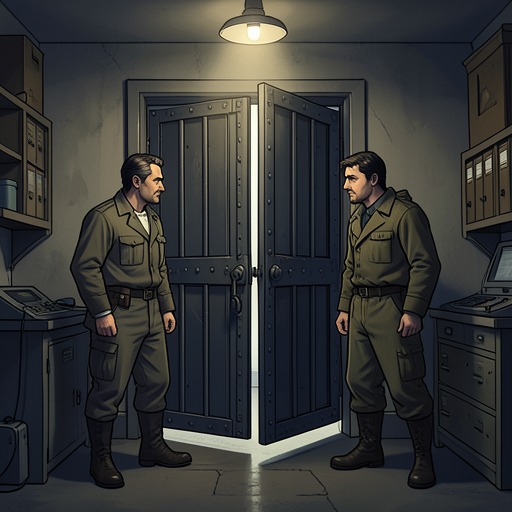
Knock before entering
Hot MilkKnock before entering is a rule of privacy that Julieta Gómez states plainly and Sofia Papastergiadis later repeats to her father. Across two different households, the same request marks a threshold between closeness and intrusion: entering a room does not itself grant permission to enter someone else’s space.
The Rule and Its Formulation
Julieta gives the clearest formulation when Matthew walks into her studio carrying wine. She tells him, “No, Matthew, no. Never walk through my door without knocking first.” She points out that there is a bell beside her name on the door, making the expected alternative concrete: Matthew can announce himself and wait rather than assume he may come in.
The rule is presented as an everyday practice of manners, but Julieta’s response makes clear that its stakes are more than etiquette. Matthew has entered while she is working, and Julieta says she needs to be alone with him to teach him manners. Knocking is the small, repeatable action by which another person’s privacy is acknowledged before contact begins.
Julieta’s Enforcement
Matthew has arrived ostensibly to bring a bottle of wine from his cellar to Sofia’s nurse. Instead of accepting the visit as harmless, Julieta addresses his conduct directly and explains that he thinks he can walk in while she is working, shout through the letterbox, and do what he likes. Her correction therefore responds to a pattern of disregard, not only to the single entrance.
The scene also gives the rule an immediate, practical force: Julieta asserts control over who enters her working space and when. Matthew’s attention shifts to a squashed cockroach on the floor, but the passage does not show him answering her or establish whether he changes his behavior. The boundary is clearly stated; its lasting effect on him remains unstated.
Sofia Repeats the Boundary
Later, in her father’s home, Sofia is in a windowless spare room on a hard canvas camping bed. When she changes the pillow’s position, the bed collapses, knocking over a bedside table with her scarlet flower hairgrips on it. Evangeline wakes and cries. Sofia remains on the floor with the table across her chest, moving her legs as if cycling to stretch them after the plane journey.
Her father comes into the room, and Sofia tells him, “No, Papa,” followed by, “No, do not come into my room without knocking first.” The request echoes Julieta’s wording, but its force here is especially intimate: Sofia addresses her father from the floor amid broken furniture, at a moment when he might be responding to her predicament. When he asks whether she is hurt, she stays silent and continues cycling her legs. The passage presents his concern alongside Sofia’s insistence that concern does not erase the need to respect a closed room.
Privacy Within Family Life
The two scenes distinguish affection or family connection from automatic access. Julieta makes the rule explicit to Matthew in her studio; Sofia carries the same boundary into her father’s home, where the request is no less necessary because the person entering is her parent. Repetition gives the courtesy a broader significance: the right to be approached rather than entered upon applies across both professional and family spaces.
The rule also sits in a narrative shaped by bodily dependence and shared routines. Sofia has described limping with Rose Papastergiadis to keep pace with her mother, and later finds herself limping even when Rose is not beside her, as though her body remembers the habit. Against that pattern of closeness becoming embodied, the demand to knock offers a distinct form of relation: care and attachment may shape how people move together, but they do not make every threshold disappear. The book shows Sofia stating that limit; it does not establish that the people around her consistently honor it.