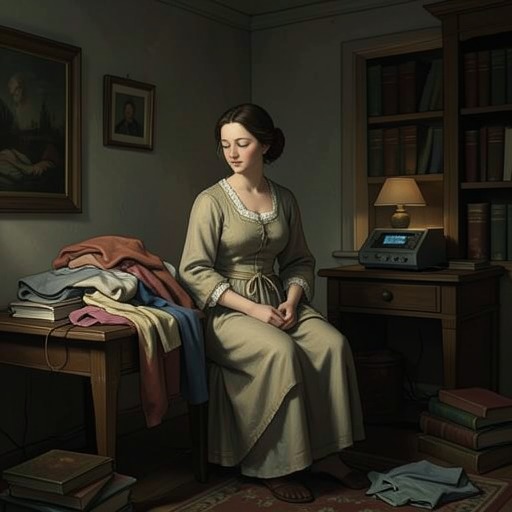
Margaret Mead quotation on the café storeroom wall
Hot MilkThe Margaret Mead quotation on the café storeroom wall is both an inscription and a personal claim: Sofia Papastergiadis wrote it in the small room where she lived while working at the Coffee House. Dan from Denver’s later repainting turns that mark into a measure of displacement, as the room she regarded as home becomes his.
The inscription and its setting
The quotation was written on the storeroom wall in marker pen. Its wording is not supplied, but Sofia recalls giving it a distinctive visual signature: five semicolons, which she connects to the use of semicolons in a text message to represent a wink. The inscription thus joins an attributed piece of writing to her own informal mark, making the wall a surface on which the academic and the personal meet.
The room was modest, but it was not merely a place to store things. Sofia had made it her sleeping space while working at the Coffee House, grinding beans, labelling cakes, and preparing flat whites. From Athens, she remembers the storeroom as spacious beside the spare bedroom where she is staying, and wonders whether Dan, sleeping in her ink-stained bed, had looked at the quotation each morning. The comparison makes the wall part of her continuing attachment to a place now at a distance.
Repainting and displacement
After Sofia has left, Dan calls to say that he has given the storeroom walls a new coat of white paint. He points out that her anthropology textbooks remain under the bed and asks what to do with her shoes and winter coat, still hanging behind the door. His practical questions reveal that her belongings and the room have not yet been disentangled: her things remain there, while his repainting makes the space feel newly claimed.
Sofia experiences the change as a catastrophe. She insists to herself that the storeroom was her place and her home, even if it was only modest and temporary. The white paint covers the wall on which she had left her mark, turning an ordinary refurbishment into a material sign of lost possession. The quotation matters not only as something she wrote, but as evidence that she had shaped the room into a place of her own.
Memory and fieldwork
In Athens, the remembered storeroom becomes a way for Sofia to reconsider her former life at the Coffee House. She wonders whether the café had been a field study under her nose all along. That thought places the wall inscription within her anthropological perspective, but the memory also makes its limits personal: she is not only observing a workplace and its people, but recalling a room where she lived and left traces of herself.
The quotation therefore links writing, work, and belonging without its text ever being disclosed. Its five-semicolon wink survives in Sofia’s memory even as Dan’s white paint removes the visible mark from the room. The contrast between the remembered inscription and the repainted wall gives the object its significance: a small act of authorship becomes a record of how temporary housing can still be experienced as home, and how that claim can be unsettled when someone else takes over the space.