Pablo
Hot MilkPablo is the director of Escuela de Buceo y Náutica, a diving school whose roof terrace becomes the setting for a recurring confrontation over his chained dog. He is introduced through other people’s accounts and observed behavior as a disliked, intimidating employer, but the novel gives no access to his private explanations. Instead, his authority is made visible in small, concrete acts: keeping the dog tethered, shouting at painters, and continuing to use the roof while the animal strains against its chain. When Sofia finally enters the school to demand that he untie the dog, the encounter makes him the human counterpart to the animal’s trapped distress, without resolving what will happen next.
Identity and Introduction
Pablo owns and directs the diving school next door to the small beach apartment rented by Sofia and her mother. The school is a white, two-storey building with porthole-shaped windows, and its reception area is being repainted by two Mexican men. This ordinary setting matters: the dog’s confinement and the workers’ vulnerability are not hidden away but form part of the daily life around a local business.
Pablo is first characterized at a distance. A student tells Sofia that nobody likes him and describes him as the sort of person who would pluck a chicken while it was still alive. That image is the student’s hostile judgment, not an independently established fact about Pablo; it nevertheless sets the terms in which his later treatment of the dog is read. The narrative supplies behavior rather than a correction or explanation: the dog howls and pulls at its chain while Pablo spends his time at his computer playing Infinite Scuba.
Authority at the Diving School
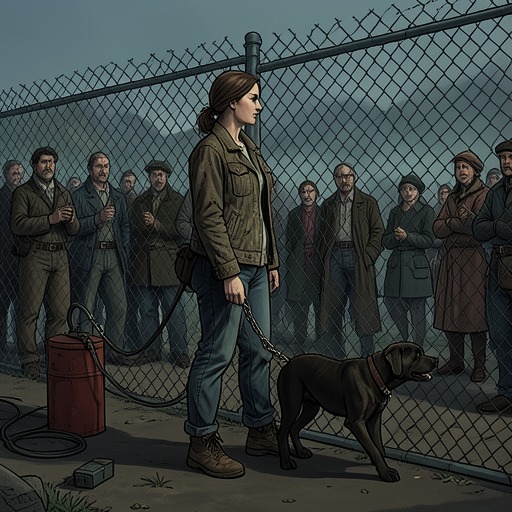
The dog is chained to an iron bar on the school’s roof terrace throughout the day. It pulls so fiercely that it regularly tries to leap from the roof, and its howling becomes a persistent presence in Sofia’s surroundings. At eight in the morning it is already straining against the restraint, standing on two legs and raising its scabby brown head above the terrace wall to snarl at the beach below. The animal’s distress is not a single incident but a condition that recurs alongside the school’s routine.
Pablo’s authority also shapes the painters’ working conditions. While they paint the walls, he shouts at them; Sofia’s narration emphasizes that they cannot shout back or make an insulting gesture because they lack the proper legal documents. Later, Ingrid tells Sofia that Pablo has fired one of the painters and still owes him money, adding that he will never be paid. Together, these details show an imbalance extending beyond the dog: Pablo can give orders and withhold work or payment, while the people affected have little room to answer him. The narrative does not describe the painters’ wider circumstances, but it directly connects their lack of legal documentation with their inability to respond freely.
Confrontation with Sofia
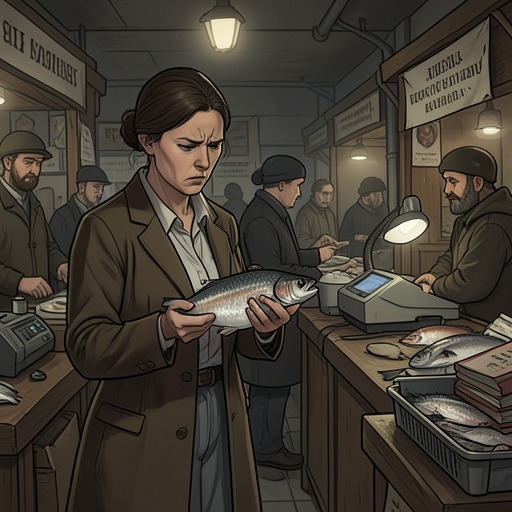
Sofia’s resolve to free the dog develops before she confronts Pablo. When Ingrid asks whether she has done so, Sofia admits that she has not; the dog’s renewed howling then drives her away from the fish she has been handling and across the sand to the diving school. Her urgency is expressed in her repeated calling of Pablo’s name and in the direct demand that he untie the animal.
She finds him bent over his computer with a glass of vermouth in his hand. He looks up and flinches. When Sofia takes his hand, he asks her to move so that he can go upstairs to the roof terrace. Waiting for him to move, she steadies herself against the freshly painted wall with a bloodied hand. She leaves one handprint, then makes another and another, so the new white surface begins to resemble a cave painting. This mark turns the confrontation into a visible disturbance of the school’s just-painted façade, but it does not itself establish that Pablo has released the dog.
Pablo curses at Sofia in Spanish as he climbs the stairs. The object he has reached for beneath his desk is a yellow, foul-smelling bone, not the panic button Sofia briefly suspects it might be. On the terrace, he kicks a chair while holding the bone. The dog stops barking and begins to snarl; Pablo makes clicking sounds that appear to calm it. A plant pot falls and shatters during the encounter. The action therefore complicates the simple picture of a man wholly unable to affect the dog: his sounds seem to alter its behavior, even as the animal remains described as snarling and the outcome of Sofia’s demand is left unconfirmed.
Narrative Role and Significance
Pablo’s scenes connect animal confinement with human power exercised through ordinary working arrangements. The chained dog is exposed to the beach and can be heard from nearby, while the painters are visible at work and constrained by their legal vulnerability. Pablo’s shouting links these situations, though the book distinguishes their forms: the dog is physically restrained, and the workers’ inability to answer him is tied to their lack of documentation and his control over their employment.
Sofia’s attempt to intervene gives the dog’s situation the force of an immediate rescue plot, but the confrontation ends without evidence that the rescue succeeds. Pablo remains on the roof with the animal, bone in hand; the dog’s barking has changed to snarling, and the shattered pot leaves a trace of disorder rather than a clear resolution. His narrative importance lies partly in that uncertainty. He is not developed through a personal history or a stated motive; instead, his presence makes visible the unequal relations surrounding the diving school and forces Sofia’s concern into direct conflict with the person who controls it.