Pablo’s dog kept chained for a prolonged period
Hot MilkPablo’s dog kept chained for a prolonged period is a recurring presence beside Sofia’s beach home: tethered on the diving-school roof, it howls, strains at its chain, and unsettles people below. The dog’s confinement becomes more than a background nuisance when Sofia resolves to free it. The episode makes the meaning of rescue uncertain, however: Ingrid Bauer warns that the dog may not be able to manage freedom safely, and the later sight of it being walked in the village ends not in reassurance but in an attack, a muzzle, and renewed disorder.
Setting and Conditions
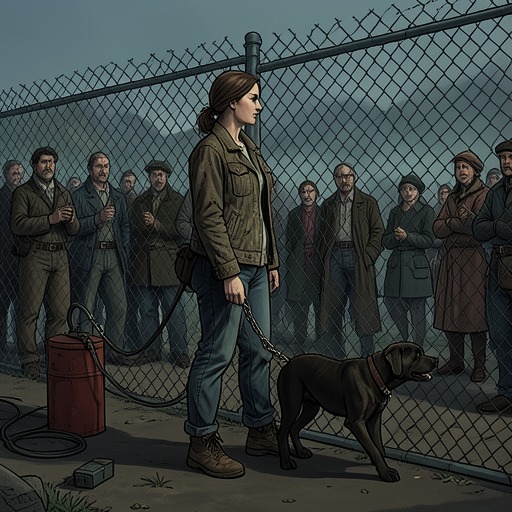
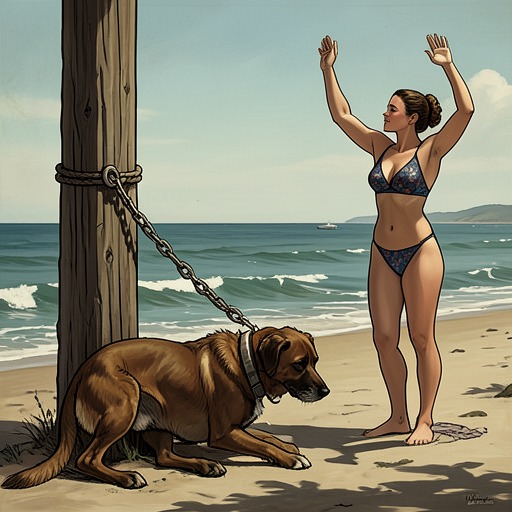
The dog belongs to Pablo, the director of Escuela de Buceo y Náutica, a diving school next door to Sofia’s small beach apartment. It is chained to an iron bar on the school’s roof terrace and remains there through the day. Its repeated howling and attempts to leap from the roof make its confinement visible and audible to the surrounding beach community. The narration describes a lean Alsatian pulling at its chains; later, the dog stands on its hind legs, raising its head above the terrace wall as it snarls toward the beach below.
The school’s ordinary work continues around the animal. Male staff teach student divers to put on their suits, then pour petrol through a funnel into plastic tanks and move them across the sand on an electric device to load onto a boat. They are uneasy about the dog being chained, but carry on with their tasks. The Swedish masseur Ingmar, who slides his massage bed over the sand on ping-pong balls attached to its legs, also complains about the noise: his clients cannot relax while the dog whines, barks, and howls during their aromatherapy sessions. These differing routines show the chain’s effects spreading beyond the dog and its owner, even as the people affected have little apparent power to change the arrangement.
Pablo and the Daily Disturbance
Pablo’s conduct is presented alongside the dog’s confinement. He spends much of his time at his computer playing Infinite Scuba, while the animal strains at the tether. One morning, as the dog pulls at its chain, Pablo shouts at two Mexican men painting the diving-school walls. The men cannot openly answer him because they lack the legal documents that would make such defiance safe. As the dog howls, Pablo raises his voice. The scene places the animal’s enforced restraint beside the workers’ vulnerability, without making their situations identical: both are visible in the same setting, while Pablo controls the space and directs the work.
For Sofia, the noise is not merely incidental. At one point it has intensified enough to leave her feeling overwhelmed; she drops a knife and runs barefoot across the sand to the diving school, calling for Pablo. She finds him bent over his computer with a glass of vermouth, and he flinches when she confronts him. The episode brings the disturbance into direct contact with its owner, but the evidence does not establish that this confrontation by itself changes the dog’s circumstances.
Sofia’s Intention and Ingrid’s Warning
Sofia announces that she intends to free the dog. Her decision follows repeated exposure to its chaining and distress, but Ingrid Bauer complicates the assumption that removing the tether would automatically make the animal safe. When the dog begins howling during a conversation, Ingrid identifies it as a working dog and says it should not be chained all day. She also warns that it has been badly treated and may not know how to live with freedom: loose in the village, it could endanger people, while taking it to the mountains would leave it without water.
The disagreement gives the proposed rescue two sharply different possible outcomes. Continued confinement means the dog remains restrained, with water available; release could give it room to run but expose it to thirst and other dangers. Ingrid’s suggested destination is not a simple solution, and Sofia recognizes the risk that the dog might die without water. The exchange therefore treats freedom as a practical condition with consequences, rather than as an uncomplicated good. It also leaves the responsibility unresolved: the dog’s need to escape the chain is set against the danger of releasing an animal whose behavior and needs are uncertain.
Release and Aftermath
Later, Sofia reacts to the dog’s renewed howling by going to the diving school, and the subsequent account establishes that Pablo has been seen walking it in the village that afternoon. The sequence suggests a change from the dog’s earlier confinement on the terrace, although the passage does not describe the act of unchaining it or specify exactly how the dog came to be out. Its appearance outside the school does not settle the question of what freedom means for it.
The walk ends in a public incident: the dog tries to bite a Belgian woman who is waiting for change at a bar. Pablo has to muzzle it and shouts and kicks at things in his way. The aftermath reverses any easy expectation that the dog’s release will promptly restore calm. It is no longer described only as a chained animal howling above the beach; it is now an animal moving through the village whose behavior has harmed or threatened another person, and its owner responds with anger. The passage also depicts Pablo as protected by his network of police, leaving the consequences of the episode unevenly distributed between the dog, its owner, and those around them.
Significance
The dog’s condition links a private act of ownership to a shared public environment. Its chain restricts the animal, while the noise reaches the workers, students, and massage clients whose routines unfold nearby. The narrative repeatedly returns to the dog’s howling, making the tether a persistent fact that cannot be kept within the boundaries of Pablo’s roof terrace.
The episode resists a clean rescue story. Sofia’s impulse answers the visible cruelty of prolonged chaining, but Ingrid’s warning and the later attack show that release alone cannot guarantee safety or well-being. The dog’s movement from roof to village changes the form of the problem rather than proving it solved. By keeping the animal’s needs, people’s exposure to its behavior, and Pablo’s authority in view together, the narrative makes the question of care inseparable from questions of responsibility and control.