Rose Papastergiadis
Hot MilkRose Papastergiadis is the mother whose changing mobility organizes much of Sofia Papastergiadis’s life in Almería, but she is not reducible to the symptoms that bring them there. Her legs are at once the subject of diagnosis, the practical focus of caregiving, and a source of uncertainty: Rose sometimes needs assistance, sometimes drives, and eventually walks alone along the shore. The contrast between what her daughter believes, what a doctor predicts, and what Rose can do makes her a person whose experience cannot be captured by any one account of her body.
Identity and Background
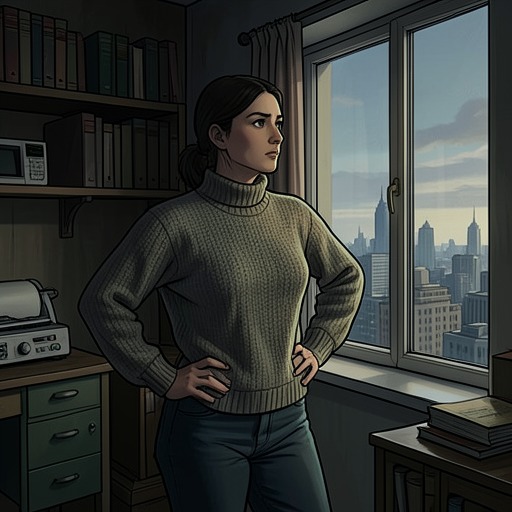
Rose is an English woman and the estranged former wife of Christos Papastergiadis. She and Christos waited eleven years for a child. When Sofia was five, Christos left Rose for a younger woman in Athens. Rose recalls this as the rupture of a marriage and a family: after years of making a home around her husband, she had to find another way to support herself and her daughter.
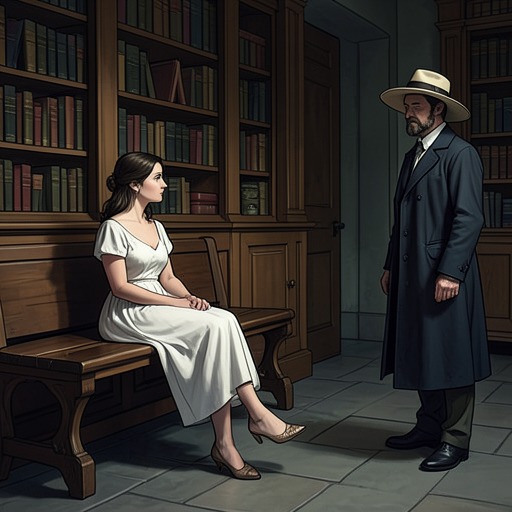
The narrative makes that earlier life tangible through the work Rose did at home. She learned to make salty goat’s cheese for Christos, warming milk, adding yogurt and rennet, cutting the curds, and preserving the cheese in jars. She also seasoned lamb with herbs unfamiliar to her from Yorkshire. After Christos left, those domestic skills could not pay the bills. Rose turned off the oven, put on her coat, and found work indexing books in a library. Her hair remained carefully pinned even as her circumstances changed. The recollection presents adaptation not as a sudden triumph but as labor: a woman leaving the kitchen, entering paid work, and continuing to hold herself together.
Rose’s attachment to her past is also visible in the places she misses. In Almería she asks for Yorkshire tea and says she misses the Wolds, which she had not seen for twenty years. Her cardigan, neatly draped over her shoulders despite the desert heat, recalls a ritual inherited from her own mother. Such details connect Rose’s present to family habits and to a life in Yorkshire that distance has not erased.
Mobility, Diagnosis, and Daily Life
Rose travels to Spain with Sofia to visit Dr Gómez and find out what is wrong with her legs. For Sofia, care has become the defining occupation of her life: when a clinic attendant asks about her work, she answers, “I don’t so much have an occupation as a preoccupation, which is my mother, Rose.” The remark is both affectionate and weary. Rose’s illness occupies the daughter’s attention before the consultation even begins, while the uncertainty of the condition makes that attention difficult to set aside.
Their pace is often set by Rose’s difficulty walking. On arriving at the clinic, it takes fourteen minutes to go from the car to the glass doors. Sofia takes her mother’s arm, and they limp together. She thinks of herself as her mother’s legs, adjusting her own movement to make a shared pace. At the reception desk, she passes Rose to a nurse with a wheelchair and feels relief at briefly handing the care to someone else. The transfer gives the scene its emotional tension: the wheelchair is practical assistance, but accepting help also makes the daughter’s responsibility visible.
Rose’s capacity does not remain consistent. Earlier in the day she had walked alone to a local Spar to buy hairpins without a walking stick. Later, Sofia notices herself limping even when she is not beside her mother, as if her body has learned their shared gait. That bodily echo shows how care persists beyond the immediate act of helping: Sofia carries the rhythm of Rose’s movement with her, even when Rose is elsewhere.
The impairment also does not prevent every demanding action. On the drive to the market, Sofia wonders how Rose can drive without feeling in her legs. Rose moves her feet between clutch, brake, and accelerator and drives fast along a straight stretch of newly tarred motorway, her left elbow out of the window. Sofia had failed her driving test four times and her theory exam, then given up driving; in this moment, the mother whose mobility is questioned is the one at the wheel. The scene does not settle what Rose can or cannot do. It places her competence beside her daughter’s fear and lets the contradiction remain.
Mother and Daughter
Sofia’s closeness to Rose is expressed through ordinary acts of service as much as through declarations. Rose calls for water, and Sofia brings it in different forms—chilled from the refrigerator, unchilled, or boiled and cooled—yet the water is always the wrong kind. The repeated request makes care both intimate and impossible to complete: Sofia responds, but cannot reliably know what would satisfy her mother. The uncertainty surrounding Rose’s body is thus mirrored in the uncertainty of their household routine.
Their relationship includes tenderness, irritation, and the strain of long dependence. Sofia says that she has spent as long as she can remember asking herself whether Rose is all right. When Rose asks Sofia the same question, Sofia wonders whether her mother does not want to hear the answer. Looking at Rose from behind, she sees thinning hair, the exposed vulnerability of her neck, and the cardigan over her shoulders. The sight brings love and pain together in the image, “My love for my mother is like an axe. It cuts very deep.” The force of the metaphor lies in its refusal to make affection gentle: loving Rose binds Sofia to her, but also cuts into her own sense of a separate life.
Rose is not simply a passive recipient of that care. When Dr Gómez asks permission to call her by her first name, she agrees and insists that it is her name; Sofia already calls her Rose, and she sees no reason the doctor should not. The exchange gives Rose a clear say in how she is addressed within the consultation. It also reveals that others have noticed the mother-daughter naming convention and found it unusual. Rose’s assent is matter-of-fact, not a surrender of authority to either her daughter or the physician.
Medical Conflict and Reversal
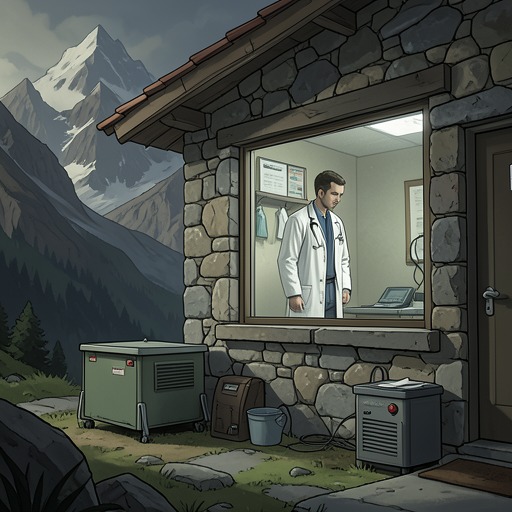
Dr Gómez eventually tells Sofia that he cannot treat Rose and doubts that she will walk again. He describes her symptoms as spectral, coming and going without physiological substance. He also tells Sofia that Rose has spoken to him about amputation and has asked for surgery. Sofia laughs at first, interpreting Rose’s familiar phrase, “Do away with these feet,” as Yorkshire humor rather than a literal request. Dr Gómez allows that it may be a joke or a threat, but says that he has nothing more to offer and that Rose is defeated.
The medical judgment intensifies the family conflict without resolving the cause of Rose’s impairment. The narrative reports a clinician’s view of symptoms that have no physiological substance, but supplies no definitive diagnosis. At the same time, Rose’s wish for amputation is presented as something she has expressed in consultation, not merely as one of Sofia’s fears. Sofia’s laughter shows how difficult it is for her to hear the request as serious; it does not establish what Rose ultimately intends. The gap between the doctor’s prognosis, the mother’s request, and the daughter’s interpretation remains consequential.
That gap becomes stark when Sofia later sees Rose walking on the beach. Rose is sixty-four and wears a dress patterned with sunflowers; she carries a hat in her left hand and walks barefoot along the shore, apparently absorbed in her own company. Sofia initially wonders whether the figure is a mirage, hallucination, or long-held wish. She is about to run to her mother, then chooses to return to the sea so Rose will not see her. When Sofia looks back, Rose is still walking, eventually making her way toward the shower on the wooden ramp to wash sand from her feet. The feet that had been discussed in terms of pain, impairment, and possible removal are attached to a body carrying itself down the beach.
Walking, Knowledge, and Ending
Rose’s walk changes what Sofia can claim to know about her mother. Earlier, Sofia’s sense of identity has been tied to keeping pace with Rose; now she watches Rose move independently and does not immediately approach. The scene does not explain why Rose can walk then, how long she has been able to do so, or what the walk means to her. Its force comes from that limit on Sofia’s knowledge. Rose is visible, but not available to be interpreted or assisted on demand.
After Rose walks, Sofia swims far out and later searches the sand for her mother’s footprints. She marks the first two prints with a rectangle drawn using a stick, preserving a trace of Rose’s passage in Almería. The gesture turns walking into evidence, but not a medical explanation: the prints confirm that Rose walked along that stretch of shore, not what caused her fluctuating mobility. They also reverse the earlier image of Sofia’s legs moving in sympathy with her mother. For once, Rose’s footprints are hers alone.
In a later conversation, Rose tells Sofia, “I went for a walk today,” adding that she had been too overwhelmed to share the good news. Sofia replies that Rose has never shared good news with her. Rose explains that she did not want to raise her daughter’s hopes. The exchange makes their difference in perspective explicit: what Rose experiences as a private, overwhelming change reaches Sofia only after it has happened, and Rose’s silence is linked to fear of disappointment. Her walk therefore belongs both to her body and to the difficult timing of communication between mother and daughter. Rose remains neither the settled patient of Dr Gómez’s prognosis nor the fully knowable figure imagined by Sofia; her independent movement opens a possibility while leaving its explanation, duration, and future unresolved.