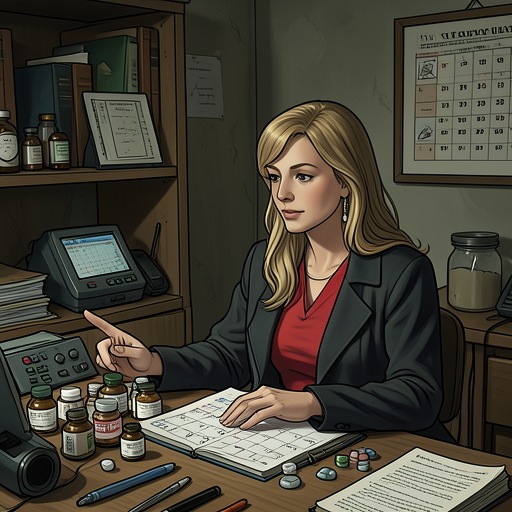
Rose agrees to stop all medication
Hot MilkRose Papastergiadis agrees to stop all her medication when Dr Gómez makes complete withdrawal a condition of continuing treatment. The decision follows an examination that finds age-related changes in her bones but no significant loss of bone material. It is therefore not presented as a response to a clear skeletal diagnosis; instead, the scene shifts attention from what the X-ray can explain to the many medicines Rose takes and the caregiving routine built around them. Her assent briefly makes treatment possible on Dr Gómez’s terms, while leaving the medical and practical consequences unresolved.
Background to the Decision
At Rose’s first consultation, Dr Gómez identifies two ulcers on the sole of her right foot. The affected area is small but slightly infected, and he asks whether she has been tested for diabetes. The finding establishes a concrete health concern, but it does not, in the evidence here, explain her wider mobility problems or the full range of her symptoms. The later discussion of medication unfolds against that uncertainty rather than as the conclusion of a single, settled diagnosis.
Dr Gómez had already proposed reviewing Rose’s prescriptions with her. He wanted her to say which medicines she felt most attached to and which she could relinquish, framing the review as a conversation about her experience as well as a clinical inventory. By the time of the later consultation, however, the proposal has become categorical: continued treatment depends on giving up every pill. The change in wording marks a shift from asking Rose to consider individual medicines to demanding a complete break with the regimen.
The Consultation and Rose’s Agreement
The atmosphere in the consulting room is tense. Dr Gómez appears irritated, with his sleeves rolled up and his hair damp with sweat. He examines Rose’s latest X-ray and says that she is losing bone density, but characterizes this as normal for women aged fifty and older. He explains that bones become less dense and strong after forty-five, while adding that Rose has not suffered a significant loss of bone material. His practical recommendation is that she walk home.
He then makes the treatment condition explicit: Rose must stop every medication, including prescriptions for cholesterol, sleep, heart palpitations, indigestion, migraines, back pain, blood pressure, and pain relief. The breadth of the list matters. It presents her treatment not as one drug under review but as a network of medicines addressing different complaints and routines. Rose looks directly at him and agrees to begin working with him. Her response accepts his proposed terms; it does not, by itself, establish that the cause of her symptoms has been found or that stopping the drugs will resolve them.
Sofia’s Place in the Medication Routine
The decision also implicates Sofia Papastergiadis, who has become used to administering her mother’s medication. Dr Gómez interprets that habit as more than practical care: he tells Sofia that she is using her mother as a shield against making a life of her own, and describes medication as a ritual he has erased from both their lives. His interpretation places the mother-daughter relationship inside the treatment encounter, making the proposed change apply psychologically to Sofia as well as medically to Rose.
That reading resonates with the pair’s daily dependence, but the narrative also gives the routine a bodily and ordinary dimension. Sofia fetches water when Rose asks, although she cannot always tell what kind of water her mother wants. At the clinic, the two have limped together, Sofia adjusting her pace to Rose’s. Sofia sometimes catches herself limping even when alone, as if her body remembers walking beside her mother. These details complicate Dr Gómez’s account: caregiving is a pattern that shapes Sofia’s movements and attention, not merely an obstacle he can remove by ending a medication ritual.
Later Consequences and Uncertainty
The later review of the clinic’s care makes the consequences less straightforward than the promise of a clean break. Dr Gómez explains that Rose was admitted to hospital for two nights because she was dehydrated and received intravenous saline. He says she cannot easily swallow water and therefore cannot easily swallow medication. When asked whether she has been taken off all medication, Rose says she is back on track and notes that the doctor at the hospital in Almería was concerned too. The account confirms that stopping medication became part of the treatment history, but also shows that hydration, swallowing, and the ability to take medicines were inseparable practical issues.
The episode thus leaves the agreement suspended between clinical authority and lived difficulty. Rose assents after hearing that her bone loss is not significant, while the subsequent hospital account introduces dehydration and difficulty swallowing as immediate concerns. Sofia, meanwhile, is asked to imagine a life without the caregiving ritual that has organized her own daily actions. The promise of treatment through withdrawal does not settle the question of what Rose’s body needs; instead, the later return to medication and the hospital’s concern reveal how provisional the agreement was.