Rose and Dr. Gómez’s treatment conflict and termination
Hot MilkRose and Dr. Gómez’s treatment conflict and termination is a relationship shaped by uncertainty: Rose seeks help for pain and impaired mobility that resist a clear explanation, while Dr Gómez’s clinical approach repeatedly tests, reframes, and ultimately withdraws from her case. Their consultations make treatment itself a contested subject, bringing Rose’s account of her body into tension with clinical judgment, medication decisions, and the narrator’s long history of interpreting her mother’s symptoms.
The search for an explanation
Rose Papastergiadis and her daughter arrive in southern Spain to seek answers at the Gómez Clinic, after remortgaging Rose’s house to cover a fee of twenty-five thousand euros. For Sofia Papastergiadis, the journey belongs to an investigation that has occupied about twenty of her twenty-five years. She has tried to read her mother’s symptoms as clues: when she was four, Rose described a headache as a door slamming in her head, and Sofia came to feel that her mother’s head was her own, with herself as the main witness to its recurring doors. New symptoms and new prescriptions repeatedly frustrate that search. Sofia imagines the illness as an unsolved crime, but cannot settle who is villain or victim, or whether a revelation will ever bring the case to a close.
The first consultations give Dr Gómez concrete physical details to examine without resolving the larger mystery. Rose reports a sharp, tearing pain inside her left elbow after sneezing, which she must hold until the sneeze passes. Dr Gómez also finds small ulcers on the sole of her right foot, slightly infected, and asks whether she has been tested for diabetes. The specific findings require immediate attention, but they do not explain the full pattern of her leg problems. The relationship therefore begins with a double register: Rose’s particular sensations and visible skin condition are clinically actionable, while the cause of her broader impairment remains unsettled.
Listening, examination, and medication
Dr Gómez’s consultations do not consist only of physical examination. He asks Rose to identify which medications she feels attached to and which she can let go, and says that he wants to review her medication with her. His manner places her preferences inside the treatment process, even as the decisions remain framed by the clinic’s authority. Later, he tells Sofia that she has become accustomed to administering Rose’s medication and may be coming off medication too; he describes the medication routine as a ritual erased from both their lives and tells Sofia she will have to invent another one. He also characterizes Rose as a shield Sofia has used to protect herself from making a life. The intervention thus addresses the mother-daughter caregiving arrangement as well as Rose’s prescriptions, though it does so through Dr Gómez’s interpretation of Sofia’s dependence.
The clinic’s conversations also make the telling of illness part of care. During Rose’s case history, her account moves among present symptoms, childhood illness, and other past experiences rather than following chronological order. Julieta Gómez Peña listens with minimal questions, tolerates silences, and records the interview for a case history. Sofia, herself trained as an ethnographer, recognizes the method as in-depth interviewing and observes that Rose’s emotions run high while Julieta remains alert without pressing her. Sofia hears more than twenty complaints and reflects that past, present, and future seem to coexist in them. Her attention shifts between the consultation and her own screen, but she becomes interested in how a clinical history is assembled and in how memory might be held in the body. This context matters to the relationship with Dr Gómez: the clinic is not simply measuring symptoms but gathering a history whose order and meaning are themselves difficult to control.
Conflicting accounts of illness and care
Rose’s account continues to resist a settled diagnosis. She tells Sofia that she has described her condition to Dr Gómez as chronic and degenerative, but that he has admitted knowing little about chronic pain. In his view, her pain has not yielded its secrets; from Rose’s perspective, it magnifies every day. She distinguishes numb feet from painful ones when Sofia asks whether they hurt. The contrast between her reports and the doctor’s uncertainty is not resolved by declaring either account definitive: the narrative gives Rose’s sensations and Dr Gómez’s limits as competing parts of the clinical encounter.
Care becomes more urgent when Rose refuses to drink water and becomes dehydrated. Dr Gómez tells Sofia that Rose’s morale is high after medication has been abandoned and that clinic staff are with her each day, but he also reports that her refusal to drink has led to dehydration. Sofia explains that finding the right water for Rose has become difficult in the summer climate of southern Spain. She sees the continuing search for acceptable water as something that can give Rose hope, while Dr Gómez says he is now more clinically interested in the water problem than in the walking problem. Their exchange marks a change in emphasis: mobility, which brought Rose to the clinic, no longer occupies the center of Dr Gómez’s stated clinical interest.
Complaint, review, and withdrawal
The rupture becomes explicit at a seven o’clock morning appointment. Rose objects to another examination, and Dr Gómez tells her that she has filed a complaint about his clinical practice. He says that an executive from Los Angeles and a health official from Barcelona are due to visit in two days, and requires Rose and Sofia to attend. Rose explains her action by saying that she has complaints to make and feels much better now that she has her medication under control. Dr Gómez cautions that the new medication is unlikely to make her well and points to the pending endoscopy, which will examine the inside of her throat. The complaint and the investigation therefore unfold alongside unresolved medical questions, not after a definitive diagnosis.
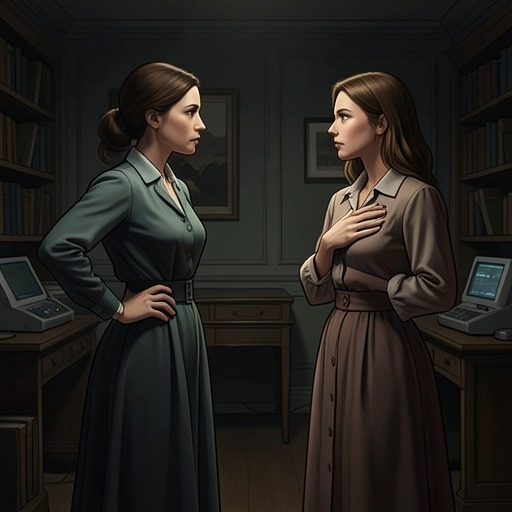
At a later meeting, Dr Gómez gives Sofia his starkest assessment: he cannot treat Rose, doubts she will walk again, and describes her symptoms as coming and going without physiological substance. He adds that while Sofia was in Athens, Rose spoke to him about amputation and asked for surgery. Sofia interprets Rose’s recurring remarks about getting rid of her feet as dark Yorkshire humour rather than a literal request, and is shaken that Dr Gómez treats the wish as serious. Dr Gómez says it is not his role to undo Rose’s words or her wish to sever parts of her body. He has arranged for a large portion of his fee to be transferred back to her bank the next day. The reimbursement does not repair the conflict: to Sofia, his refusal feels like abandonment at the moment when Rose’s stated wish most needs interpretation.
The subsequent review meeting exposes the difference between the clinic’s account of continuing treatment and Rose’s. Dr Gómez describes her dehydration and intravenous saline treatment, and explains that difficulty swallowing water also makes it difficult for her to swallow medication. When asked whether she has stopped all medication, Rose says she is back on track and refers to concern from a doctor at the hospital in Almería. Julieta Gómez Peña initially describes treatment as proceeding, but Rose corrects her: the treatment is over, and she has made other medical arrangements for her return to London. The discussion turns to Rose’s current prescriptions and whether the clinic had provided a progress plan or shown that treatment made her more effective in life. The question unsettles her; she pales, trembles, falls silent, and gestures toward Sofia, whose reading of the gesture remains uncertain. The formal review seeks a legible measure of progress, while Rose’s response shows how difficult that framework is for her to inhabit.
What remains of the relationship
Despite the termination, the clinic has not been simply a site of failure for Sofia. During the review, she says that the Gómez Clinic has given her hope, though her voice trembles and she is unsure of her own conviction. Dr Gómez interrupts to speak at length in Spanish with the executives; Julieta Gómez Peña sometimes joins in, visibly affected despite her efficient manner. That moment preserves a distinction between Sofia’s hope in what the clinic has offered and Rose’s declaration that its treatment is finished. The doctor-patient relationship ends amid complaint, disagreement over the meaning of symptoms and amputation, and a practical transfer of care elsewhere, but its significance is not exhausted by the ending. It has forced the family’s explanations of pain, medication, memory, and responsibility into the open, without producing the diagnostic certainty that originally brought Rose to the clinic.