Rose files a complaint against Gómez
Hot MilkRose Papastergiadis’s complaint against Dr Gómez turns a strained treatment relationship into an institutional dispute. The complaint is disclosed not when it is filed but during a later consultation, where Rose says that she has complaints to make and feels better with her medication under control. Dr Gómez responds by announcing an imminent review with a pharmaceutical-company executive and a health official, bringing the private conflict over pain and treatment before outside scrutiny.
Background to the Complaint
Rose’s complaint follows a course of care in which her many symptoms have resisted a single, settled explanation. At an earlier examination, Dr Gómez found two ulcers on the sole of her right foot, one slightly infected, and asked whether she had been tested for diabetes. The discovery supplied an immediate, specific problem to address, but it did not explain the larger history of Rose’s mobility difficulties and pain.
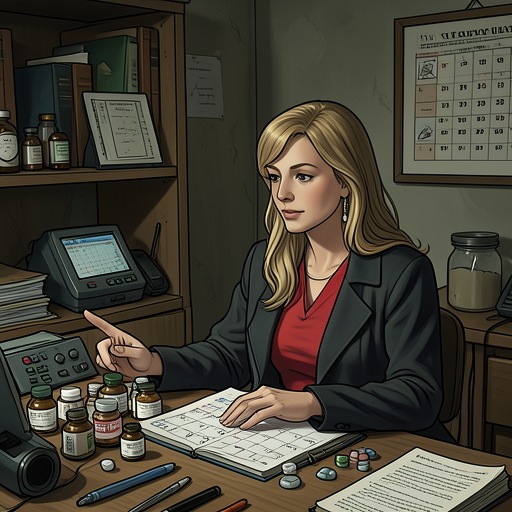
The treatment relationship also involved an effort to reconsider Rose’s medication. Dr Gómez asked which medicines she felt attached to and which she could let go, presenting the review as a joint examination of her prescriptions. Later, he told Sofia Papastergiadis that she had become accustomed to administering her mother’s medication and had used Rose as a shield against making a life of her own; he described the medication routine as a ritual he had erased from both their lives. This interpretation made the treatment plan about more than Rose’s body: it also assigned meaning to Sofia’s caregiving and dependence. The evidence does not establish that this exchange alone prompted the complaint, but it shows how the clinic’s account of treatment could reach into the family relationship.
Rose, meanwhile, continued to describe pain that did not yield to a clear explanation. She told Sofia that Dr Gómez knew little about chronic pain and had said that her pain had not yet yielded up its secrets. Rose’s own account was blunt: the pain seemed to magnify every day, while her feet were numb rather than painful. The contrast between a clinician’s uncertainty and a patient’s intensifying experience frames the disagreement without resolving its medical cause.
Disclosure and Rose’s Stated Reason
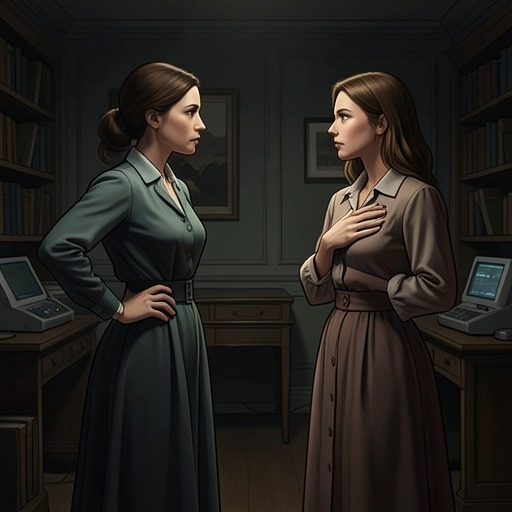
The complaint comes to light when Dr Gómez tells Rose and Sofia that Rose has filed a complaint regarding his clinical practice. Sofia then asks her mother why she did it. Rose sits very straight, her hair pinned in an immaculate chignon, and answers, “Because I have complaints to make. I feel very much better now that I have my medication under control.” Her explanation connects the act of complaining to a changed sense of control, rather than offering a diagnosis or a detailed list of allegations.
That answer complicates any simple division between medical authority and patient resistance. Rose does not say that her condition has been cured: she reports feeling better because she has her medication under control. Dr Gómez immediately cautions that her new medication is very unlikely to make her well and points to the still-pending endoscopy, a procedure he explains will examine the inside of her throat with a flexible tube carrying a video camera. His response keeps the clinical uncertainty in view, but it also shows that Rose’s improvement and his expectations do not coincide.
The complaint therefore registers a contest over whose account of treatment carries weight. Dr Gómez speaks in terms of likely medical outcomes and further investigation; Rose identifies control of medication as a practical change that has made her feel better. The scene does not settle which account is medically sufficient. Instead, it makes their difference explicit: the patient’s assessment of how she is doing cannot be reduced to the clinician’s prediction of whether a prescription will make her well.
The Review and Its Stakes
Dr Gómez tells them that the complaint will bring an executive from Los Angeles and a health official from Barcelona to the clinic in two days, and that both Rose and Sofia will be required to attend. He adds that the executive is a client of Matthew Broadbent and that Matthew has been coaching him to communicate effectively with investors. The complaint thus opens onto a wider institutional setting, where clinical practice, pharmaceutical business, and the language used to address investors meet.
At the review, the two visitors sit below the electrocuted vervet specimen displayed in Dr Gómez’s consulting room. The executive, Mr James, is gaunt, silver-haired, and repeatedly handles a golf ball; the official, Señor Covarrubias, has thinning black hair and greased it over his scalp. Dr Gómez introduces them to Rose and Sofia, while Julieta Gómez takes notes. The arrangement places Rose, seated regally in her wheelchair, at the center of a hearing-like encounter, with Sofia standing beside her and the clinic’s clinician and physiotherapist present.
Mr James asks about Rose’s two-night admission to the clinic. Rose says she was dehydrated. Dr Gómez explains that she was hydrated with intravenous saline and that she could not easily swallow water, which also meant she could not easily swallow her medication. When Mr James asks whether she has been taken off all medication, Rose says she is back on track and notes that the doctor at the hospital in Almería was concerned too. These details make hydration and the ability to take medication concrete issues for the review, rather than leaving the dispute at the level of competing impressions. They also show that the complaint’s scrutiny extends across Rose’s care and her admission, not just the question of whether a particular treatment will make her well.
Significance and Limits
The complaint changes the scale of Rose and Dr Gómez’s disagreement. What had been a series of consultations about symptoms, medication, and uncertain causes now requires the patient and her daughter to appear before outside representatives. Dr Gómez’s announcement makes clear that the complaint has consequences for the clinic as well as for Rose’s treatment, while his reference to Matthew Broadbent links one visitor to a business relationship beyond the consultation room.
Yet the episode supplies no final verdict on the complaint or on Rose’s condition. It records Rose’s stated reason, Dr Gómez’s response, the planned review, and the questions raised there; it does not establish what the reviewers decide. That unresolved outcome preserves the central tension of the event: Rose can report a meaningful improvement in her control of medication while her pain remains unexplained, her swallowing presents a practical difficulty, and the clinician continues to doubt that the new medication will make her well. The complaint gives Rose a formal route to make her dissatisfaction visible, but it does not, by itself, settle either the medical dispute or the question of whose account will prevail.