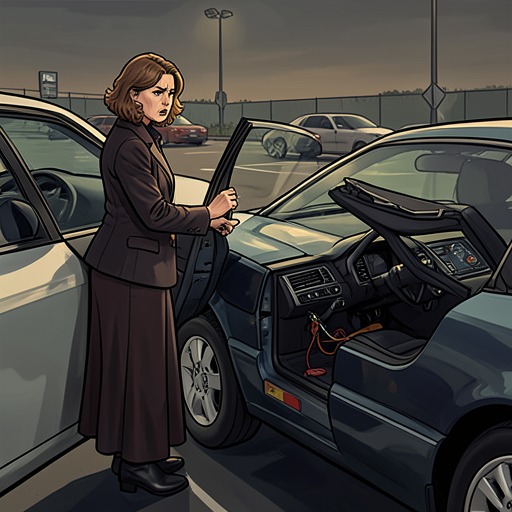
Rose lets Sofia drive for the first time
Hot MilkRose lets Sofia drive for the first time when she throws the keys into Sofia’s lap and tells her to take them home. The drive is hesitant and imperfect: Sofia reverses over a child’s doll, struggles with the gears, and needs Rose’s instructions. Yet the scene turns a practical handover into a revealing exchange of care. Rose gives Sofia the chance to act, then coaches her through the journey; together they arrive at a phrase for their interdependence, with Rose as Sofia’s eyes and Sofia as Rose’s legs.
Background and stakes
The drive belongs to a relationship already organized around Rose’s uncertain mobility and Sofia’s practical responsibility. While being observed at a first-aid hut after a sting, Sofia describes her mother as her preoccupation and explains that they are in Spain to visit the Gómez Clinic to learn what is wrong with Rose’s legs. Their first appointment is still three days away. The clinic visit gives the journey a wider setting of care and uncertainty, but the driving scene itself is not a medical breakthrough: it shows how the two manage ordinary movement while the cause of Rose’s difficulty remains unresolved.
Sofia’s caregiving role also carries financial weight. Elsewhere, she connects the family’s limited resources to her estranged father, who inherited a fortune from his grandfather’s shipping business in Athens but, as Sofia describes it, has not shared any of it with her and Rose. She casts Rose as her creditor and her own legs as the means of repayment, because they are continually running around for her mother. That image gives the first drive a pointed reversal. Sofia’s legs, usually enlisted in Rose’s service, are now being tested at the pedals; Rose, whose legs are the source of concern, contributes by watching, advising, and helping Sofia manage the car.
The handover of the keys
Rose’s instruction leaves little room for Sofia’s hesitation. Sofia says she cannot drive, but Rose answers that the anise liqueur was too strong and that she cannot drive either. Rose starts to edge herself into the passenger seat, forcing Sofia to get out, walk around, and take the driver’s place. The transfer is both literal and relational: Rose does not merely ask Sofia to help with a task but makes a place for her at the controls.
Sofia inserts the key, starts the engine, works the handbrake, and begins to reverse. Rose praises the manoeuvre as perfect, but the next sound is a crunch beneath the wheels. Rose identifies the object as a child’s doll and immediately directs Sofia to change gear, signal, and put on her seat belt. The mishap is not allowed to end the attempt. Rose folds correction into encouragement and keeps the journey moving, treating a mistake as something to respond to rather than a reason to take the keys back.
Learning the road together
The first stretch is slow: Sofia drives at ten miles an hour while Rose leans forward to adjust the mirror and tells her to go faster. Sofia initially has the wrong gear, then corrects it and dares to increase her speed on the new, empty motorway. Rose tells her she feels safe in Sofia’s hands, then points out that traffic in Spain keeps to the right. Sofia laughs. The exchange makes the lesson intimate without making it effortless: reassurance and instruction arrive together, and Rose’s confidence does not prevent her from correcting Sofia.
The car continues to demand attention. An unidentified object rattles around in the boot as Sofia turns; she slows, the vehicle jerks to a stop, and Rose tells her to balance the brake and accelerator, select neutral, and start again. When the car moves, Rose corrects the gear position herself. Her sharper concern is not Sofia’s lack of a licence but her lack of spectacles: Rose says she will have to be Sofia’s eyes. The detail makes their dependence concrete. Sofia can operate the pedals and steer, but Rose supplies the visual guidance that Sofia lacks; Rose’s instructions, meanwhile, depend on Sofia being the one who can drive them onward.
Reciprocity and significance
After they reach the car park at the end of the village, Sofia pulls up the handbrake and Rose announces that she has a new chauffeur. It is a small declaration of changed capability, not evidence that Sofia has become an experienced driver: the scene has shown a stalled car, misjudged gears, a crushed doll, and close coaching. Its significance lies instead in the pair’s ability to turn a first attempt into a usable arrangement. Rose can entrust Sofia with the driving, and Sofia can accept guidance without the scene presenting her only as a passenger in her mother’s life.
Sofia’s formulation that Rose is her eyes and she is Rose’s legs gathers the episode’s practical details into a compact account of mutual reliance. The wording also complicates the earlier image of repayment. Sofia has described her legs as what she pays her mother with; here, the roles are reciprocal rather than simply creditor and debtor. The drive does not remove the burden of care or settle what is wrong with Rose. It gives their dependence a visible, shared form: one guides while the other moves the car, and both are needed for the journey home.