Rose’s medication crisis
Hot MilkRose Papastergiadis’s medication crisis is a conflict over how illness is described, treated, and endured: after Dr Gómez removes her medicines from the treatment plan, she waits for pain to change, asks Sofia Papastergiadis to obtain painkillers, and later returns to a broad regimen prescribed at a hospital in Almería. The shift exposes how medication has organized both Rose’s days and Sofia’s caregiving, while leaving the causes of Rose’s symptoms unresolved.
Background and the work of interpreting illness
Rose’s changing symptoms have drawn Sofia into an investigation lasting much of her life. Sofia remembers asking what a headache meant when she was four; Rose described it as a door slamming in her head. Over time, Sofia came to treat her mother’s sensations as something she had to interpret and witness. She sees this prolonged effort as resembling detective work, but the clues do not lead to a settled diagnosis: each apparent breakthrough gives way to another symptom and another prescription. The crisis therefore takes place against a history in which treatment has repeatedly changed while the underlying account of Rose’s condition remains uncertain.
That uncertainty is also difficult to contain in a clinical history. At a consultation with Julieta Gómez, Rose’s account moves between present symptoms, earlier experiences, and expectations about what may happen next. Julieta must later turn that shifting account into a case history, while Sofia recognizes the task as similar to ethnographic work. Sofia hears more than twenty complaints, not a single complaint that can be isolated from the others. The difficulty is not simply the quantity of symptoms: past, present, and anticipated illness arrive together, complicating any straightforward sequence from diagnosis to treatment.
Dr Gómez’s medication review
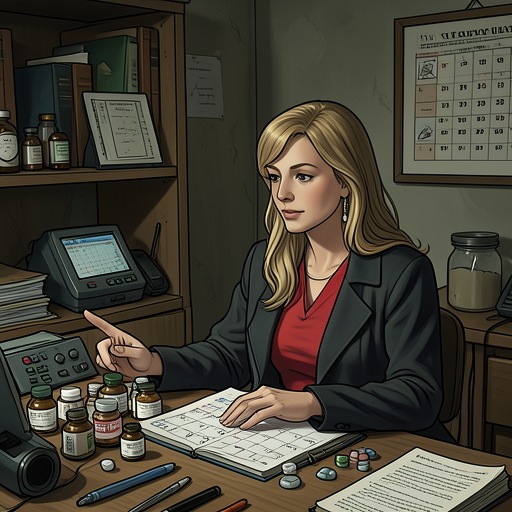
At the Gómez Clinic, Dr Gómez asks Rose to go through her medicines and identify which she feels most attached to and which she can relinquish. His approach treats the regimen not only as a list of drugs but as part of Rose’s habits and attachments. The review culminates in the removal of medication from her treatment plan. Dr Gómez also tells Sofia that she has become accustomed to administering Rose’s medicines and presents that routine as a shield from making a life of her own. With the medication ritual erased from both their lives, he says, Sofia will have to invent another one. His intervention thus reaches beyond Rose’s prescriptions: it alters the daily arrangement through which daughter and mother have been bound together.
For Sofia, the change is difficult to live with as well as to understand. She tells Julieta Gómez that returning to the temporary seaside home in Spain to live with Rose after the medication was cancelled has been hard, and that she has nowhere else to go. Her housing insecurity and her caregiving role converge: the loss of the medication routine does not free her from dependence on the household, but makes that dependence newly visible. The decision that is meant to interrupt one pattern leaves both women waiting to see what will take its place.
Withdrawal, waiting, and renewed requests
Rose describes the period without medication as a state of waiting. She regards the removal of her medicines as being stripped of them and anticipates that something will happen, though she does not know what. The small acts that structure this interval take on the shape of the routine they replace. She watches a watch that continues to keep time and rolls pieces of soft white bread into pellets, sucking them for hours because they resemble pills and offer some comfort. She says she eats because she cannot take medication on an empty stomach, making food part of a treatment schedule that has been interrupted rather than simply abandoned.
Her account of pain remains unsettled. Rose tells Sofia that Dr Gómez knows little about chronic pain and that her pain has not yielded its secrets; when Sofia asks about her feet, Rose says they are numb rather than painful. She then asks Sofia to go to a farmacia in Spain for painkillers, where she says a prescription is not needed. Sofia refuses. The exchange shows the practical pressure created by the treatment dispute: Rose seeks relief through a familiar medication pathway, while Sofia is asked to act as its intermediary and declines. It does not resolve whether the requested drugs would address Rose’s symptoms, or what is causing them.
Hospital prescriptions and competing accounts
During Sofia’s absence, Rose develops water on the knee and strains a ligament. Matthew drives her to the General Hospital in Almería, where the injury is treated as straightforward and she receives a new group of prescriptions. Rose reports nausea while taking antidepressants, while also wondering whether the nausea could be related to medicines for cholesterol, blood pressure, dizziness, or acid reflux. The hospital regimen also includes prescriptions for diabetes, gout, inflammation, sleep, muscle relaxation, and the side effects of the other medicines, including laxatives. The breadth of this list contrasts with Dr Gómez’s removal of medication and restores medication to the center of Rose’s daily life, now through a different course of care.
At a review meeting, a representative asks whether Rose has been taken off all medication. Rose says she is back on track and points to the Almería hospital doctor’s concern as well. Dr Gómez explains that Rose had been dehydrated and received intravenous saline; in his account, her difficulty swallowing water also makes it difficult for her to swallow medication. Rose, meanwhile, says that the treatment at the Gómez Clinic is over and that she has made other arrangements for her return to London. Asked to list her current medicines, she does so at length. The accounts do not settle into a single agreed explanation: the clinic describes treatment as continuing, Rose rejects that description, and the hospital prescriptions have already re-established a substantial regimen.
Consequences and significance
Rose’s medication crisis is not a clean passage from dependence to independence, or from illness to cure. The removal of medicines produces a period marked by waiting, renewed requests, and uncertainty; the subsequent hospital prescriptions bring medication back without resolving the disagreement about treatment or the meaning of the symptoms. Rose’s own description of being back on track sits beside her nausea and the number of medicines she lists, while Dr Gómez’s concern about hydration complicates the question of whether she can take them reliably.
The crisis also makes visible how illness determines the pace of Sofia’s life. She has long monitored Rose’s complaints and administered her medicines; when that ritual is stopped, she remains in the same precarious home arrangement and is still asked to help secure relief. Sofia sometimes finds herself limping in the manner of someone walking with Rose, as if her body remembers their shared pace. Yet the story does not make that bodily echo proof of a diagnosis or of recovery. Later, Rose is seen walking along the shore in Almería, a change in what she can do that the narrative places beside the earlier dependence without establishing that medication caused it. The unresolved movement between treatment, waiting, and altered capacity is central to the crisis: Rose’s medicines change, but neither her history of symptoms nor the family labor of attending to them disappears.