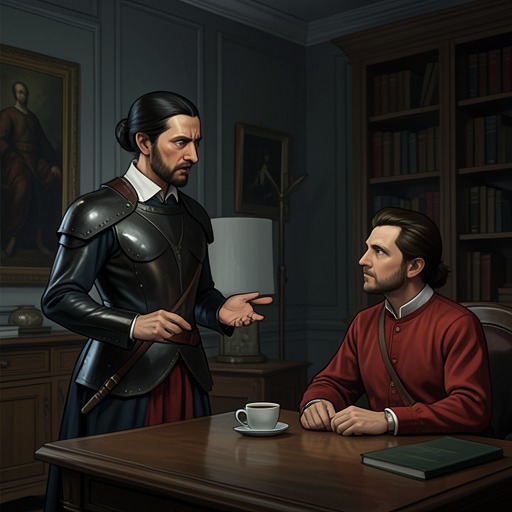
Sofia and Christos’s tentative rapprochement after rejection
Hot MilkSofia Papastergiadis and Christos Papastergiadis’s relationship is a tentative rapprochement shaped by eleven years of estrangement, a difficult request for support, and gestures too small to repair the past. Their reunion in Athens brings Sofia into the life her father has built without her; their subsequent exchanges offer moments of tenderness, but no promise that he will become the dependable parent she needs.
Estrangement and reunion
Christos is waiting for Sofia at Athens International Airport with his new wife and their infant daughter. Sofia arrives alone with her suitcase. The two recognize one another immediately, despite not having seen each other for eleven years. Christos takes her suitcase, kisses her cheek, and welcomes her. His carefully ironed blue shirt and relaxed appearance register the ease of a life that has continued in her absence; the baby in his wife’s arms makes that new family physically present at the first moment of reunion.
On the second day, Sofia offers to walk with him through the park along his route to work. It is their first time alone together without his wife and daughter, whom Sofia imagines as human shields protecting him from her as a creditor. The metaphor makes their meeting feel less like an uncomplicated homecoming than an encounter over an unpaid account. Sofia knows that his absence from her life cannot actually be repaid, yet finds it exciting to pretend they can negotiate a deal. They walk in silence: Sofia in black suede platform sandals, Christos carrying what she describes as a small portion of guilt his god has not entirely absolved.
A request met with withdrawal
The possibility of practical advice brings the unresolved debt into the open. Sofia considers asking Christos for financial help or simply asking him to listen while she explains her circumstances. She is not certain what it would mean for listening to be to his advantage, a question that shows how carefully she has learned to assess the terms of his attention.
When she tells him she is thinking of finishing her doctorate in America, she also names the problems attached to that plan: she would need funding and would have to leave Rose Papastergiadis alone in Britain. Christos responds, “Do as you please,” adds that grants are available for overseas study, and says Rose has chosen to live as she does and is not his concern. Sofia has asked for advice, not merely information about grants. His answer closes down the personal appeal: he puts his hands in his pockets and steps backward toward the closed door. The exchange repeats the old absence in a present-tense form. He is in the room, but when she asks him to take part in a difficult decision, he retreats from the responsibility of being her father.
Money and the limits of generosity
The night before Sofia leaves, Christos offers her spending money. The gesture touches her partly because he has not given her money in this way since she was fourteen. But his worn brown wallet is empty of the promised generosity: he has forgotten to go to the bank and, after searching, produces a single ten-euro note. He smooths it on the table and hands it to her with a flourish, making a small sum carry the weight of a much larger history.
Sofia does not keep the note. When a woman begging comes to her table, she slips it into the woman’s plastic cup. The woman speaks Greek, limps nearer, and kisses Sofia’s hand; Sofia recognizes this as the first affection anyone has shown her in Athens. The moment does not turn Christos’s offering into a repair. Instead, the money passes onward, and the warmth Sofia receives comes from someone she has just met. Sofia’s realization that the first man in her life would act to her disadvantage if doing so benefited him is painful, but she also describes it as a revelation that somehow sets her free. Seeing the pattern clearly changes what she expects from him, even though it cannot change what he has done.
A flower and a name retained
At the café, Christos folds a paper napkin into a flower with three dense layers of petals. He seems surprised by the flower in his own hand and does not initially claim it as a gift. Sofia has become bolder and tells him that she thinks he made it for her. He confirms that he did, explaining that she likes wearing flowers in her hair. This is a modest moment of mutual recognition: Sofia names the intention he has hesitated to voice, and Christos is pleased that she accepts the flower rather than giving it away.
The flower is not a substitute for the support she sought, and the scene does not resolve their history. Its value lies in its difference from the larger promises and debts surrounding the relationship: it is a small, concrete offering that Christos can actually make and Sofia can choose to keep. Her willingness to accept it marks a possibility of connection without requiring her to deny the limits of his care.
Sofia also refuses to treat her inherited surname as something she must discard because her father failed her. She has not changed it to Booth, although she knows it might be easier for people to spell. Christos gave her his name, and she has not given it away; instead, she finds something to do with it, locating herself in a wider world of names that cannot be easily said or spelt. Her reflection on kinship allows for relationships to exceed simple roles—daughter, mother, sister, wife—without making the past disappear. Keeping his name is not evidence that Christos has earned her trust; it is Sofia’s own decision about what the name can mean.
An unfinished rapprochement
The father-daughter relationship remains sharply unequal. Sofia approaches Christos with questions about money, study, and the care of Rose; he offers a grant suggestion, dismisses Rose’s needs as outside his concern, and gives Sofia a small amount of cash and a handmade flower. Those gestures matter, but they do not answer her larger request for time, advice, or sustained involvement. The reunion therefore moves between rejection and brief tenderness rather than toward a settled reconciliation.
Sofia’s responsibilities to Rose give that imbalance practical force. Earlier, she describes fetching water for her sick mother while trying to guess which water Rose will accept. At the clinic, Sofia walks in step with Rose, calling herself her mother’s legs; later she notices herself limping even when Rose is not beside her, as though her body remembers their shared pace. When Sofia considers America, leaving Rose alone is part of the dilemma she puts to Christos, but he declines to treat it as his concern. The contrast is not that one relationship is simple and the other difficult: care for Rose is embodied in repeated acts and altered movement, while the bond with Christos must be approached through negotiation, memory, and incomplete gifts.
Near the story’s later beach scene, Sofia sees Rose walking along the shore without her and stays in the sea rather than immediately approaching her. That image belongs to the changing mother-daughter relationship, not to a reconciliation with Christos. It nevertheless clarifies the family world in which Sofia has been trying to make choices: closeness can involve dependence, distance, and unexpected changes in what another person can do. Against that shifting background, her connection with Christos remains open but unguaranteed. She can accept a flower, retain a surname, and recognize the freedom of seeing her father clearly without pretending that his absence has been repaid.