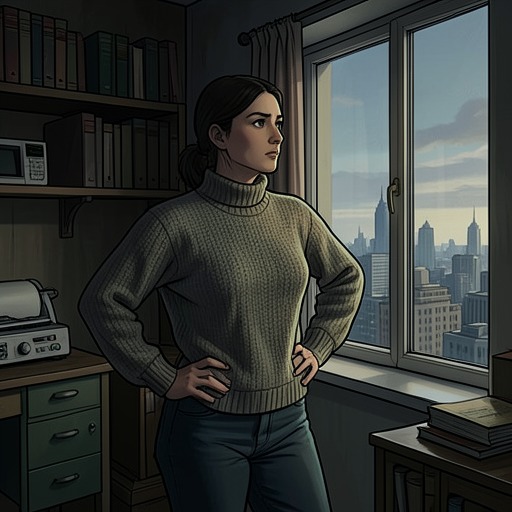
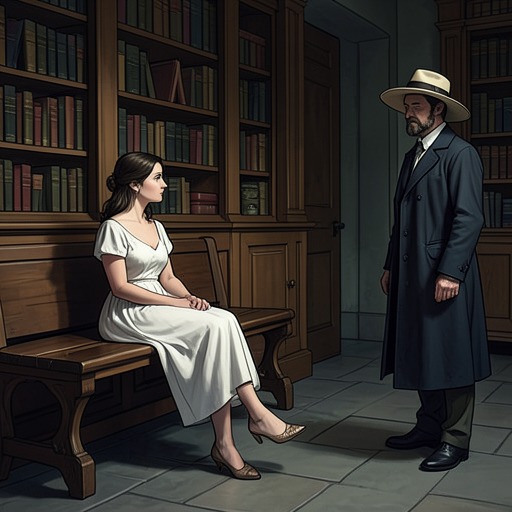
Sofia leaves Rose by the road; Rose later walks home
Hot MilkSofia leaves Rose by the road; Rose later walks home is a rupture in the caregiving routine that has organized their life in Almería. After stopping on a darkening drive, Sofia wheels her mother into the road and abandons her, then tells Dr Gómez that she thinks she has killed her. Rose survives and eventually makes her way home, accepting a lift from a woman driving a lorry. The episode turns the question of Rose’s mobility into a question of agency: Sofia has treated herself as her mother’s legs, but Dr Gómez insists that Rose’s life and her decision to keep living belong to Rose.
Background: A Shared Pace
Before the roadside abandonment, Sofia and Rose’s relationship is framed through the practical work of moving together. At the Gómez Clinic, it takes fourteen minutes to walk from the car to the glass doors. When the receptionist calls for Rose, Sofia takes her arm and they limp across the marble floor together. Sofia describes matching her pace to her mother’s as a way of moving forward: her legs, in that moment, are Rose’s legs. Their shared gait is an accommodation, but it also makes Sofia’s sense of responsibility bodily and immediate.
That arrangement is not consistent with every account of Rose’s abilities. On the same morning as the clinic visit, Rose has walked alone to a local Spar to buy hairpins, without a walking stick. Sofia knows this, but does not want to dwell on it. Later, Sofia catches herself limping even when Rose is not beside her, as though her body has learned the movement through repetition. The memory of walking together persists beyond the circumstances that first gave it meaning. In this context, the roadside scene does not introduce Rose’s mobility as a simple, settled fact; it exposes the uncertainty and assumptions through which mother and daughter have come to understand it.
The Roadside Abandonment
The event unfolds during a drive through the Almería landscape. Sofia takes a rough road across the mountains, passing ruins marked for sale and a garden where a fruit-laden cactus has toppled. The route is uneven, and after joining the motorway Sofia drives fast, with limited visibility. When Rose asks for water, Sofia pulls into a service station to buy a bottle. Back on the road, the hire car’s clock reads 8.05, its temperature display 25°C, and Sofia is travelling at 120 kilometres per hour. An abandoned Ferris wheel stands in the desert beside the road.
Sofia then stops on the hard shoulder and proposes that they look at the sunset, although there is no sunset for Rose to see. The wheelchair has to be taken out of the car, and getting Rose into it requires heavy lifting: Rose leans first on Sofia’s arm and then on her shoulder. A white lorry approaches in the distance, carrying tomatoes grown under plastic on the desert farms. At this point, Sofia wheels Rose into the middle of the road and leaves her there. The account establishes the action plainly, without presenting a rescue or an explanation before Sofia has gone.
The circumstances sharpen the contrast between the two women’s positions. Rose has relied on Sofia for assistance, and Sofia has understood that dependence as an extension of her own body. Yet placing Rose in the road makes the consequences of that arrangement suddenly impossible to delegate: Sofia has left her mother exposed to danger, while Rose must act, or be acted upon, without her daughter’s support. The approaching lorry makes the danger concrete, but the narrative does not describe what happens at the roadside immediately afterward.
Confession and the Question of Agency
After leaving Rose, Sofia goes to Dr Gómez and insists that she needs to speak to him urgently. When he initially refuses to see her without an appointment, she begins to sob and says she thinks she has killed her mother. Asked how, Sofia explains that she left Rose in the road and that Rose cannot walk. Her certainty about her mother’s incapacity is already entangled with uncertainty about what has actually happened: when pressed on whether Rose can walk, Sofia cannot say that she knows.
Dr Gómez answers by treating Sofia’s own account as evidence against that certainty. If she left Rose in the road, he argues, then Sofia knows Rose can walk; he predicts that Rose will stand and move to the side. Later, he frames the question in more consequential terms: Rose’s legs are her own, and if she wants to live, she will walk out of danger. Sofia has to accept that the decision is Rose’s. This is not proof that Rose’s mobility is predictable or that the danger was harmless. Rather, it challenges Sofia’s claim to know in advance what Rose can do and shifts attention from Sofia’s fear to Rose’s agency.
The exchange also changes the terms of Sofia’s confession. She presents the event through the possibility of her mother’s death, but Dr Gómez redirects her from the supposed walking problem to her own confusion and her unwillingness to know what Rose may choose. The emotional stakes therefore extend beyond whether Rose can physically reach safety. Sofia must confront the possibility that care has become inseparable from the assumption that her mother cannot act without her.
Rose’s Return and the Aftermath
Rose’s survival is confirmed later, when she tells Sofia that she went for a walk and had been too overwhelmed to share the good news. Rose explains that a lorry driver gave her a lift home. Sofia initially resists hearing about the driver; Rose corrects her assumption by saying that the driver was a woman. The exchange supplies what the roadside scene withheld: Rose did get home, and someone encountered her and helped her along the way. It does not establish that she walked the entire distance, or give a full account of what happened between her being left and her arrival home.
Rose’s report also reveals that the return was not simply a physical recovery from danger. She had good news but did not feel able to tell Sofia, fearing that it would raise her daughter’s hopes. Sofia answers that Rose has never wanted to raise those hopes. Their brief exchange shows how much remains unresolved between them even after Rose’s safe return: relief does not immediately become trust, and the fact of Rose’s independent journey does not erase their established pattern of withholding and disappointment.
Rose then reprimands Sofia for driving without a licence and with the car’s lights off at night, saying she had feared for Sofia’s life. Sofia responds that Rose is the head of her own household and needs to begin doing things to her advantage. Rose says she will try. Their positions have shifted: the daughter who abandoned her mother is now urged to recognize the mother as a person capable of directing her own life, while Rose also voices concern for Sofia’s safety. The roadside event thus ends not with an uncomplicated reconciliation but with a changed understanding of dependence. Rose’s return demonstrates that Sofia cannot treat her mother’s capacity as hers to define; the conversation afterward begins to name a different balance between care, fear, and autonomy.