Sofia leaves Rose in the road
Hot MilkSofia Papastergiadis leaves her mother, Rose Papastergiadis, in the road after stopping on a hard shoulder. The act turns their already strained caregiving relationship into an immediate danger: Sofia has just helped Rose into her wheelchair, and a white lorry is approaching in the distance. Later, at Dr Gómez’s clinic, Sofia describes what happened and says she thinks she has killed her mother. The scene’s force lies partly in the gap between that fear and what is known: Rose’s mobility has varied, and the evidence does not establish what happens to her after Sofia leaves.
Background: Care, dependence, and changing mobility
Sofia’s departure follows a pattern of care in which her mother’s needs structure the daughter’s time and movement. Earlier, while Rose is ill and sleeping in the next room, Sofia anticipates being called to fetch water. The request may be met with water from different sources—chilled, unchilled, or boiled and left to cool—yet none reliably counts as the right kind. Care here is repetitive and uncertain: Sofia responds, but the task offers no assurance that she has understood or satisfied what Rose needs.
Their physical relationship also shifts between dependence and unexpected independence. At the clinic, Sofia takes Rose’s arm and matches her pace, describing their shared limp as a way of moving together. Yet that same morning Rose had walked to a local shop alone, without a walking stick. Sofia knows this, but does not want to dwell on it. Later, she notices herself limping as if her body has remembered walking with her mother. These details make mobility in the story changeable rather than a simple, constant condition, and they complicate the statement Sofia eventually makes that Rose cannot walk.
The beach offers another sharp contrast. Sofia sees Rose walking along the shore in a sunflower-patterned dress, carrying a hat, and continuing towards the shower ramp. Rose appears absorbed in her own company and does not see Sofia. The sight unsettles the established image of Rose as someone who needs assistance: she is walking, but Sofia does not approach her. By the time of the roadside event, then, the mother’s capacity is neither presented as reliably absent nor as a guarantee of safety. That uncertainty gives Sofia’s later claim urgency without resolving what Rose could or could not do at that moment.
The roadside abandonment
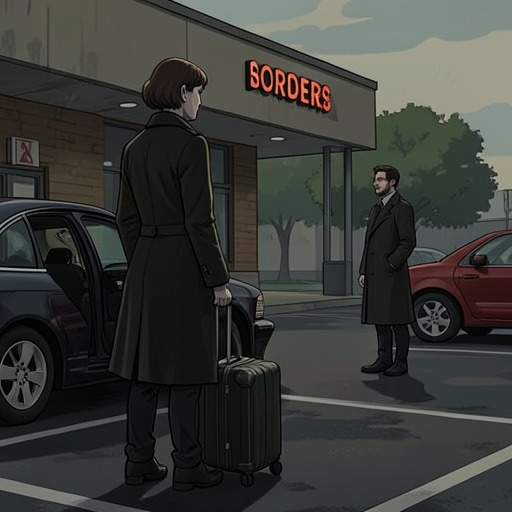
Sofia stops the car on the hard shoulder and suggests looking at the sunset, although there is no sunset to see. Rose does not appear to notice the mismatch. The car stop becomes a practical, laborious pause: Sofia takes out the wheelchair and spends fifteen minutes lifting and positioning her mother. Rose leans first on Sofia’s arm and then on her shoulder as she lowers herself into the chair. The account makes the effort of transferring Rose explicit, establishing that Sofia has helped her into a position of dependence immediately before abandoning her.
A white lorry is approaching in the distance. It carries tomatoes grown under plastic on the sweltering desert farms, a detail that places the intimate family crisis against Almería’s agricultural landscape. Sofia wheels Rose into the middle of the road and leaves her there. The sequence is starkly physical: the wheelchair is moved from the hard shoulder into the path of traffic, and Sofia withdraws from the situation rather than remaining to protect or assist her mother. The approaching lorry makes the danger concrete, but the account does not state that it reaches Rose or that she is struck.
The scene also reverses the ordinary direction of their shared movement. At the clinic, Sofia had used her own legs to keep pace with Rose; on the roadside, she controls the wheelchair and places Rose where she is exposed to danger. The change is not simply from accompaniment to separation. It turns the means by which Sofia has helped her mother move into the means by which she leaves her behind.
Confession and unresolved outcome
After leaving Rose, Sofia goes to Dr Gómez and says she needs to speak urgently. He tells her that it is not the right time for an unplanned visit and that she is speaking loudly enough to frighten his animals. Sofia begins to sob and says she thinks she has killed her mother. When Dr Gómez asks how, she explains that she left Rose in the road and that Rose cannot walk. The confession confirms Sofia’s action and her immediate understanding of its stakes; it does not independently establish Rose’s condition or the outcome of the abandonment.
Dr Gómez responds by asking how Sofia knows that Rose cannot walk. His question brings the earlier evidence of Rose walking back into the encounter without cancelling the danger Sofia has created. Her mother had walked alone to the shop and along the beach, but Sofia had also just helped her into a wheelchair and believed she could not walk. The scene sustains that contradiction rather than supplying a medical or practical resolution. No rescue, collision, or reunion is established in this account.
Significance of the act
The abandonment is a decisive rupture in a relationship organized around bodily assistance. The earlier image of the two women limping together gave their shared pace a quality of accommodation: Sofia moved with Rose, and described her own legs as serving her mother. The roadside action breaks that arrangement. Sofia remains responsible for the wheelchair transfer, yet uses that responsibility to place Rose in danger and leave. The event therefore makes caregiving neither a simple expression of devotion nor a stable bond; it is also a source of strain whose consequences can become immediate and grave.
Walking and its absence remain central to the event’s uncertainty. Rose’s mobility changes across the narrative, while Sofia’s body appears to retain the memory of moving in step with her. At the roadside, however, Sofia presents Rose’s inability to walk as the reason she believes she may have killed her. The distinction between what Rose can do, what Sofia thinks she can do, and what safety requires is left unsettled. The confession closes on that unresolved knowledge: Sofia has exposed her mother to danger, but the account does not yet say what happened to Rose.