Sofia’s reunion with her father in Athens
Hot MilkSofia’s reunion with her father in Athens turns a long-anticipated meeting into a test of what family can offer after absence. At Athens International Airport, Christos Papastergiadis welcomes Sofia after eleven years without seeing her, but she arrives alone while he stands with his new wife, Alexandra, and their infant daughter, Evangeline. The visit offers recognition and tentative intimacy, yet it also exposes the limits of reconciliation: Christos’s new household belongs to the life he made after leaving Sofia and Rose, while Sofia must decide what, if anything, she can still ask of him.
Arrival and the New Family
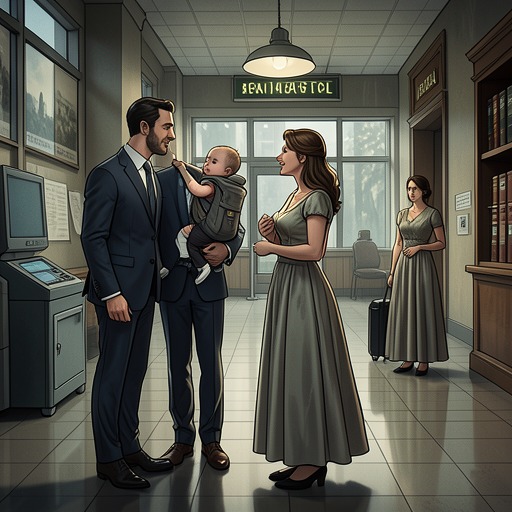
The reunion begins amid the ordinary sounds of the airport rather than a prepared declaration. Christos takes Sofia’s suitcase, kisses her cheek, and asks about her flight. His carefully ironed blue shirt and relaxed, tanned appearance contrast with her memory of his hair as silver; it now seems blacker. The years apart have altered him, but recognition between them is immediate. He welcomes her and asks her to call him Papa, an invitation to kinship that arrives before they have addressed the history separating them.
He then introduces Alexandra and Evangeline. Alexandra, tired and damp with milk on her denim shirt, looks wary but welcoming; the baby’s brown eyes catch Sofia’s attention. Watching the couple look down at their daughter, Sofia sees an open, unashamed love between them. The sight makes the family’s arrangement difficult to place: Christos is sixty-nine and Alexandra twenty-nine, and they can appear like a father, daughter, and grandchild. Yet Sofia distinguishes the apparent strangeness of the age difference from the affection she observes. Christos is caring for two new women, while Sofia understands herself as belonging to the earlier life that had made him unhappy. She has pinned up her hair with three scarlet flamenco flower clips bought in Spain, a small act of preparation as she approaches this unfamiliar family.
A Walk Framed by Debt
On her second day in Athens, Sofia offers to walk through the park with Christos along his route to work. It is their first time alone together without Alexandra and Evangeline, whom Sofia figures as human shields between Christos and the creditor he left behind. The image turns their estrangement into an account that cannot simply be settled: Sofia knows his absence from her life is not a debt he can repay, although pretending to negotiate still feels exciting.
The walk offers no easy release into conversation. Sofia moves unsteadily in black suede platform sandals, Christos carries the small portion of guilt that, in her description, his god has not entirely absolved, and they stagger through the park in silence. Graffiti near the metro asks, “WHAT NEXT?” The words fit the uncertainty of the meeting: the two are together again, but neither the route he takes to work nor the fact of their shared history supplies an answer about what their relationship should become.
The Request and Its Refusal
When Sofia tries to speak plainly, she considers what she might ask for: financial help, or time in which to explain where her life stands. She is also unsure whether listening would be to Christos’s advantage. At last she tells him she is thinking of finishing her doctorate in America. The possibility is entangled with care: she would need funding and would have to leave Rose alone in Britain, and she does not know what to do.
Christos tightens his face and withdraws behind a practical-sounding answer. He tells Sofia to do as she pleases, mentions grants for overseas study, and says Rose has chosen to live as she does and is not his concern. Sofia asks for advice, not merely information about grants, but Christos steps backwards toward a closed door. The exchange makes the boundary of the reunion concrete. Sofia has approached him as a father whose counsel might help her weigh work, money, and responsibility for her mother; he declines the responsibility she is asking him to share. His response does not erase the possibility of contact, but it leaves her facing the decision without the guidance she sought.
Ten Euros and a Paper Flower
The night before Sofia leaves, Christos announces that he wants to give her spending money. The offer moves her because he has not given her money in that way since she was fourteen. He searches his worn leather wallet, then realizes he has forgotten to go to the bank. After rummaging, he produces a single ten-euro note, smooths it on the table, and hands it to her with a flourish. The smallness of the sum and the effort of the presentation sit together: this is an awkward, limited offering, but it is also an attempt to give.
When a woman begging approaches Sofia’s table, Sofia puts the note into the woman’s plastic cup. The woman speaks Greek, limps nearer, and kisses Sofia’s hand—the first affection anyone has shown her in Athens. Sofia recognizes how hard it is to accept that the first man in her life might do things to her disadvantage when they serve his own advantage. That recognition, painful as it is, also becomes a revelation that sets her free. The money has passed through her hands without repairing the father-daughter relationship; its meaning lies instead in what Sofia can see and choose after receiving it.
Christos then folds a paper napkin into a flower with three dense layers of petals. At first he seems not to recognize what he has made. Sofia becomes bolder and tells him she thinks the flower is for her. He confirms that it is, remembering that she likes wearing flowers in her hair, and gives it to her. His happiness that she keeps it, and the reluctance with which he had claimed the gift, make the gesture tender but tentative. Unlike the money, the flower is made by hand for Sofia; unlike an apology, it does not explain or undo the years of absence. It gives their parting a small object of attention without pretending to settle the larger account.
Departure and What Remains
As Sofia wheels her suitcase toward the bus station to catch the X95 to the airport, she feels more like herself—and alone. Her suitcase holds the paper flower, made from the same kind of paper as the books her librarian mother spent her life indexing. The image connects Christos’s fragile gift to Rose’s labor with words, while Sofia recognizes that neither her mother’s cataloguing nor her father’s gesture can restore wishes dispersed by a world not arranged to their advantage.
The reunion therefore ends in partial, not complete, rapprochement. Sofia leaves with no assurance that Christos will fund her doctorate or help care for Rose, and the family he has formed remains distinct from the history she shares with him. But she has met Alexandra and kissed Evangeline’s feet and hands, accepted that a gesture from her father can matter without cancelling his failures, and retained the flower. Her departure does not turn solitude into abandonment: she feels more like herself as she goes, carrying an imperfect gift and a clearer sense of what the reunion has—and has not—changed.