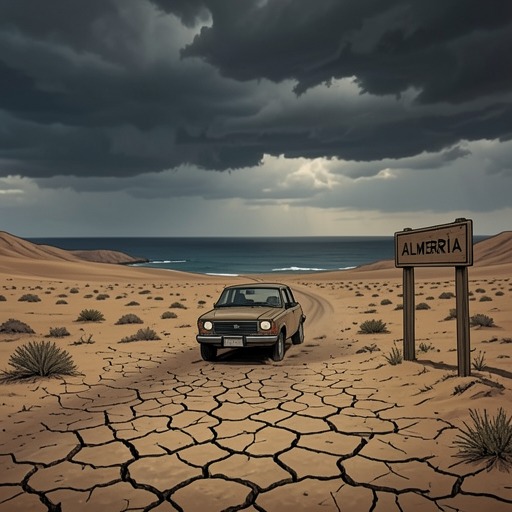
Spain’s recession and austerity climate
Hot MilkSpain’s recession and austerity climate is the economic pressure surrounding the novel’s events in Almería: it determines which services remain open, what kinds of work people can hope to find, and how the costs of illness and care fall on households. Its effects extend from a beach first-aid hut to desert greenhouses and a private clinic, linking personal insecurity to public spending, labor conditions, and unequal wealth.
Work and public services
A first-aid worker explains that the injury hut depends on tourists needing treatment. He has to record the people stung by jellyfish, including their names, ages, occupations, and countries of origin, because evidence of demand helps keep the service open during the recession. The register covers people aged seven to seventy-four, mainly from Spain, as well as visitors from the United Kingdom and elsewhere. The administrative list is thus more than a medical form: it connects a worker’s livelihood to the continued presence of a public-facing service and to the injuries that make its usefulness visible.
The worker’s own prospects are uncertain. He is studying for a master’s degree at the School of Philosophy at Granada University, but regards a summer position at the hut as fortunate. If the Coffee House is still hiring when he graduates, he hopes to move to London. His account makes employment appear as a sequence of contingent possibilities rather than a stable professional path. Even the phrase he uses to describe the end of a dream is, he admits, borrowed rather than a settled personal conviction; he questions who has the authority to decide when another person’s aspirations are finished.
A later broadcast about Spain’s austerity programme intrudes into Dr Gómez’s consultation with Rose Papastergiadis. While examining her X-rays, he pauses to listen to the news and identifies the financial analyst reporting on the programme. The juxtaposition makes national economic policy part of the clinic’s ordinary working environment, not an abstraction separate from diagnosis. Dr Gómez then turns to Rose’s many medications, asking which she is attached to and which she could relinquish, bringing the practical management of illness into the same scene as austerity news.
Agriculture, infrastructure, and unequal exposure
The economic landscape is also visible in the plastic-covered greenhouses spread across Almería. The first-aid worker describes farms where temperatures can reach forty-five degrees and where undocumented migrants pick tomatoes and peppers for supermarkets under highly exploitative conditions. Their labor supports a food supply extending well beyond the region, while the workers themselves bear the heat and insecurity. The narrative places this system beside the student’s limited summer employment, showing different degrees of vulnerability within the same regional economy rather than treating economic hardship as a single shared experience.
Around the beach opposite the cement factory, industrial and tourist development occupies the same landscape. A cargo ship bearing a Greek flag lies offshore; cranes from a desalination plant rise nearby, while cement powder is stored beside unfinished hotels and apartments cut into the mountains. These details connect local economic activity to shipping, water infrastructure, cement production, and tourism construction. The beach is not simply a place of leisure: it sits alongside industries and building projects that reorganize the surrounding environment, while the greenhouse economy depends on migrant labor farther inland.
The novel also links agricultural production to an immediate reminder of this labor system: a lorry carrying tomatoes grown under plastic passes along the road. The vehicle makes the produce that sustains commercial circulation tangible at the moment when Sofia’s family crisis is unfolding. The economy’s products continue moving even as the people who care for one another are caught in personal emergencies; the lorry does not resolve that conflict but places private distress within the region’s working landscape.
Health care and household finances
Rose’s treatment at the Gómez Clinic depends on financing arranged through her mortgage provider. Sofia takes time away from her job at the Coffee House for the bank interview, losing eighteen pounds and thirty pence in wages for three hours away from work. The bank assesses Rose’s property, notes that its mortgage has been paid off, and considers a loan for the clinic. The process turns the family home into collateral for medical care, while Sofia’s lost pay shows how the effort to obtain treatment also consumes income and working time.
The arrangement exposes unequal access to resources. Rose is excited by the prospect of an unfamiliar medical experience, but the family must negotiate credit and offer the property for valuation before they can meet the clinic’s costs. Sofia describes herself as indebted to her mother for supporting her, and the account of her absent father adds a sharp contrast: he has inherited wealth from a shipping business in Athens, yet has not shared it with them. The novel does not present their strain as the result of one policy alone; rather, austerity forms the setting in which illness, family obligations, employment, and inherited money distribute security unevenly.
Dr Gómez’s clinic offers a further contrast between scarcity and private institutional resources. He reports unemployment of about 29.6 percent in Spain and presents his daughter, Julieta Gómez, as fortunate to have specialized physiotherapy training and a position at the clinic. He also acknowledges using his own position to secure that job for her. His description makes professional opportunity dependent not only on training but on personal influence, even within an institution that displays substantial resources. The clinic’s marble construction and its staff stand against the widespread unemployment he cites, complicating any simple picture of a uniformly impoverished region.
Economic insecurity as a lived condition
Sofia’s own circumstances connect care work with insecure employment and restricted choices. In London, she works at the Coffee House and sleeps in its storeroom during the week, staying with Rose on weekends. She continues to organize her life around her mother’s illness, including the recurring task of trying to provide water Rose will accept. These routines are not identified as direct products of austerity, but they show the unpaid labor and unstable living arrangements through which the economic climate is experienced at household level. A national downturn becomes legible in lost wages, constrained housing, reliance on credit, and the effort required to keep care going.
The narrative’s scale repeatedly shifts between intimate and structural pressures: a family seeking money for treatment, a graduate hoping for a café job, an injury worker trying to justify a service, and migrants working in extreme greenhouse heat. None of these situations is interchangeable. Together they show how recession and austerity shape different people’s options according to their access to income, employment, property, and institutional connections. The economic climate therefore serves as a material framework for the story’s conflicts over care and mobility, while the contrasting landscapes of agriculture, industry, tourism, and medicine reveal who performs the work and who can draw on resources.