Starfield screensaver
Hot MilkThe Starfield screensaver on Sofia Papastergiadis’s laptop is more than a background image: it becomes a private cosmos in which she arranges family, memory, and uncertainty. Its constellations are at once a place to look when pain resists explanation and a digital refuge that, in the end, cannot keep her from the difficult material world beneath the real night sky.
Appearance and Recurrence
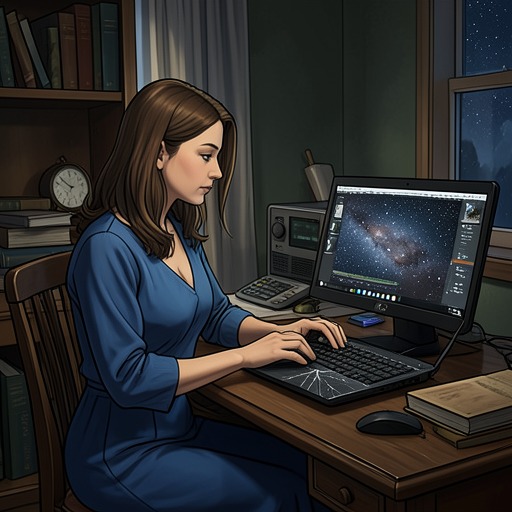
The screensaver first comes into view as Sofia turns away from her mother, Rose Papastergiadis, and looks at the shattered starfield on her laptop. The moment follows Rose’s account of waiting for new pain after coming off medication, and her complaint that a doctor has little knowledge of chronic pain. Against that unresolved bodily experience, the screensaver offers shapes to gaze at, but no answer. Its stars are not a stable, reassuring picture: Sofia describes their constellations as misty and undefined, passing before her eyes until one resembles a calf. The image prompts a small, unanswered problem of its own: where could the animal find grass in a galaxy? It would have to eat stars.
That strange substitution makes the digital scene feel less like a decorative escape than a world with its own scarcity. The calf has no ordinary pasture; even its imagined food belongs to the starfield. In the same passage, Rose’s pain is described as magnifying each day, while the screensaver’s shapes remain indistinct. One presents suffering as a bodily reality that has not yielded its secrets; the other turns looking into a wandering passage through images that do not settle into clear meanings.
A Family Mapped in Stars
Sofia later uses the screensaver’s cosmology to think about her family and her own uncertain place among them. She resists the idea that either her god or her father should be the major plot of her life, but immediately doubts that refusal: Christos Papastergiadis is already mapped in the screen’s cosmos. He is shattered, yet functioning. The image gives Sofia a compact way to hold those two conditions together without making either disappear.
Rose occupies a different place in that imagined sky. Sofia sees her mother’s small, fierce blue eyes shining from the wreck of her body as the brightest stars in the shattered galaxy. The screensaver’s broken cosmos thus becomes a frame for Sofia’s recognition of Rose’s sacrifice, and of her own feeling of being bound to it. Her imagined alternative—a mother who had left for Hong Kong when Sofia was five, while Sofia stayed with her grandmother in Yorkshire—makes the cost of that sacrifice legible through a life Rose did not choose. The imagined journey and its practical details belong to Sofia’s speculation, not to the screensaver itself; what the digital sky supplies is a vocabulary of distance, brightness, and brokenness in which she can picture the family’s attachments.
The image also marks a limit to Sofia’s claim of independence from inherited stories. She calls herself opposed to major plots, yet the starfield already contains her father and mother. Her statement that even at five she was older than the stars made in China adds a pointed contrast: the screensaver’s artificial stars can be manufactured, while Sofia’s childhood perspective is presented as older than their manufactured appearance. The image is therefore both a structure for arranging family history and an object whose constructed nature Sofia notices.
The Virtual Galaxy and the World Outside
At the beach home, the screensaver’s digital night is set directly beneath the real night sky. Sofia’s laptop rests on the terrace table, its stars open under the stars over Spain. She recalls having spent the summer moonwalking through the digital Milky Way, leaving footprints along faintly glowing paths in a virtual universe. The scene makes the screensaver feel like a traversable landscape, but the movement remains virtual: Sofia says that the starfields are calm while she herself is not.
Her description turns the screen’s apparent calm into a contrast rather than a cure. The digital paths do not resolve the agitation of her mind, which she associates with the harsh edge of motorways and the competing demands of profit and pain. She also recognizes the possibility that technology looks back: like Medusa, it may petrify her and make her afraid to descend to Earth, where ordinary material pressures await. The screensaver’s gaze reverses the usual relation between viewer and image. Sofia is not simply using the starfield as a harmless retreat; she fears that looking into it has helped hold her away from life beyond it.
That concern gives the object’s recurrence a narrative consequence. The passage on the terrace is followed by Rose telling Sofia that she went for a walk and was too overwhelmed to share the good news. The transition places a real bodily act of movement beside Sofia’s imagined footprints in the virtual galaxy. The screensaver can picture paths across a boundless digital space; Rose’s walk belongs to the ground-level world in which movement has immediate significance.
Significance
The Starfield screensaver gathers several tensions without resolving them: manufactured stars and real stars, a shattered image and a functioning father, virtual calm and Sofia’s unrest, the desire to look and the fear of being held by what is seen. Its changing shapes allow Sofia to think in images where direct explanations fail, but their very instability resists becoming a dependable map. The calf that must eat stars captures this uneasy logic: the screen invents a universe, yet even there ordinary needs cannot be met in ordinary ways.
As an object, the screensaver remains on Sofia’s laptop; as a recurring image, it expands into a way of seeing her family and her own relation to the world. It can hold the brightness of Rose’s eyes alongside the family’s damage, and it can offer paths when Sofia feels suspended. But its digital Milky Way is not the Earth below it. By bringing the two skies into one scene, the narrative makes the screensaver’s refuge visible—and makes visible, too, the danger of mistaking that refuge for a life lived beyond the screen.