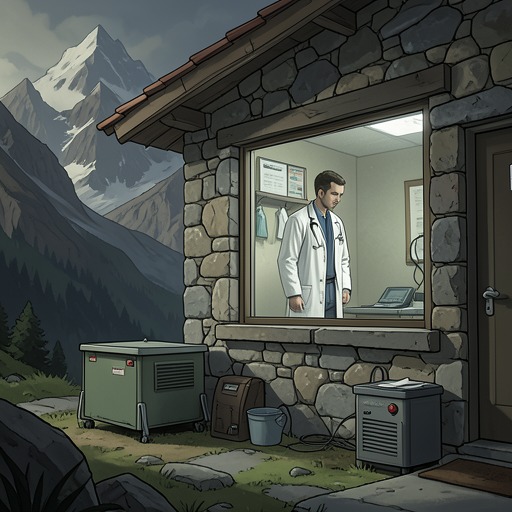
The controversy over Gómez’s clinic’s reputation
Hot MilkThe controversy over Gómez’s clinic’s reputation is not resolved by a single diagnosis or verdict. It grows out of an expensive attempt to understand Rose Papastergiadis’s persistent and shifting symptoms, then becomes public through graffiti, competing accusations, and a review of the clinic’s treatment. The novel leaves the central question unsettled: the clinic may be a target of commercial pressure, a dangerous or discredited practice, or both an imperfect medical institution and the focus of accusations that cannot be independently confirmed. Its reputation matters because Rose and Sofia Papastergiadis must decide what to trust while neither symptoms nor clinical authority offer a stable answer.
Cost, Care, and Uncertainty
The dispute has immediate material stakes. Sofia describes the family’s investigation into Rose’s condition as having lasted for most of her life: as a child, she asked what a headache meant, and Rose explained it as a door slamming in her head. Sofia comes to understand herself as a witness to her mother’s pain, even likening the effort to interpret its triggers and motives to investigating an unsolved crime. That account makes her neither a detached observer nor a neutral judge of the clinic. The treatment concerns a history she has long tried to decipher, and the consequences fall on both mother and daughter.
The family remortgages Rose’s house to pay for treatment at the clinic near Carboneras. The total is twenty-five thousand euros, a substantial sum against years of inconclusive symptom-tracing. The price sharpens the question of what the clinic can reasonably be expected to deliver. When Dr Gómez tells Sofia that Rose has a chronic iron deficiency and prescribes vitamin B12, Sofia privately wonders whether a vitamin prescription justifies the cost. Rose, meanwhile, names the medications removed from her routine as though mourning absent companions. The financial sacrifice and the emotional force of medication make the treatment more than a technical decision: each change affects the family’s trust in the care being offered.
The clinical encounters provide particulars, but not a comprehensive explanation. Rose reports a sharp, tearing pain in her left arm after sneezing, located at the inside of her elbow. Dr Gómez examines her feet and finds small, slightly infected ulcers, asking whether she has been tested for diabetes and saying they need prompt attention. These findings give the clinic concrete problems to address, yet they do not account for the larger pattern of pain and impaired movement. The contrast between a visible ulcer and the many unexplained complaints helps explain why the family’s assessment of the clinic remains unsettled: treatment can identify and respond to local conditions without solving the illness as a whole.
The Clinic’s Account and Its Critics
Dr Gómez presents his approach as a deliberate effort to reconsider Rose’s medication rather than simply add to it. He asks her which drugs she feels attached to and which she can let go, and plans to review the prescriptions with her. The method places Rose’s own relationship to medication inside the consultation, but it also gives Dr Gómez considerable power over a ritual that has structured her care. His decision to erase medication from both Rose’s and Sofia’s lives is later explained to Sofia as a way of disrupting their dependence on that routine. He says Sofia has become accustomed to administering her mother’s medicines and has used Rose as a shield against making a life of her own. This is Dr Gómez’s interpretation, not an account the narrative establishes as objectively correct.
A further challenge emerges when Rose says Dr Gómez has admitted knowing little about chronic pain. She reports that he has said her pain has not yet yielded its secrets, while its intensity seems to increase every day; when Sofia asks whether her feet hurt, Rose answers that they are numb. The admission can be read as a candid acknowledgment of the limits of his knowledge, but it also unsettles the expectation that the expensive clinic should produce answers. The book keeps both implications in view rather than turning uncertainty into proof either of honesty or incompetence.
The question of credibility is also bound to how Rose’s story is heard. During a consultation, Julieta Gómez listens while Rose gives an account that moves between present symptoms, earlier illness, and childhood history. The complaints do not form one neat, chronological narrative: Sofia overhears at least twenty, with past, present, and future seeming to coexist. Julieta’s questions are minimal, and she leaves silences unfilled rather than pressing Rose to speak. Sofia observes this as an ethnographer as well as a daughter, comparing clinical history-taking to in-depth interviewing. In this setting, reputation is not only about whether the clinic can diagnose; it is also about whether its practitioners make room for the patient’s account without forcing it into a simpler shape.
Graffiti and Suspected Commercial Pressure
The clinic’s reputation becomes a visible conflict when someone paints QUACK in blue on its marble exterior. Dr Gómez tells Sofia that the defacement happened that morning, after Matthew had collected the car and received documents and keys from Julieta Gómez. He suspects Matthew may have been involved, but the narrative does not confirm who painted the word. Dr Gómez interprets it as an accusation that he is a charlatan and a con man, and says that his staff will clean the marble. The defaced building turns an argument about medical trust into a public mark against the practice, while leaving the source of the accusation uncertain.
Dr Gómez offers a possible motive for an attack on his clinic: he says a pharmaceutical company has approached him about funding research in return for his buying and prescribing its medicines. He also says the company has been troubling him for years and notes that Matthew plays golf with one of its executives. These are Dr Gómez’s allegations, not independently verified findings. They complicate the simple image of a clinic accused of quackery: the doctor presents himself as resisting commercial influence, while his own account also asks Sofia to accept his interpretation of who wants to discredit him. The novel supplies a conflict of interests and a suspected connection, not proof that the graffiti was commissioned by the company or that the clinic’s treatment is sound.
The surrounding details make that uncertainty tangible. During an earlier visit, Dr Gómez pauses to listen to a radio broadcast about Spain’s austerity programme, identifying a financial analyst for Rose and Sofia before returning to the consultation. The clinic’s treatment takes place amid economic pressures that are not abstract to the family: Rose’s house has been remortgaged, and the price of care is already part of their experience. Later, Sofia’s attention to greenhouse agriculture and Matthew’s phrase Sunshine is Sexy connect the clinic’s marble wall to the wider economic landscape, but neither detail resolves the specific accusations against Dr Gómez.
Review and the Unsettled Verdict
The clinic’s critics are explicit. Matthew tells Sofia that Dr Gómez should be struck off and calls him dangerous, citing an executive he is training from Los Angeles who, Matthew says, describes the doctor as a discredited quack. Matthew presents this as authoritative confirmation, but the information reaches the reader through his report of what another person has said. It stands against Dr Gómez’s claim that commercial interests are trying to undermine his practice, without conclusively establishing either account. Sofia’s response is qualified: she allows that Matthew might be right, but does not claim to know.
A review of the clinic brings the dispute into a more formal setting. A representative asks Rose whether she has been given a progress plan describing how her treatment is advancing and what has been achieved. Rose says she has seen no such plan. The reviewer then asks whether treatment has helped her become more effective in her life. The question leaves Rose pale and trembling; she falls silent, waves her fingers toward Sofia, and asks for the question to be repeated. The scene does not provide a verdict, but it makes the review’s central measure concrete: the clinic is being asked to account for progress in Rose’s everyday life, while Rose herself struggles to answer under scrutiny.
The meeting also complicates any easy claim that the clinic has simply abandoned basic care. Dr Gómez explains that Rose was admitted for two nights after becoming dehydrated and received intravenous saline. He says her difficulty swallowing water also makes it difficult for her to swallow medication. Rose tells the reviewers that she is back on track with her medication and notes that a doctor at the hospital in Almería was concerned too. This account places the clinic’s treatment alongside hospital care and the practical difficulty of hydration, but it does not settle whether its broader treatment has helped. The record contains both attentive interventions and a lack of a progress plan, both a doctor’s admission of limited knowledge and a patient’s continuing uncertainty.
The controversy therefore remains a struggle over whose explanation can be trusted. Rose’s symptoms are real within the narrative, but they do not yield a single cause; Sofia’s long investment in interpreting them makes the clinic’s failure to provide certainty personally costly; and the doctor, his critics, and the reviewer each frame responsibility differently. The novel does not convert the graffiti, the pharmaceutical allegation, or Matthew’s report into a final finding. Instead, it shows reputation being made through money, testimony, visible marks, and institutional questions, while the patient’s unsettled experience persists beyond every claim about what the clinic is.