1·4-inch anomaly
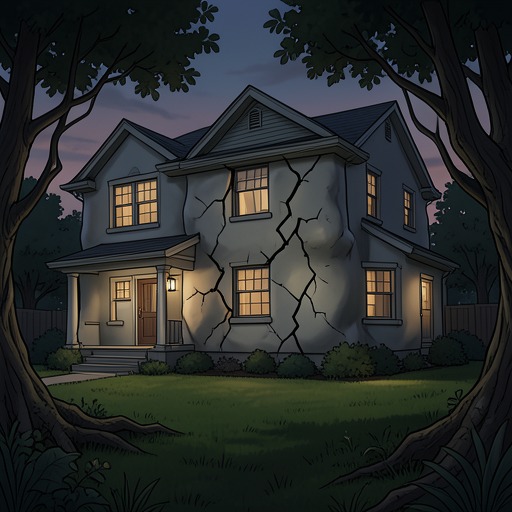
House of LeavesThe 1/4-inch anomaly is the decisive material discovery that transforms the impossible architecture of The Navidson Record from an unsettling optical effect into a physical contradiction. Will Navidson’s measurements repeatedly establish that the inside of the house exceeds the outside by exactly one quarter of an inch, making the house itself the first demonstrable instrument of spatial impossibility.
Discovery Through Measurement
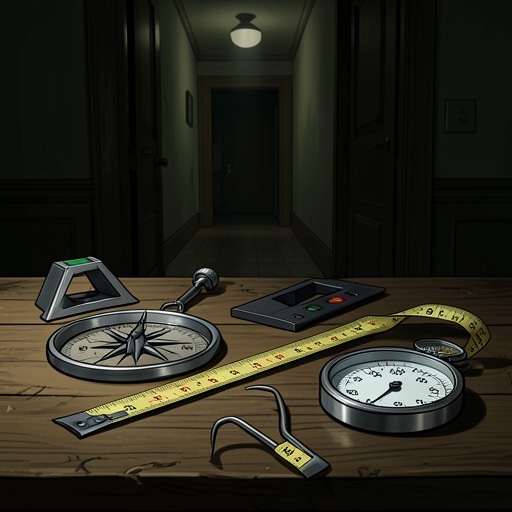
Will Navidson turns to the building plans only after the visible irregularities in the house have exhausted more ordinary explanations. At first, the investigation appears almost casual: he compares the dimensions printed on the plans with measurements taken personally. The process changes when he retrieves a 25-foot Stanley Power Lock and begins moving repeatedly between the tape and the cold blue pages spread across his bed. The discrepancy is sufficiently disturbing that he mutters that it must be a case of bad mathematics.
The film then identifies the discovery with the stark title card “1/4.” The number is not an impression, metaphor, or interpretive estimate. It announces a measurement whose smallness makes it more unnerving, not less. A large architectural distortion might be dismissed as an obvious illusion; a quarter inch can survive precisely because it is narrow enough to invite correction while remaining exact enough to resist it.
The Measurements and Their Contradiction
To test the plans, Navidson climbs a ladder to the second story, despite painful inflammation around his toes caused by a skin condition dating from childhood. Using a 100-foot Empire fiberglass tape with a hand crank, he measures from the far end of the master bedroom to the far end of the children’s bedroom. The exterior span totals 32 feet 9 3/4 inches, a result corroborated by the house plans within approximately an inch.
The interior calculation produces the impossible result. Navidson measures the new area, adds the lengths of both bedrooms, and includes the widths of all the intervening walls. The total is 32 feet 10 inches exactly. Thus the interior width exceeds the exterior width by one quarter of an inch. The difference is not a rounding error: the exterior measurement is 32 feet 9 3/4 inches, while the internal measurement is precisely 32 feet 10 inches.
Navidson attempts to eliminate the possibility that the walls or his instruments have produced the discrepancy. He drills through the outer walls and, with Karen Green’s help, fastens fishing line to the edge of one wall. He runs the line through the drilled opening, across the master bedroom, the new space, and the children’s bedroom, then through a corresponding hole in the opposite wall. He checks that the line is straight, level, and taut before marking it. The internal measurement remains 32 feet 10 inches exactly.
He then takes the same line outside and stretches it from one side of the house to the other. It is a quarter inch too long. The result is exact. The line that spans the interior has more length than the exterior width can contain, establishing the anomaly through a repeated physical procedure rather than through a single suspicious reading.
Domestic Consequences
The anomaly matters because it cannot remain an intellectual puzzle detached from lived experience. An impossible dimension is comparatively manageable in an Escher print: the viewer can close the book and return to an ordinary room. In the house, however, the contradiction occupies the same walls, bedrooms, and thresholds through which the family moves. The mind encounters the impossible as a bodily environment rather than as an image.
Karen refuses the knowledge and tells Navidson that she does not care and that he should stop drilling holes in her walls. Her response places the anomaly within a conflict between measurement and domestic preservation. Navidson continues despite her resistance, repeating the measuring process six consecutive times in six consecutive segments. Each attempt fails to destroy the quarter inch. The persistence of the discrepancy gradually darkens his mood, while Karen becomes quieter.
The children, Chad Navidson and Daisy Navidson, respond to the altered emotional atmosphere by hiding in other parts of the house. The anomaly therefore changes the family before anyone can explain it. Its immediate consequence is not a spectacular collapse but an accumulation of tension: drilling, retesting, silence, withdrawal, and the sense that another night has passed without making the house intelligible.
The following morning retains the routines of ordinary life—orange juice, The New York Times, NPR, a dispute over sugared cereal, the dishwasher, and the toaster—but the domestic scene now carries the pressure of the impossible. Even the coffee becomes an image of unstable containment: Will Navidson stirs in sugar and milk until the liquid rises above the rim, holds there briefly, and then spills across the newspaper. The small failure of surface tension echoes the larger failure of the house to keep its interior within its exterior boundaries.
From Discrepancy to Spatial System
The quarter inch is not an isolated mistake in the film’s architecture. It anticipates the doorless hallway from which Chad and Daisy’s voices return with separate echoes, despite the house’s ordinary rooms being no longer than twenty-five feet. It also belongs to a wider pattern in which direction, distance, and enclosure cease to behave consistently. Karen cannot obtain a reliable orientation inside the house: even two different compasses fail to settle on north, south, east, or west.
The anomaly’s significance expands as the film’s spaces become more difficult to map. The Infinite Corridor, the Anteroom, the Great Hall, and the Spiral Staircase exist for all observers, yet their dimensions and layouts can change; other areas never repeat the same pattern twice. No one sees the labyrinth in its entirety, so understanding must be assembled from within the space while the space remains capable of altering the conditions of observation.
Later events magnify the same contradiction. During an ascent, rope slack vanishes and Billy Reston is pulled upward even after Navidson releases the rope, while a quarter dropped from above falls for at least fifty minutes before appearing beside Navidson, implying an impossible distance far beyond the Earth’s circumference. In another episode, a seven-foot shelter at the brink of an abyss changes its orientation while Navidson sleeps: its door disappears and its horizontal staircase rises through the ceiling. A window later vanishes with the room, leaving Navidson on an ash-black slab suspended in darkness. These episodes do not explain the quarter inch; they reveal it as the first small-scale manifestation of a much larger spatial agency.
Narrative and Thematic Significance
The anomaly converts instruments of certainty into witnesses against certainty. The Stanley tape, the Empire tape, the architectural plans, drilled walls, fishing line, and repeated checks should stabilize the house as a measurable object. Instead, each tool confirms that measurement itself has encountered an object it cannot contain. The material world becomes conspicuous precisely when its supposedly transparent operations—length, width, alignment, and enclosure—stop working.
The filmed investigation also makes the anomaly a problem of representation. Will Navidson’s camera work is exceptionally steady and controlled, unlike the unstable footage recorded by Holloway Roberts, Karen Green, and Tom Navidson. His photographic discipline gives the evidence an unusual authority, yet the more carefully the house is documented, the less possible it becomes to reduce the contradiction to poor framing or faulty perception. The record’s claim to documentary precision therefore intensifies the impossibility it records.
The 1/4-inch anomaly is consequently both a physical event and a narrative threshold. It is minute enough to appear correctable, but persistent enough to survive six attempts at correction; domestic enough to emerge from bedrooms and walls, but profound enough to reorganize the meaning of space. By making a quarter inch endure where mathematics says it cannot, The Navidson Record establishes its central terror: the house does not merely contain an unexplained space. It refuses the boundary between inside and outside on which measurement, habitation, and understanding depend.