Amber Rightacre
House of LeavesAmber Rightacre is one of the readers who survives as a living connection to Zampanò’s otherwise isolated existence. After Johnny Truant begins sorting through Zampanò’s papers, Amber becomes both a source of information about the old man and a participant in the network of reading, translation, and memory that continues his work after death.
Identity and Introduction
Amber first enters Johnny’s account through the difficult Latin material surrounding the destruction of Carthage. She suggests that the passage may concern Carthage’s destruction and provides the translation and source of an earlier Tolstoy phrase as well. Johnny has never read War and Peace, whereas Amber has read it and even read it aloud to Zampanò. In this indirect way, Zampanò introduces Johnny to Amber: the old man’s reading life creates a connection between two people who might otherwise never have met.
Johnny later discovers a notepad filled with the names and telephone numbers of Zampanò’s readers. The list contains easily more than a hundred people, although many numbers no longer work and few names include usable surnames. Johnny leaves messages for several of them, and Amber answers on the third page of his attempts. When Johnny tells her about his inheritance, she immediately agrees to meet him for a drink, turning a scattered archival trace into a living encounter.
Appearance and Personal Details
Amber is described as one-quarter French and one-quarter Native American. She has naturally black hair, dark blue eyes, and a long, flat, slender belly marked by a thin silver navel piercing. A blue-and-red barbed-wire tattoo circles her ankle. Johnny’s description makes her physical presence striking, especially in contrast with the absent Zampanò, who could only have encountered her through voice, memory, or the written traces left behind. The description also establishes Amber as someone who possesses an identity and vitality unavailable to the old man, whose world has become confined to his apartment, his papers, and his readers.
Relationship with Zampanò
Amber describes Zampanò as “imperceivable and alone, though not I think so lonely.” Her formulation distinguishes physical isolation from emotional solitude: Zampanò was difficult to perceive or reach, yet he was surrounded by an inner or imagined community. She recalls that he liked to boast about being uneducated, saying that he had never gone to high school and using this claim to present himself as less intelligent than his reader. Their exchanges could be teasing and competitive, but most of the time Amber read to him.
Zampanò insisted on Tolstoy and praised Amber as a reader of Tolstoy. She believes his preference was partly practical, because her Canadian background enabled her to handle the French passages. Her role therefore exceeds that of a casual visitor. She gives voice to texts that Zampanò wants to hear, mediating between languages and between the literary world and the isolated room in which he receives it.
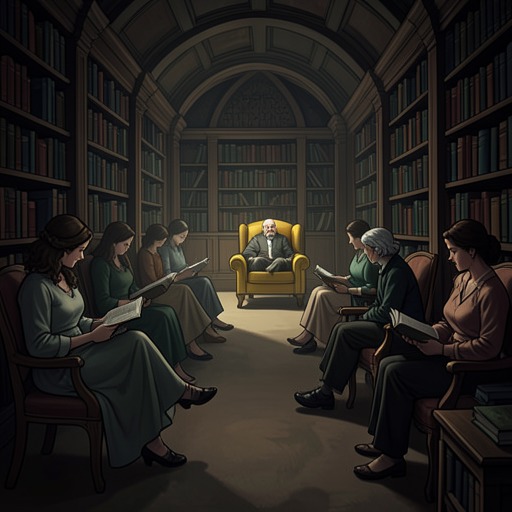
Amber’s most unsettling memory concerns Zampanò’s answer when she asked whether he had children. He said that he did not have any children any more, then added, “Of course, you’re all my children.” Although Amber was the only person present, Zampanò looked toward the empty space with blank eyes as if the small apartment had filled with faces he could see and address. The statement transforms his readers into a substitute family and makes authorship resemble a strange form of parenthood: Zampanò’s children are not biological descendants but the people who receive, interpret, and perhaps carry forward his words.
Meeting with Johnny and Lude
Johnny and Amber meet for a drink and later walk to the Viper, where Lude admits that he discovered the manuscript and called Johnny about it. Amber and Johnny quickly recognize a powerful shared connection through Zampanò. Their conversation becomes so absorbing that Lude, despite repeatedly insisting on his own role in finding the manuscript, cannot participate in its particulars because he never took the time to read the text. He orders a drink on Johnny’s tab and goes in search of other entertainment while Amber and Johnny remain absorbed in a deeper history.
Their physical proximity intensifies the intellectual bond. Amber grabs Johnny’s arm on the stairs, and later resumes speaking by moving closer until her elbow grazes his. The encounter thus joins literary recognition to bodily attraction without reducing the connection to either one. Both are linked by Zampanò, but their intimacy also arises from the fact that each has been drawn into the unfinished problem of what Zampanò wrote and what his readers inherit.
Narrative Role and Significance
Amber’s function is fundamentally mediating. She translates Latin and recalls Tolstoy; she preserves details about Zampanò that cannot be recovered from bibliographies or etymologies; and she converts the anonymous list of readers into a network of particular voices. Through her, the manuscript appears not as a sealed object but as a fragment whose meaning depends on readers passing it between languages, rooms, and generations.
She also deepens the ambiguity surrounding Zampanò. Her memories suggest both intimacy and estrangement: he jokes about his education, depends on her reading, calls his readers children, and yet remains “alone.” Amber’s account therefore refuses to make him simply a lonely old man or simply a commanding intellectual. He is sustained by an audience he cannot physically gather, while that audience must reconstruct him from incomplete encounters. Amber stands at the point where the absent author, the living reader, and Johnny’s uncertain investigation meet.