Billy Reston
House of LeavesBilly Reston is a paraplegic engineer, a longtime user of an aluminum wheelchair, and a gruff, sharply practical ally of Will Navidson and Tom Navidson. His importance lies in the tension between his material realism and the impossible environment he is asked to measure: he approaches the house with tools, calculations, and professional skepticism, yet becomes one of the people most directly caught in its distortions.
Identity and Background
Reston is described as caustic and more like a drill sergeant than a tenured professor, but his severity is paired with technical authority. He first met Will Navidson when Navidson was twenty-seven, after a photograph taken during an assignment in India brought them together. Navidson had been photographing trains, rail workers, and engineers outside Hyderabad when an inexperienced crane operator struck an electrical pole. A severed high-voltage cable fell toward Reston, who ran for his life while sparks lashed the air around him.
The resulting black-and-white photograph, an 11-by-14 print, records the instant before the cable reached him. Reston’s stride is stretched, his hands search for something to pull himself clear, and the image preserves the fear and disbelief of a man who had been thinking about lunch one moment and facing death the next. The accident cost him the use of his legs. The photograph remains on his office wall, where it functions both as a record of catastrophe and as an explanation of his wheelchair to visitors who might otherwise ask how he became paraplegic.
Technical Ally to Navidson
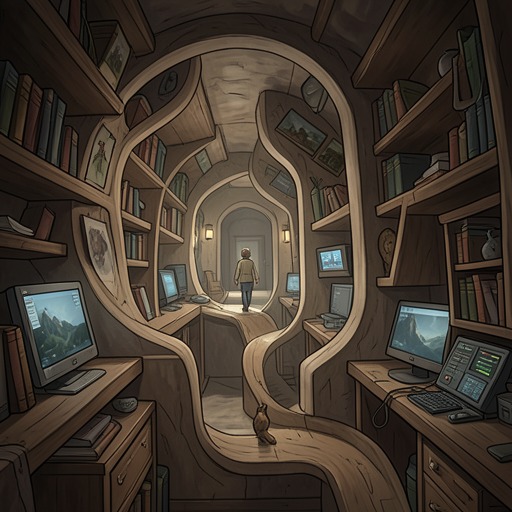
Reston enters the house investigation after Navidson and Tom have exhausted more obvious explanations for the discrepancy between the building plans and their measurements. Navidson measures the exterior span at 32 feet 9 and three-quarter inches, a figure consistent with the plans within roughly an inch. Inside, however, the measured width is exactly 32 feet 10 inches. The interior therefore exceeds the exterior by one-quarter inch.
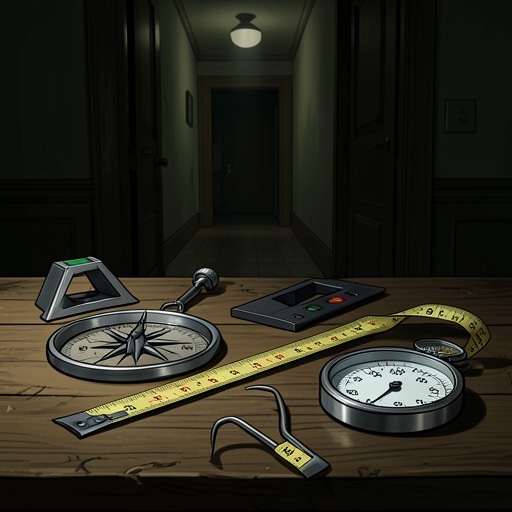
Reston initially treats the anomaly as an equipment problem rather than a supernatural one. He tells Navidson that he would need to inspect Tom’s instruments, but bets that something is out of order. He offers a Stanley Beacon level and a Leica laser distance meter, confident that better equipment will put the apparent ghost in the grave. His advice is deliberately ordinary: he even suggests that Navidson would be better off taking his family for a long drive instead of devoting so much time to the measurement.
This response establishes Reston as the voice of practical reason, but it does not make him merely dismissive. His skepticism produces a testable method. The anomaly survives the use of more precise instruments and the repeated checking of walls, lines, levels, and distances. Reston’s rational framework thus becomes part of the evidence that the house cannot be explained by careless arithmetic alone.
Descent and the Impossible Ascent
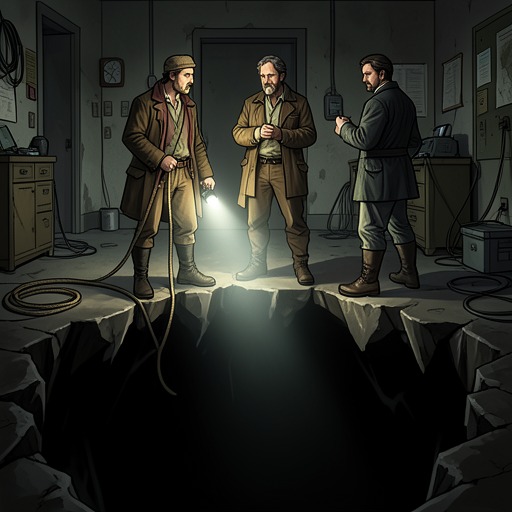
Reston later enters the house with Navidson and the others. During one ascent, Navidson draws in slack rope and steadily lifts Reston through the bore of a stairway. Halfway up, the rope begins to behave impossibly: excess rope lying at Navidson’s feet vanishes, while the section in his hands slides rapidly across his palms, burning a gash into them. Navidson is forced to release it, yet Reston does not fall. Instead, his ascent accelerates, marked by the green flare he continues to hold.
The event overturns the ordinary relationship between rope, weight, and support. Reston rises even after Navidson ceases to provide the expected force, leaving the source of the upward pull unexplained. The later interview records that the pulley at the top was torn from the banister. Tom nevertheless managed to seize both Reston and the rope before the entire apparatus plunged back down the shaft. Reston recalls that he and Tom needed several minutes to recover their bearings and still did not understand what had happened.
Reston’s green flare makes the scene conspicuous against the darkness. Its glow is practical, signaling his position and accompanying his movement, but it also becomes an image of fragile human control: a small, hand-held light rises through a structure whose dimensions and forces no longer obey the rules that made the equipment useful.
Survival, Testimony, and Aftermath
Reston survives the ascent, but the larger expedition produces devastating consequences. After Kirby “Wax” Hook is loaded into an ambulance, police investigate the death of Jed Leeder. Reston gives them a copy of the Hi 8 tape showing Holloway Roberts shooting Wax and Jed. To the police, the murder appears to have occurred in an ordinary dark hallway, a description that radically understates the ash-walled maze known to the expedition members.
Reston also participates in the account of the search for Navidson. In the interview, he responds with a soft laugh and a shake of the head when recalling the effort to deal with the house, suggesting both exhaustion and disbelief. His testimony does not solve the maze. Instead, it preserves the limits of what the survivors can establish: they can describe equipment failure, falling bodies, altered distances, and missing passages, but they cannot supply a stable cause.
His earlier accident gives this testimony additional force. Reston has already lived through a moment when an apparently ordinary industrial environment suddenly became lethal. The photograph of the falling cable taught him to regard catastrophe as something that can be documented without being mastered. In the Navidson House, that lesson returns in a more radical form, because even documentation and measurement become unstable.
Narrative Role and Significance
Reston occupies a distinctive position between bodily vulnerability and professional competence. His paraplegia is not simply an abstract symbol of damage; it is part of his concrete history, visible through the wheelchair, the photograph, and the practical adaptations that shape his work. At the same time, the narrative repeatedly places his expertise inside environments that resist adaptation through ordinary tools. The wheelchair and the measuring instruments belong to a world of designed surfaces and dependable dimensions, while the house continually withdraws those guarantees.
His character also complicates the opposition between disability and action. Reston is not presented as passively defined by injury. He is a technical authority, a participant in exploration, a witness to violence, and a survivor whose testimony helps establish what happened. Yet the house’s impossible pull makes even a competent team dependent on one another: Navidson must handle the rope, Tom must catch Reston, and the equipment that should provide security becomes part of the danger.
For that reason, Reston serves as one of the account’s strongest reality checks. His humor, bluntness, engineering judgment, and history of surviving an electrical accident anchor the narrative in recognizable material life. When the house defeats his instruments and violates the expected behavior of rope, distance, and gravity, the resulting impossibility is more persuasive precisely because it has been confronted by someone prepared to distrust appearances and verify them.