Daisy Navidson
House of LeavesDaisy Navidson is the five-year-old daughter of Will Navidson and Karen Green and the younger sister of Chad Navidson. She first appears as an observant child adjusting to a radically different home and landscape, but her place in the story changes as the house becomes dangerous. Through Daisy, the family’s experiment in reconciliation is measured against the needs of children who cannot control either their parents’ decisions or the space surrounding them.
Identity and Introduction
Daisy is introduced during Will Navidson’s filmed account of the family’s move to Virginia. In carefully composed images, she and Chad are shown in sunlight against the lawn and trees, a visual counterpoint to the house’s later darkness. Daisy approves of the new home and says, “It’ s nice here,” while shyly noting the absence of stores such as “Bloomydales.” The remark gives her an immediate, concrete personality: she evaluates the pastoral setting through the practical expectations of a child recently relocated from the city.
Her response also establishes the fragile optimism of the move. The family is unpacking crates, arranging furniture, laying pale blue oriental rugs, replacing light bulbs, and hanging pictures, including one of Navidson’s prizewinning photographs. Daisy belongs to this process of making rooms inhabitable, in which each family member contributes a personal texture to the house. Her approval therefore registers not merely as childish enthusiasm but as an early sign that the new home might become a shared domestic world.
Family Context and Domestic Tension
Daisy’s childhood unfolds within a reconciliation project that is more troubled than the pastoral footage initially admits. After nearly eleven years of professional departures and brief returns, Will Navidson and Karen Green have reached an impasse: Karen has demanded that he abandon his habits of constant travel or risk losing his family, while Navidson, unable to make that choice directly, turns reconciliation into the subject of a documentary. Daisy and Chad are consequently not outside the adult conflict; their homecoming is the visible surface of a strained family arrangement.
Karen’s fear of the house is explicitly connected to her love for Will and to her wish to preserve the children’s future. She insists that if Will enters the dangerous space, she will go too, because that is their agreement, but she also points to Chad and Daisy as the people who would be destroyed by losing him. Her desire is to grow old with Will, and her concern for Daisy helps convert the exploration from a private test of courage into a threat to the family’s continuity.
The parents’ renewed domestic closeness does not resolve the imbalance. Will gives up assignments abroad and spends more time at home, but he quickly takes refuge in the documentary; Karen experiences his work as still occupying the house. He plays with the children and fills the rooms with his energy and authority, while Karen is described as unable to define a space of her own and in need of help. Daisy is thus situated inside a household where physical return has not yet produced emotional security.
Crisis in the House
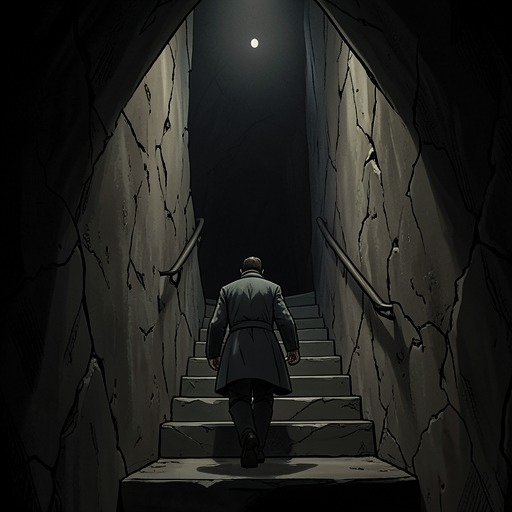
Daisy’s most consequential appearance comes during the panic surrounding the family’s evacuation. As the house heaves around its occupants, she becomes trapped upstairs in the shadows and screams in terror. The crisis separates her from the adults who are trying to understand or escape the structure, making her fear immediate rather than analytical. Unlike the documentary’s explorations, her experience has no investigative purpose: she is simply a child caught inside an environment that has ceased to behave like a home.
Tom Navidson becomes the person who reaches her. He has managed to move through the distorted house toward the cries of the five-year-old, while Chad has already slipped outside, preferring the solitude of early morning to the packing and panic indoors. Tom finally finds Daisy frozen in the shadows, lifts her without a word, and races back to the first floor by taking the rear route rather than the dangerous drop into the living room. Daisy has stopped screaming because of Tom, and his rescue gives their relationship a decisive emotional function: the estranged brother becomes, in the moment of greatest danger, the child’s protector.
The rescue also clarifies the difference between Daisy and Chad during the same emergency. Chad sees what has happened but cannot describe it, while Daisy’s terror is expressed through screams until Tom reaches her. Both children are rendered as witnesses without the language to explain the house, but Daisy’s dependence on being carried out makes the physical vulnerability of the family unmistakable.
Trauma and the Meaning of the Home
Chad’s school drawing provides an indirect image of the children’s changing relation to the house. A week before Will’s rescue attempt, he submits a picture with no chimney, windows, or door: a black square covering ninety percent of the page, built up through layers of crayon and pencil so that the paper beneath disappears. In the margins he adds marauding creatures. Daisy is not identified as the artist, but the drawing belongs to the same family environment in which she is trying to live, and it shows how the house’s threat has entered the children’s symbolic world.
At first Daisy can describe the home through missing shops and the pleasures of a new setting. Later, the household must be evacuated, and her screams become part of the evidence that the domestic space has turned against its inhabitants. The contrast is central to her narrative role: the child who once approves the house becomes one of the people whom the adults must save from it.
Daisy’s presence also exposes the limits of Will’s documentary ambition. He attempts to transform marital reconciliation, fear, and family life into recorded material, yet Daisy’s crisis cannot be made safe by being filmed. Her terror and Tom’s wordless intervention return the story to bodily care, showing that the family’s most urgent obligation is not to interpret the house but to get its children out of danger.
Narrative Role and Ending
Daisy functions as a measure of the household’s moral stakes. Will’s curiosity, Karen’s fear, and the brothers’ unresolved history all acquire greater weight because Daisy and Chad depend on the adults’ choices. She does not lead an exploration or provide an explanation of the house; instead, her small comments, frightened cries, and rescue make the consequences of exploration legible at the level of family life.
Her relationship with Tom is especially important because it briefly repairs a broken family line. Tom is Will’s fraternal twin, and the brothers have barely spoken for more than eight years amid resentment, perceived abandonment, and rivalry. Yet Tom’s decisive act is directed toward Daisy, not toward proving himself to Will. Carrying her through the house turns his return into an act of protection and gives the family’s damaged brotherhood a concrete, child-centered expression.
Daisy’s final significance lies in the contrast between her ordinary childhood and the adults’ extraordinary narrative machinery. She begins as a five-year-old who wants a pleasant home and notices the absence of familiar stores; she is later immobilized in darkness while the house generates panic around her. The record never grants her control over these events, but it makes her vulnerability impossible to ignore. Through Daisy Navidson, the house’s transformation from refuge into threat is registered not as an abstract architectural impossibility but as a direct assault on the conditions a child needs in order to feel at home.