Darkness and Light
House of LeavesDarkness and Light is a central conceptual opposition in House of Leaves, organizing the book’s thinking about vision, photography, memory, intimacy, and the limits of knowledge. Light appears as illumination, evidence, and emotional connection; darkness appears as concealment, threat, and the material environment of the house. Yet the opposition never settles into a simple conflict between good sight and bad blindness. Zampanò writes obsessively about visual perception while having been blind for decades, Karen Green makes a film of familial light that answers the house’s emptiness, and Will Navidson discovers that even the smallest surviving glimmer may reveal less than it promises.
Vision, Blindness, and Irony
Zampanò’s writing returns constantly to seeing: what can be seen, how seeing is organized, and what remains inaccessible. His vocabulary repeatedly circles light, space, shape, line, color, focus, tone, contrast, movement, rhythm, perspective, and composition. This preoccupation is structurally appropriate because his subject is The Navidson Record, a documentary made by a Pulitzer Prize-winning photojournalist attempting to capture the most difficult subject of all: darkness itself.
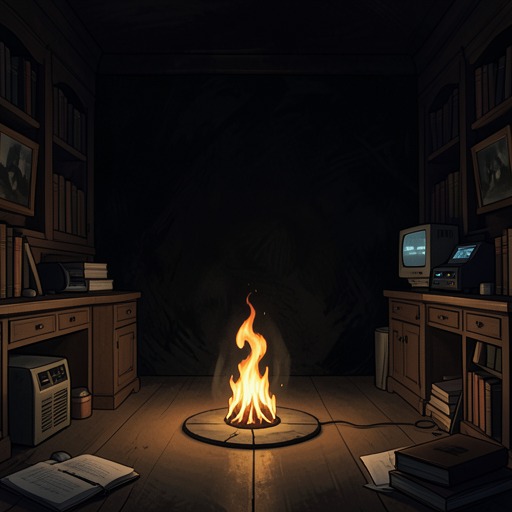
The irony becomes decisive when Zampanò’s living conditions are considered. His apartment contains unused candles, no clocks, few light bulbs, and pale books; nearly half of his books are in Braille. Although readers from community centers, the Braille Institute, and USC, UCLA, or Santa Monica College visited to read to him, none of the people consulted claimed to know him well. The man who wrote about the mechanics of sight had not seen anything since the mid-1950s. His blindness therefore does not simply oppose his visual criticism. It makes the criticism stranger and more dependent on language, testimony, memory, and the descriptions supplied by others.
Entering the Dark
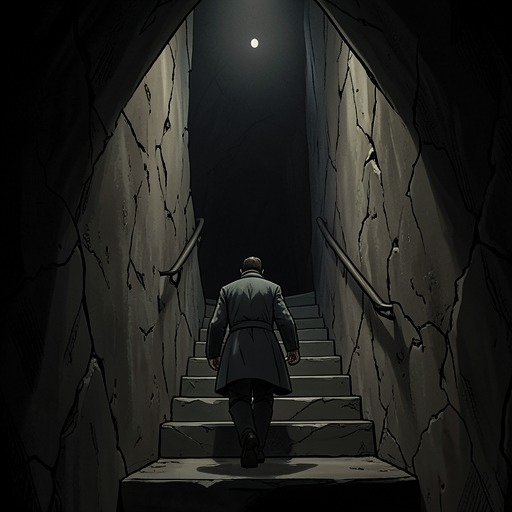
When Navidson first steps through the immense arch, he moves away from the warm light of the living room into a space compared to the demanding faith of deep-sea exploration. His flashlight beam scratches at an unchanging blackness, offering an instrument of sight that cannot convert darkness into a stable landscape. His attention fixes on the floor, and the floor loses its ordinary transparency: it may conceal a fissure or open into an immeasurable depth. Silence then replaces the sound that briefly disturbed it, leaving Navidson uncertain whether he truly heard something growl.
The scene changes the function of light. The flashlight is not a guarantee of knowledge but a fragile gesture against an environment that refuses to become fully visible. Looking downward does not increase security; it makes the ground itself questionable. Darkness thus acts as a force that reorganizes perception, turning familiar spatial assumptions into hazards and making the act of seeing inseparable from fear.
Karen Green’s Counter-Film
Karen Green’s film, A Brief History Of Who I Love, develops a deliberate counter-form to the darkness of the house. The labor of constructing it—more than a hundred edits—allows Karen to see Navidson apart from her own fears and projections. Through his photographs and expressions, she recognizes his tenderness toward her and their children, as well as his continuing faith in the human will to persevere. The film’s visual work becomes an act of interpretation: Karen does not merely display Navidson’s images but discovers what his guarded photographic obsession has meant.
Her editing also makes private memory collide with public history. Family portraits give way to images of tank drivers in Cambodia, peasants carrying empty canisters of nerve gas, children near body bags, crowds in Thailand, a murdered man in Israel, and the dead in Angola. Navidson’s thousands of photographs contain no frame without a person; he does not photograph scenery, because the world matters to him through the people who inhabit it. Karen’s film therefore turns light toward human persistence while retaining the violence that persistence must confront.
The film’s final contrast is formal as well as emotional. It contains only 8,160 frames, set against the house’s apparently infinite hallways, rooms, and stairs. The house is empty and dark; Karen’s film is full and glowing. The growl that haunts Ash Tree Lane is answered by Charlie Parker. Against coldness and vacancy, the film offers light, love, and colour. By following her heart through this work, Karen understands what the house is not and begins preparing for reconciliation: she stops seeing Fowler, ends questionable liaisons with other suitors, and resists her mother’s proposed breakup, sale of the house, and settlements.
The Photograph and the Ethics of Seeing
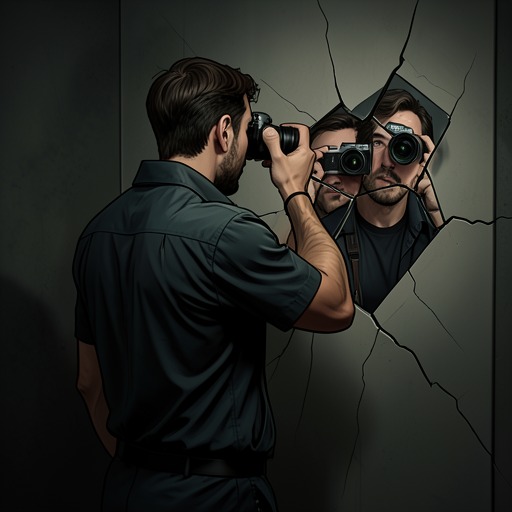
The opposition between darkness and light is complicated by Navidson’s famous photograph of Delial. Karen holds the image on screen for twenty seconds and then shows its back for ten more seconds, where the name “Delial” appears. The photograph shows a Sudanese child dying of starvation while a vulture waits behind her. Its ethical force lies not only in its subject but in the arrangement of the frame. The vulture sits at the left, slightly out of focus, while Delial occupies the center in sharp focus; the entire right side remains physically empty.
That empty space is not experienced as empty. It represents Navidson’s absent body and continuing influence, placing him on the right side of the image even though he does not appear there. The composition makes the viewer more than a detached spectator: the balance of objects draws the beholder into the scene and produces an immediate bodily disturbance. The image records suffering, but it also implicates the photographer and the viewer in the act of looking. Light makes the scene visible without making the suffering reducible, solvable, or ethically harmless.
This pattern persists throughout Navidson’s work. He is drawn to people caught in terrible circumstances and thereby places himself in conflict with death, yet he never photographs scenery and never confronts the threat of death without placing another person between himself and it. Returning to Ash Tree Lane removes that intermediary. The house contains no population and no participant whose existence can stand between Navidson and the danger. He must photograph something unlike anything he has previously encountered: a place that threatens no one else’s existence but his own. Darkness becomes the condition in which his established ethics of witnessing can no longer operate normally.
The Last Lights
Near the end of Navidson’s passage through the void, ordinary sources of illumination fail one by one. His watch has stopped, his flashlights are expiring, and the hand-powered pumper flashlight was lost with the bike and trailer. He uses three flares for warmth and retinal activity, though the intervals between them may last hours or days. With the Hi 8 batteries depleted, only the microcassette recorder and the 16mm Bolex remain: one preserves thought in sound, the other captures the sputtering remnants of light.
The three flares behave differently. The first drops straight down and illuminates nothing beyond itself before disappearing without reaching a bottom. The second floats, becoming briefly useful as a lamp by which Navidson reads several pages of the book he brought with him. The third rises directly upward and vanishes into the black above. Their different trajectories make the darkness spatially unknowable, while Navidson’s decision to keep filming after each flare disappears gives the departure of light an emotional duration. The camera lingers over loss rather than treating darkness as a mere interruption.
Navidson grows increasingly disoriented, suffering nausea and losing any reliable sense of whether he is floating, falling, or rising, or whether he is upright, inverted, or lying on his side. Eventually the questions cease to matter to him. With only a little water, a sleeping bag, and House of Leaves, he turns to the last possible activity: reading while vision and orientation collapse together.
At the final moment, Navidson croaks, “Light,” and then reports that he can see it. The film captures a tiny blue fleck in the upper right corner, bright enough to be visible but not bright enough to see by. The film runs out. This ending does not convert darkness into a solved mystery. Instead, the last light preserves the possibility of perception at the exact point where perception can no longer provide practical control. Light survives as a fragile event, a trace, and perhaps a promise, but darkness remains the larger space surrounding it.