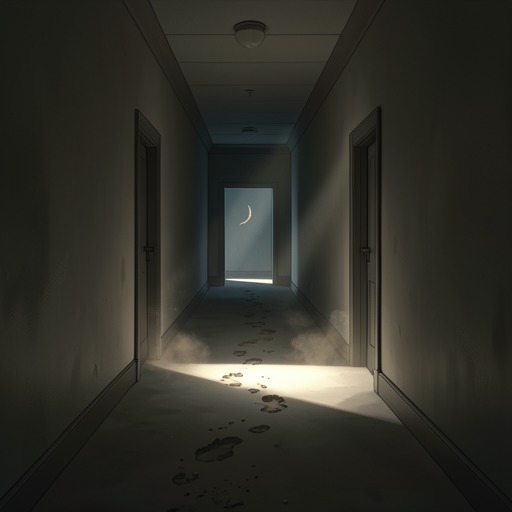
Derealization and depersonalization
House of LeavesDerealization and depersonalization name a paired disturbance in which the world feels unreal and the self feels detached from itself. The book treats the condition both as a medical description and as a crisis of narration: perception loses its authority, memory becomes doubtful, and the distinction between an experience and the account that records it begins to fail. The state therefore links Karen Green’s fear of enclosed spaces, Johnny Truant’s psychic deterioration, and Pelafina Heather Lièvre’s institutional history without reducing any of them to a single explanation.
Clinical Description and Karen Green
The clearest formal account concerns Karen Green, identified in a study as Subject #0027-00-8785. Her panic attacks occurred when she confronted dark, enclosed, usually windowless and unfamiliar spaces. Alongside accelerated heart rate, sweating, trembling, suffocation, choking, chest pain, dizziness, and fear of dying, the attacks included derealization, described as feelings of unreality, followed by depersonalization, described as detachment from oneself. The report diagnosed a situational specific phobia and recorded that behavioral-cognitive techniques had failed to alter her response to anxiety-provoking stimuli.
The study’s treatment history makes the condition a fluctuating bodily and perceptual state rather than a simple aversion. Karen Green first received Tofranil, at 100–200 milligrams per day, without improvement. Propranolol produced vivid nightmares, and Tranylcypromine also failed to satisfy her. Fluoxetine, commonly known as Prozac, improved her tolerance when she was intentionally exposed to enclosed, dark spaces, but moderate weight gain and orgasmic dysfunction led her to leave the study. She subsequently relied on avoidance, staying clear of elevators, basements, unfamiliar closets, and similar spaces, while sometimes returning to Prozac when the attacks became more frequent.
The report leaves the phrase “more frequent” unexplained, and that omission matters. The surrounding commentary proposes that changes in Karen’s life affect her sensitivity to space, while Celine Berezin associates the attacks with early adolescent betrayal and says they increase with intimacy, or even the threat of intimacy, involving Will Navidson or the children. Karen’s derealization thus operates at the intersection of architecture and attachment: the unknown enclosed space is an external form of a threatened interior relation. The Navidson Record’s concentration on the house, while omitting much of Karen’s personal history and the earlier calamities of her life, becomes part of that pattern of concealment.
Johnny Truant’s Bodily Anxiety
Johnny Truant encounters the same vocabulary through his own attacks, but his experience is narrated from inside an unstable first-person record. When he tries to leave his home to visit Tatiana, a former scribe of Zampanò, merely reaching for the door latch produces nausea, chest tightness, and an immediately elevated pulse. He recognizes the irrationality of his anxiety and mocks himself for having nothing particular to fear, yet the recognition does not cancel the terror. Instead, fear turns upon its own reaction: Johnny is frightened not only by an identifiable object but by an overwhelming response for which he can find no object at all.
That contradiction is crucial to the state’s representation. Johnny can observe himself laughing at the absurdity of his fear while simultaneously experiencing himself as absolutely terrified. Reason remains present, but it no longer governs sensation. The attempt to disprove the anxiety intensifies it, creating a split between an interpretive self that calls the reaction irrational and a bodily self that treats it as undeniable. The black trunk associated with Zampanò becomes a concrete measure of that otherwise elusive certainty: Johnny cannot explain the fear, but he can feel its reality in his body.
Later, Johnny reports that his fear has worsened after hearing Bailey describe his screams on the radio. He wakes not merely tired but tired and afraid, suspects that unremembered dreams and words heard only by others are trying to name his horror, and finds the inside of his cheeks mutilated from grinding, gritting, and chewing. Aching teeth, headaches, and stomach trouble extend the disturbance into ordinary bodily life. He consults Dr. Ogelmeyer, receives a prescription and another appointment, then tears up the appointment card and sells his radio and CD player, abandoning objects that have become connected with the management or transmission of his fear.
The Collapse of Authorship and Self
Johnny’s most expansive episode of derealization occurs in his relation to Zampanò’s manuscript. He imagines the pages as a body spread across a table: bloodless and still, yet dependent on him for ink, paper, copying, and animation. At first he understands himself as the source who sustains the work. Increasingly, however, that relation reverses. He feels that the manuscript has created him rather than the other way around, making him the matter of another voice and assigning him histories he should not recognize as his own.
This reversal transforms depersonalization from a clinical symptom into a metaphysical and narratological crisis. Johnny’s sense of self becomes unreal and detached, while the manuscript acquires an agency that competes with his own. His memories and relationships, including Raymond, Thumper, Kyrie, Ashley, the women in his life, the Shop, and his studio, seem liable to be reduced to inventions imposed upon him. He cannot identify the force responsible and suspects that the fabrication may have been made neither by him nor by Zampanò. The question of who speaks is therefore inseparable from the question of who exists: the unstable text does not merely describe Johnny’s disorientation but appears to produce it.
The same logic governs the book’s larger documentary structure. The Navidson Record presents spaces whose size and layout change, while the Infinite Corridor, the Anteroom, the Great Hall, and the Spiral Staircase remain recognizable enough to seem shared by everyone. Some areas never replicate the same pattern twice. Billy Reston’s nausea is consequently treated as a physiological consequence of spatial disorientation, whether that disorientation acts upon the inner ear or upon what is called the inner labyrinth of the psyche. Physical sensation, psychological interpretation, and documentary evidence all become competing explanations for an environment that refuses stable perception.
Memory, Institution, and the Problem of Reality
By October 30, 1998, Johnny’s memory has become fragmentary. He has not slept, cannot distinguish nightmares from waking minutes or hours, and has lost the ability to separate what is real from what is not, what he invented from what has invented him. He returns to a hotel room, locks and barricades the door, and regards the guns as necessary protection. The scene presents derealization as a practical emergency: once reality cannot be sorted, ordinary security measures become inadequate, and fear converts the room into a defended enclosure.
Pelafina Heather Lièvre’s letters provide a parallel institutional version of the same instability. In one phase, she believes the New Director and the attendants are conspiring to detain and empty the patients, and she identifies medication as the mechanism of their control. She describes the pills by their colors and claims that they rob her of memory, function, the ability to flee, and feeling, reducing the recurring mark “1” to a sign of loss of self. She pretends to swallow the medication, retrieves it from her mouth, crushes it, and hides or discards the powder. Her resistance treats the institution’s pharmacological order as an assault on identity, even as the reliability of her account remains uncertain.
A later letter reverses that understanding. Doctors tell Pelafina that Johnny visited several times while she was unresponsive and that the five reams of paper and postage she believed she had sent him were figments of her imagination. She comes to believe that the New Director is actually the Old Director, the same decent and honest patient caretaker who has looked after her for more than ten years. New drugs and biochemical cycles have restored a period of clarity, although the Director warns that her lucidity may not last. The institutional explanation does not erase the earlier account; it places competing realities side by side, leaving the reader to experience the instability rather than resolve it into a single secure version.
Consequences and Narrative Significance
Derealization and depersonalization repeatedly convert perception into an unreliable threshold. Karen Green’s symptoms make intimate threat legible as spatial panic. Johnny Truant’s attacks make the body both witness and antagonist, while his relation to Zampanò’s work makes authorship itself feel like possession. Pelafina’s letters show how diagnosis, medication, surveillance, and memory can be arranged into incompatible accounts of the same life. In each case, the state is not merely an inward feeling; it reorganizes action, relationships, objects, and records.
The condition also binds the book’s psychological and formal architectures. The dark, enclosed room, the barricaded hotel, the manuscript spread across a table, and the institution administering colored pills are different settings for the same threatened boundary between self and world. The final institutional notice states that Pelafina Heather Lièvre died on May 4, 1989, at The Three Attic Whalestoe Institute from self-inflicted asphyxiation using bed linen hung from a closet hook. That bureaucratic confirmation supplies a fixed fact after pages of uncertainty, but it does not restore a stable reality to the surrounding narratives. Instead, derealization and depersonalization remain the book’s governing experience of how reality can be documented, disputed, inhabited, and lost.