Documentary Authenticity
House of LeavesDocumentary Authenticity names the contested belief that documentary images preserve reality rather than manufacture an effect of reality. In House of Leaves, the issue becomes decisive through The Navidson Record, a film whose supposed evidence is continually undermined by missing witnesses, fictitious citations, uncertain edits, and technologically incompatible explanations, yet whose material roughness and economic circumstances repeatedly make fabrication seem impossible. Authenticity therefore functions not as a settled property of the film but as the condition under which viewers argue, doubt, interpret, and fear.
Definition and Cultural Dispute
Documentary Authenticity first appears as the word most likely to provoke debate among both enthusiasts and detractors of The Navidson Record. The central dispute concerns whether the reels and tapes are genuine, but it immediately expands into a larger question: whether, in the age of digital technology, the image has surrendered its formerly unquestioned authority over truth. Skeptics call the project a hoax while conceding that it would be an exceptionally accomplished one; believers may accept the film's validity while attaching that belief to increasingly implausible claims. The result is an epistemological controversy in which neither credulity nor disbelief remains intellectually stable.
The film's status is further complicated by its resistance to classification. It can be treated as a gothic tale, an urban folk myth, or a ghost story, but each category fails to contain its mixture of horror, sadness, technical discussion, contemporary references, and even comedy. The house remains resistant to summary, and the film is similarly difficult to secure as either document or fiction. The debate eventually shifts from proving or disproving the film's existence to interpreting the events represented within it, because the question of what happened becomes more productive than the question of whether the entire artifact is a prank.
Will Navidson nevertheless insists that the documentary should be taken literally. His warning that viewers should keep driving if they ever pass the house, because there is nothing there and they should beware, preserves an apparently straightforward relation between image and fact even as the film's ending encourages many viewers to heed him. The contradiction is characteristic: the strongest assertion of literal truth is delivered inside a work that offers no secure external position from which literal truth can be verified.
The Film as Evidence and Counter-Evidence
The Navidson Record is presented as a film that does not exist outside its own textual and evidentiary apparatus. Johnny Truant reports that searches for it in theaters and video stores lead nowhere, while people identified as authorities deny having heard of Will Navidson or Zampanò. The books cited in the footnotes produce the same mixed result. Some works, including Gavin Young's Shots In The Dark and The Works of Hubert Howe Bancroft, Volume XXVIII, are fictitious; others, such as W. M. Lindsay and H. J. Thomson's Ancient Lore in Medieval Latin Glossaries, can be found in a library. A real rebellion during the 1973 Skylab mission is set beside invented works and an apparently invented story about Quesada and Molino, making verification itself a field of alternating fact and fabrication.
The apparatus also admits error. Truant accepts responsibility for his own mistakes and for failing to notice or correct errors made by Zampanò. The editorial framework is correspondingly unstable: the editors state that Zampanò's footnotes and Truant's footnotes will appear in different typefaces, while also acknowledging that they have never actually met Truant and have handled publication through letters or occasional telephone calls. The work thus presents itself as an archive whose custodianship, transmission, and editorial authority are all partially documented and partially withheld.
The early circulation history of the film intensifies this uncertainty. Nearly seven years before the work reached its later form, The Five and a Half Minute Hallway circulated as a five-and-a-half-minute optical illusion. Its technical achievement was modest, but the accompanying claim that the events were true transformed a simple visual trick into a documentary problem. The film was never officially distributed through festivals or commercial channels; VHS copies passed from hand to hand, each successive dub degrading the image and preserving remarkably little information about the owners or maker. The artifact's unofficial circulation gives it the aura of contraband evidence while simultaneously weakening its chain of custody.
Exploration #4, which surfaced less than a year later, was more intensely sought. Its eight minutes are discontinuous, jarring, and marked by poor, hurried edits, leading viewers to suspect that it represents fragments of a larger work. Holloway Roberts's tape introduces a more specific problem: Part 12 has been accused of being impossible because its framing and lighting suggest a recording device other than Holloway's, although versions released at different times appear to contain different visual evidence. No adequate explanation resolves the anomaly. Authenticity here is not merely challenged by an absent original; it is troubled by variant prints that make the record's own history part of the mystery.
Recording Technology and the Appearance of Truth
The documentary's persuasive power depends heavily on the difference between kinds of equipment. Hollywood films use sets, actors, costly stock, effects, and trade publicity, all of which help audiences retain a protective awareness that the spectacle is entertainment. Documentaries instead appear to rely on interviews, inferior equipment, and minimal effects, removing the safety net of disbelief and forcing audiences to confront the possibility that what they see is an event rather than a constructed scene. Yet no documentary is ever entirely free from suspicion that its setting was designed, its actions staged, or its lines written and rehearsed; even reenactment openly acknowledges this instability.
Digital manipulation makes the problem more severe because it can alter an image in ways that are virtually undetectable. Andy Grundberg predicts that readers will increasingly treat news photographs as illustrations rather than reportage because they will no longer be able to distinguish genuine images from manipulated ones. Vincent Alabiso and the National Press Photographers Association defend accurate representation as the benchmark of photojournalistic ethics, while William J. Mitchell argues that digital imaging may expose the hidden constructions behind photographic objectivity. The same technology therefore produces two opposite effects: it teaches viewers to mistrust images while creating new means to authenticate them.
The Navidson Record exploits this contradiction through the quality of its footage. Will Navidson's personal camera work is notably steady, even under terrifying conditions, with controlled framing and a refined aesthetic sensibility. By contrast, Holloway Roberts's tape is tilted, unfocused, shaky, poorly lit, and finally overwhelmed by danger; Karen Green and Tom Navidson produce recordings that are useful mainly for their content because of their inexperience. Navidson's authority as a photojournalist makes him unusually capable of facing and shaping the impossible subject, but that very composure can be read in two ways: as evidence of professional courage and as evidence of an artist able to manufacture a convincing image.
The film's physical resources seem to argue against an elaborate hoax. Equipment accumulated in the living room includes monitors, decks, a VHS machine, a computer, Zip drives, a color printer, radio transmitters and receivers, electrical and video cables, several cameras, flashlights, flares, rope, fishing line, batteries, tools, compasses, and a broken megaphone. Shelves hold sample jars, graphs, books, and an old microscope. More decisively, the tax statements of Will Navidson, Karen Green, Tom Navidson, and Billy Reston appear to show that they lacked the money required for the effects. Sonny Beauregard estimates that reproducing the special effects would cost at least six and a half million dollars, leaving Navidson roughly five and a half million dollars short after grants, credit, savings, and equity are considered. Financial evidence cannot prove the impossible house, but it narrows the plausible explanations.
Form, Absence, and the Limits of Verification
The documentary's most extreme challenge to authenticity arrives at its climax. Navidson's recording reports that he has no food or water, that his flash is dead, and that he is cold and in pain. Later, he says that the slab beneath him has disappeared and that he is floating, falling, or unable to determine which. The film does not supply a coherent visual synthesis of this fall. Instead it offers a still photograph of a window, hundreds of feet of flares dropping, hovering, or shooting upward, photographs of Navidson reading and burning the book, and scattered audio impressions as he begins to die from exposure.
Nearly six minutes of screen time are black. The blankness becomes simultaneously an absence of evidence and a material event that audiences must endure. Some critics treat the darkness as the end of cinema or as a stunt; others find it a daring achievement. The response of serious sound specialists shifts attention from the unavailable image to the audible trace. Tom Holman cleans the tapes and monitors the transfers, and even when Navidson's words cannot all be understood, his voice seems hauntingly close, tapering without echo. Silence dominates whenever Navidson is not speaking, and even the growl does not disturb that absence. The documentary's claim to truth consequently migrates from visible proof to damaged sound, proximity, and the experience of not knowing.
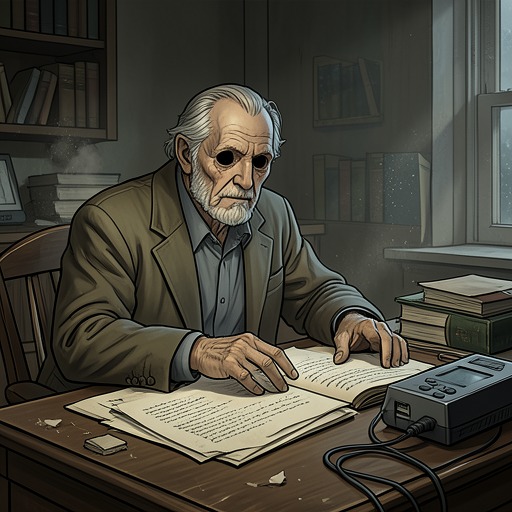
The same logic governs the strange archive surrounding the film. Zampanò's project consists of immense quantities of fragmented writing: pages, napkins, envelope edges, and even a postage stamp carry layered handwriting, typescript, corrections, stains, burns, folds, tape, and passages that alternate between legibility and opacity. The material resembles an archive while refusing to reveal whether it preserves sense, truth, deceit, prophecy, lunacy, or nothing at all. Documentary Authenticity is therefore not only a question about recorded images. It also concerns the authority of the written record that interprets those images and the damaged forms through which that interpretation reaches a reader.
Narrative Significance
Documentary Authenticity makes The Navidson Record a self-questioning object. The book repeatedly comments on its own sources, editorial procedures, citations, missing testimony, and uncertain publication history, exposing the machinery that ordinarily allows a document to pass as transparent. Rather than offering a final verdict, it places contradictory materials beside one another: real and invented books, professional and unstable footage, detailed equipment and inadequate finances, confident testimony and absent witnesses, visual darkness and unusually intimate sound.
The controversy becomes part of the film's cultural life. Hundreds of thousands of people have seen The Navidson Record, yet it remains an enigma. Some insist that it is true, others compare it to Orson Welles's The War of the Worlds broadcast, and still others regard it simply as a compelling story regardless of its factual status. Its likely future is cult recognition rather than mainstream acceptance: storytelling will preserve its popularity, while its strangeness will prevent ordinary cultural assimilation. Authenticity thus proves less a destination than a recurring test imposed on every layer of the work—image, tape, citation, testimony, archive, and reader.