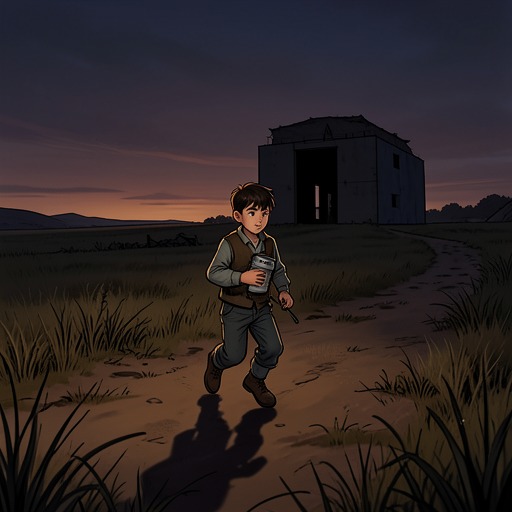
Donnie Truant
House of LeavesDonnie Truant, Johnny Truant’s biological father, is remembered as a dedicated flier and an exceptionally gentle man whose life is reconstructed from incomplete documents and Pelafina Heather Lièvre’s letters. His importance lies less in direct action within the plot than in the contrast he provides to the violence, institutional control, and emotional instability surrounding Johnny’s childhood: Donnie’s defining qualities are calmness, tenderness, and a devotion to flight, yet his family story ends in separation and an early death.
Identity and Background
Donnie Truant’s identity is partly obscured by the fragmented record surrounding Johnny’s past. An obituary reports that a local pilot, whose name has been partially withheld, died when the Mack truck he was driving swerved into a ditch after the driver fell asleep at the wheel. The notice identifies him as a lifelong flier and quotes a friend’s impression that Donnie seemed most at home in the sky. It also records a life spent moving between forms of aviation: after serving in the Air Force, he worked as a crop duster in Nebraska, carried mail in Alaska, flew a spotter plane off the coast of Norway, and eventually became a commercial pilot for American Airlines. On leave, he performed aerial stunts at regional shows.
The obituary’s damaged names and omitted details mirror the unstable documentary conditions through which Donnie reaches the reader. His life is not presented through a continuous biography but through editorial gaps, family correspondence, and Johnny’s retrospective discoveries. The result is a figure who is factually identifiable yet emotionally assembled from remnants.
Temperament and Relation to Flight
Pelafina’s recollections give Donnie a character distinct from the danger associated with aviation. She remembered that preparations for a flight were conducted with the care of a pediatrician and that, once airborne, Donnie treated thousands of miles as quietly as a whisper despite the engine’s roar. She wore earplugs and remained agitated by rattling, wind, and turbulence, while Donnie seemed oblivious to the noise and remained peaceful, especially in the air.
This calmness was not limited to professional competence. Pelafina recalled him as the most peaceful man she had known and described his touch and speech as gentle even on the chaotic day when he had to take her away. His heart was already broken, though neither of them yet understood that fact, but his manner remained as controlled and tender as his way of flying above the clouds. Donnie therefore functions as a figure of steadiness whose composure does not erase suffering; instead, it becomes most visible when suffering is already close.
Family Separation and Johnny’s Childhood
Donnie’s relationship with Pelafina and Johnny is inseparable from institutional separation. A later letter recalls that Donnie stopped Pelafina and took her to the Three Attic Whalestoe Institute when Johnny was seven. She describes it as the last time she saw him before a much later reunion followed by another loss of contact. The event divides Johnny’s childhood into before and after: his mother disappears into institutional care, while the child is left with a memory that is partial, blurred, and difficult to recover.
Another account states that Pelafina’s mental condition had deteriorated severely. She believed life had become an unbearable burden to place upon a child, gathered Johnny into her arms, and attempted to choke him. Donnie intervened almost immediately and had her taken away for Johnny’s safety. Johnny’s recollection is not a clear scene but a silhouette in a doorway, with his father leading his mother away. Donnie’s intervention protects the child, yet it also becomes the mechanism of the family’s rupture. In this history, rescue and abandonment are structurally entangled: Johnny is kept safe, but the person who might have explained the separation is removed from his daily life.
Memory, Letters, and the Locket
Donnie survives in Johnny’s story through objects and mediated recollection rather than sustained presence. When Johnny’s mother dies, the only thing she leaves him is the locket. Its back bears an inscription from Johnny’s father, dated March 5, 1966, and the object contains Johnny’s own carefully folded childhood letter, written when he was eleven. The locket thus joins Donnie’s paternal memory to Pelafina’s maternal archive and to Johnny’s lost childhood. It is not treated as a valuable commodity; its importance is relational and mnemonic.
Pelafina’s letters repeatedly preserve Donnie as a counter-image to other forms of authority in Johnny’s life. She insists that Johnny’s tendency toward fighting does not come from his father or his father’s family, describing Donnie as exceedingly gentle and as someone who never fought or even quarreled with another person. His only conflict, she writes, was with gravity. The phrase turns aviation into a family emblem: Donnie’s struggle is directed toward the physical limit that flight momentarily overcomes, not toward other people.
Narrative Significance and Legacy
Donnie is a largely absent character whose absence organizes Johnny’s emotional inheritance. His career in the sky, his tenderness toward Pelafina, his intervention during Johnny’s childhood crisis, and his eventual death create a pattern of elevation followed by forced descent. Flight represents freedom and composure, while the Institute, the family separation, and the later obituary return the character to institutional and material limits.
His legacy also complicates any simple opposition between a violent son and a peaceful father. Johnny receives from Pelafina the claim that his aggression belongs to her contentious family rather than to Donnie, but the narrative offers no uncomplicated restoration of paternal presence. Donnie’s gentleness is known through another person’s letters, his death through an incomplete obituary, and his emotional significance through the locket Johnny refuses to sell. He remains therefore not a fully recoverable biography but a durable fragment: a father remembered as calm above the clouds, lost within the broken documents of a family that could not remain together.