Evacuation from the Navidson House
House of LeavesEvacuation from the Navidson House is the decisive retreat from a structure that has ceased to function as a home and has begun to behave like an unstable, predatory environment. The evacuation is not a controlled departure but a sequence of emergency rescues in which ordinary domestic objects, rooms, floors, and thresholds become lethal. Its immediate value shift is from the possibility of escape to the recognition that escape itself may require sacrifice: Karen Green reaches apparent safety, Billy Reston is pulled from a collapsing foyer, and Tom Navidson disappears into the house while getting Daisy Navidson out.
Causes and Background
The evacuation follows the discovery that the house cannot be understood through ordinary measurements or orientation. Will Navidson compares the building plans with measurements taken using a 25-foot Stanley Power Lock and finds that the figures do not add up. The exterior distance between the far ends of the master and children’s bedrooms measures 32 feet 9 3/4 inches, consistent with the plans, but the corresponding interior calculation becomes impossible. The discrepancy establishes that the danger is not a hidden room or a carpenter’s mistake but a contradiction between exterior structure and interior space.
That contradiction develops into a labyrinth whose dimensions and arrangement are unstable. The Infinite Corridor, the Anteroom, the Great Hall, and the Spiral Staircase exist for everyone, yet their size and layout can change; other areas do not repeat the same pattern twice. No observer sees the labyrinth in its entirety, so understanding must be produced from within the space rather than from a secure external viewpoint. Even direction fails: Karen Green’s replacement compass refuses to settle inside the house, making the domestic setting resistant not only to measurement but also to navigation.
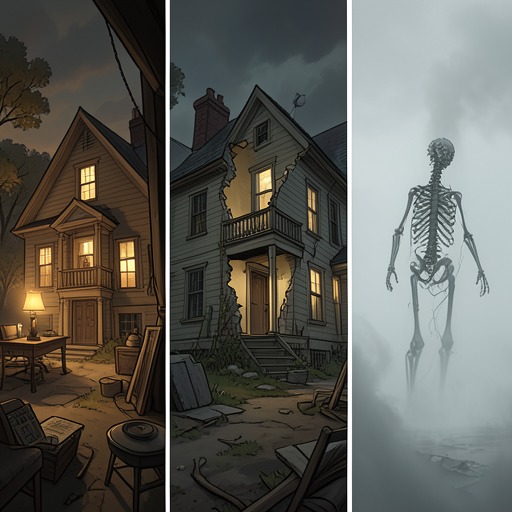
The evacuation becomes unavoidable when the house’s spatial anomaly turns into direct violence. The family’s voices once echo through a hallway that should be impossible given the house’s dimensions, and the house later begins to shudder, crack, fragment, and reassemble. Walls melt back together, floors buckle, the ceiling tears as though by invisible claws, pipes rupture, electrical wires spit and short out, and black ash spreads through rooms and corridors. The earlier distance, darkness, and cold are joined by an active force capable of acting on inhabitants and objects.
The Initial Flight
Karen Green responds first. Unlike Will Navidson, she does not need to watch the relevant tape twice before acting; she immediately begins dragging suitcases and boxes out into the rain, with Billy Reston helping her. Will Navidson does not resist the decision to leave, but he recognizes that departure will take longer than a few minutes because the video and film still have to be packed. He tells Karen Green that she can go to a motel if necessary while he gathers the recorded evidence, preserving his attachment to the documentation even as the house becomes uninhabitable.
The evacuation is interrupted when the upstairs lights go out one by one and Karen Green screams. Will Navidson is outside loading a box of Hi 8 cassettes into the car during a thunderstorm. He is dehydrated, has not eaten for two days, and is moving through severe pain, yet her voice immediately overrides the practical work of removal. He drops what he is carrying and runs back into the house to reach her; some rolls of film are lost to water damage. Because there are no exterior cameras, this part of the action is reconstructed through personal accounts, while the wall-mounted Hi 8 cameras continue recording inside.
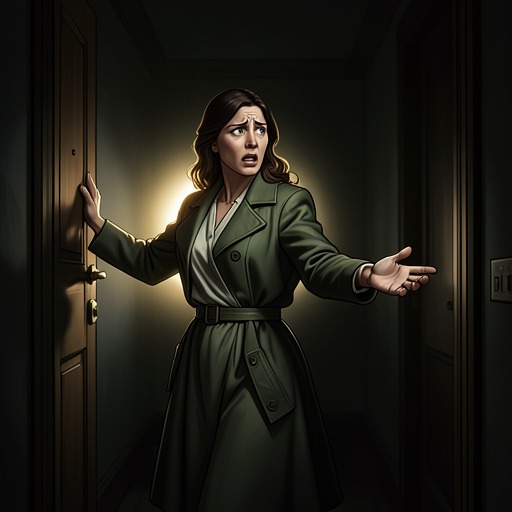
Upstairs, Karen Green is packing hair brushes, perfume, and a jewelry box when the bedroom begins to collapse. The ceiling changes from white to ash-black and falls. The walls close with enough force to splinter the dresser, snap the bed frame, and throw lamps from their nightstands, their bulbs bursting as the light is extinguished. Karen Green escapes into the strange closet space between the parents’ and children’s rooms just before the bed is cut in half. The house has therefore crossed a new threshold: it is no longer merely difficult to enter or impossible to map, but physically acting upon people and domestic possessions.
Rescue from the Collapsing House
The closet does not provide safety. Its space rapidly enlarges, swallowing the light and reducing Daisy Navidson’s cries to a faint sound. Karen Green collapses while the darkness appears to crush her. Will Navidson finds her hyperventilating on the floor and carries her in his arms; according to the account of the rescue, she calms when held. The growl then returns, rolling through the structure like thunder. Will Navidson flees through the bedroom, barely passing before the door frame falls like a guillotine, striking his shoulder and grazing Karen Green’s head hard enough to render her unconscious.
Will Navidson reaches the exterior, but the evacuation immediately turns back into a rescue mission. He reenters the house calling for Chad Navidson and Daisy Navidson and runs down the hall toward the children’s bedroom. The floor suddenly drops away, sending him sliding toward the living room. He avoids falling only by making a desperate grab for the handle of a door. The ordinary threshold becomes a temporary anchor above a void, while the route that should lead toward the children becomes a trap.
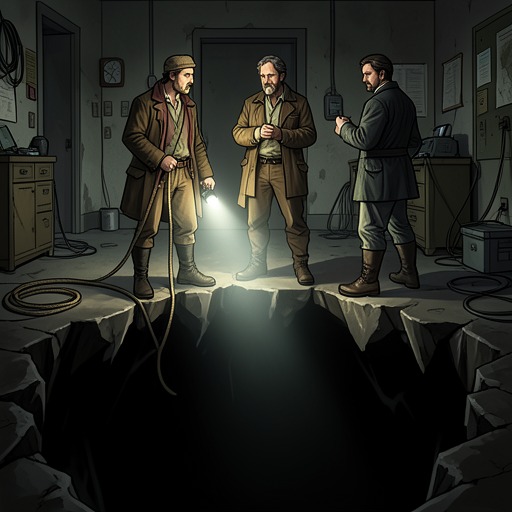
Billy Reston is trapped on the other side of the danger. The pounding that had come from the barricaded hallway stops without warning, leaving a silence more powerful than the preceding noise. When Reston turns to investigate, the china cabinet and bureau begin to sink, followed by his wheelchair. He realizes that the floor beneath the barricade is dropping. The floor descends six or seven feet below the baseboard, exposing not concrete or a foundation but blackness. His damaged hands cannot maintain their grip indefinitely, and his impaired wheelchair prevents an ordinary exit.
Will Navidson reaches Reston by swinging the door on which he is hanging back and forth until he can scramble within roughly three feet of him. He then jumps. The recorded image makes the movement seem almost instantaneous, but both men experience it as prolonged: Will Navidson is suspended above the steep drop, his shoulder already injured, while the hinges begin to tear loose. He reaches Reston and drags him to safety just as the door breaks free and tumbles into the abyss. The brief action therefore acquires the duration of an ordeal, illustrating how the house transforms seconds into an expanded experience of mortal risk.
Tom Navidson’s Last Rescue
After Will Navidson gets Karen Green outside, the rain overwhelms the street. Billy Reston sits soaked on the grass and refuses shelter, Karen Green remains unconscious in the car, and Daisy Navidson and Chad Navidson are still missing. Tom Navidson is missing as well. The evacuation has not produced a stable refuge; it has merely moved some survivors beyond the immediate threshold while leaving the children and another adult inside the collapsing structure.
Tom Navidson reaches the kitchen with Daisy Navidson in his arms. He throws a stool through the window and tells Daisy that getting through it will make her free, but the floor assumes the motion of a conveyor belt and begins carrying them away from the opening. Tom Navidson runs while cradling Daisy, trying to outrun the void opening behind them. Will Navidson appears at the window, and Tom pushes forward until he can extend Daisy toward him. Although broken glass cuts long bloody lines into Will Navidson’s forearms, he immediately tears Daisy out of the house and into safety.
Tom Navidson cannot continue. Out of breath, he falls to his knees and clutches his sides while the floor carries him backward another ten or fifteen feet before stopping. The walls and ceiling continue to stretch, bend, and tilt around him. When the linoleum dissolves, the kitchen becomes a vertical shaft. Tom Navidson falls into the blackness without a scream, while Will Navidson’s scream follows uselessly after him. An unexpected gasp later returns an audible trace of Tom’s end, heard by Billy Reston and perhaps by Karen Green, while Chad Navidson listens from among the trees and watches his father and sister sob.
Consequences and Aftermath
The immediate aftermath is defined by absence rather than closure. Karen Green is alive but unconscious; Billy Reston has escaped the sinking floor but remains soaked and injured; Daisy Navidson is rescued; Chad Navidson survives outside; Tom Navidson is gone. The family’s flight therefore succeeds only in fragments. Evacuation protects some bodies while confirming that the house can separate, injure, and erase members of the household faster than any coordinated plan can respond.
The event also changes the meaning of the house. Earlier anomalies could be treated as problems of bad mathematics, failed instruments, altered perspective, or incomplete representation. During the evacuation, however, architecture itself becomes an agent in the sequence of events. Floors withdraw, rooms enlarge, walls contract, objects sink, and a doorway becomes both lifeline and falling debris. Human decisions still matter—Karen Green packs, Will Navidson returns, Billy Reston investigates, and Tom Navidson carries Daisy—but those decisions operate inside a material system whose shifting behavior determines the available choices.
The narrative presentation intensifies this instability. Exterior action cannot be shown directly because no cameras cover the outside; interviews and retrospective testimony supply the missing moments, while interior Hi 8 footage records the house’s transformations. The event is therefore both an escape and a crisis of witnessing. The film offers images of collapse but depends on memory and testimony for the most intimate bodily experiences, making the evacuation’s decisive seconds simultaneously documented, reconstructed, and partly inaccessible.
Finally, the evacuation does not end the house’s threat. When Karen Green later returns, the bookshelves are flush with the walls and the closet space has disappeared. The north-wall door opens onto a closet barely a foot and a half deep, filled with white walls, molding, and daylight rather than an infernal corridor. The apparent restoration does not console her. Having entered the familiar horror in order to find Will Navidson, she discovers that the terror has vanished when she most needs it to provide a path toward him. The house’s return to normality thus becomes another reversal: safety removes not only danger but also the hope that danger might lead to the missing person.