Exploration 5
House of LeavesExploration #5 is the final and most devastating expedition into the house on Ash Tree Lane. Undertaken by Will Navidson on the first day of April, it transforms exploration from a controlled documentary project into a one-man passage through corridors that continually defeat measurement, equipment, memory, and the expectation of return. Navidson enters with enough provisions and recording technology to sustain a two-week campaign, yet the expedition steadily strips those supports away until only a microcassette recorder, a few images, a book, and his failing body remain. Its decisive significance lies in the reversal of documentary mastery: the man who can frame even the impossible with extraordinary steadiness is finally left inside footage that offers almost six minutes of blackness and a voice disappearing into exposure and darkness.
Causes and Preparation
On the first day of April, Navidson sets out on what the film identifies simply as Exploration #5, the last exploration of the strange hallways and rooms. Unlike an impulsive venture, the expedition is organized as a technical operation. He carries a 1962 H16 hand-crank Bolex 16mm camera, 16mm, 25mm, and 75mm Kern-Paillard lenses, a Bogen tripod, a Sony microcassette recorder, a Panasonic Hi 8, ample batteries, at least a dozen 120-minute Metal Evaporated tapes, a 35mm Nikon, flashes, and a USA Bobby Lee camera strap. His film stock includes 3,000 feet of 7298 16mm Kodak in one-hundred-foot loads, twenty rolls of 35mm film, including Konica 3200-speed stock, and ten rolls of assorted black-and-white film. The thermal video camera he had arranged to rent is unavailable at the last moment, an early sign that the expedition will not possess every instrument its planner intended to deploy.
His survival equipment is equally deliberate. Navidson takes a rated sleeping bag, a one-man tent, two weeks of rations, two five-gallon containers of water, chemical heat packs, flares, high- and regular-intensity lightsticks, neon markers, fishing line, three flashlights, a small pumper light, spare batteries, a carbide lamp, matches, a toothbrush, a stove, a change of clothes, an extra sweater, extra socks, toilet paper, a small medical kit, and one book. He loads these supplies into a two-wheel trailer secured to an aluminum-frame mountain bike. The inventory makes the expedition resemble both a scientific survey and a military deployment, while the bicycle and trailer establish the practical scale of the burden he expects to move through the interior. The later destruction and disappearance of this equipment therefore mark not incidental inconvenience but the systematic collapse of the expedition’s material safeguards.
Entry and Descent
When Navidson first starts down the hallway, he does not head toward the Spiral Staircase. He chooses the corridors instead, pursuing horizontal passage through a space whose dimensions and orientation refuse ordinary architectural expectations. The route soon becomes a descent in every sense. After traveling downhill for eight hours at nearly twenty miles per hour, he calculates that merely returning to his starting point may require six or seven days, perhaps more. By the time he makes camp in a small room, he already understands that the trip is effectively over. The calculation is both practical and existential: the house has converted forward motion into separation, and distance into a condition from which retreat may no longer be possible.
The downhill run ends at a brink. Navidson attempts to brake, but the rubber pads cannot hold the wheels. He hears the brakes shriek and continues toward the pale light that may indicate an end. He finally yanks the bicycle to the ground; his left thigh is badly torn and still bleeding, while the trailer is completely wrecked. He slides to the edge with his legs hanging over it and senses what he describes as a terrible emptiness reaching upward. The scene gives physical form to the expedition’s central reversal: the vehicle intended to carry him safely through the labyrinth becomes wreckage, and the equipment meant to document the journey becomes part of the debris left behind.
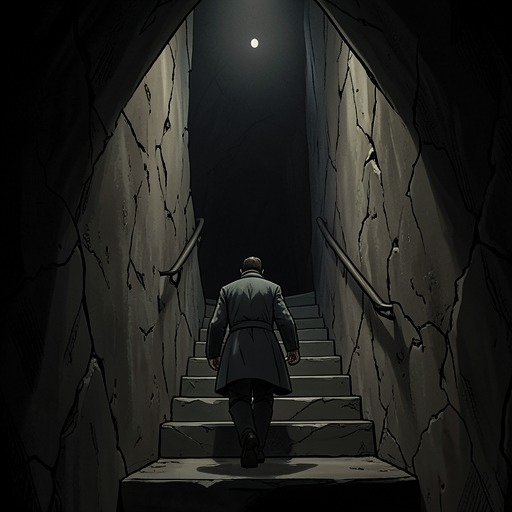
At the brink stands a structure reminiscent of a bartizan, no more than seven feet high and containing a single door. Inside, Navidson finds a winding staircase lying on its side and penetrating through the wall toward the abyss rather than leading conventionally upward or downward. Still badly shaken, he does not investigate immediately. He spends the night, or whatever interval can still be called a night, inside the unexpected shelter, while the Hi 8 timestamp ceases to function. Time has begun to lose its documentary authority. The shelter offers temporary enclosure without restoring safety; even a house-like structure at the edge of emptiness cannot guarantee a stable inside.
Equipment Failure and Isolation
Once Navidson begins up the new staircase, the floor below vanishes with the bicycle, trailer, and everything else left behind, including water, food, flares, and lenses. He runs upward to escape the opening, but the winding stairs have no landings and no exits. After an unknowable number of hours, he reaches a small circular chamber with no doorway or passage, only black rungs jutting from the wall and leading into a narrower vertical shaft. The expedition’s route has become a sequence of architectural traps: each apparent continuation removes the ground behind him and replaces navigable space with a more constricted passage.
The loss of the equipment also changes the kind of record the expedition can produce. The batteries for the Hi 8 eventually die, leaving Navidson with the microcassette recorder for his thoughts and the 16mm Bolex for the remaining fragments of light. His flashlights expire one by one, and the hand-powered pumper flashlight has already disappeared with the bicycle and trailer. He uses the three flares not to mark a route or summon assistance but to obtain brief warmth and visual stimulation. His watch stopped functioning long before this point, and he no longer cares about the meaning of a minute or even a week. The failure of clocks, cameras, lights, and supplies does not merely impair the expedition; it dismantles the systems by which an expedition can be known, timed, retraced, and brought home.
The flares produce three different relations to the surrounding void. The first drops straight down, illuminating nothing but itself and never reaching a bottom. The second floats rather than falls, and Navidson eventually treats it like a lamp while reading a few pages of the book he brought. The third shoots directly upward and vanishes into the black above. Falling, suspension, and ascent no longer behave as dependable physical categories. The corridor’s darkness is therefore not simply an absence of light; it reorganizes the behavior of objects and makes even gravity appear provisional. What remains visible is not a stable world but isolated events of illumination without a recoverable whole.
The Final Record
At the end of the expedition, Navidson has one page and one match. He delays using this final illumination while waiting in darkness and cold, but eventually grips the match, finds the friction strip, and sparks it. He reads several lines by the matchlight, then applies the flame to the page as the heat reaches his fingertips. The page becomes fuel for its own final act of interpretation. As the fire consumes it, his eyes move down the text ahead of the flames; fire reaches his hands, ash peels away into the surrounding emptiness, and the book disappears without leaving anything behind except invisible traces already dismantled in the dark.
The act is simultaneously reading, destruction, and survival. The book supplies the last available light, but preserving its contents is impossible because illumination requires consumption. Navidson’s documentary impulse thus contracts to an intimate contest between text and flame: he continues to read while the medium that carries the words is being destroyed. The scene gives material form to the expedition’s larger logic, in which every instrument of orientation eventually becomes unavailable, altered, or consumed.
Navidson’s recorded condition then becomes explicit. He reports having no food or water, no working flash, and severe cold and foot pain. He says that he has no sense of anything other than himself, while the narration states that he is forgetting and dying. His physical deprivation and his narrowing consciousness advance together. The expedition no longer yields information about the architecture; it records the erosion of the person attempting to observe it.
The final images refuse to provide a coherent visual account of his fall. The film contains a still photograph of a window, several hundred feet of flares dropping, hovering, and shooting into the void, and photographs of Navidson reading and burning the book. The remainder is a jumble of audio clips capturing his impressions as he begins to die from exposure. Nearly six minutes of screen time are black. The documentary’s climax is therefore not a completed image of catastrophe but a formal failure that becomes the catastrophe’s most powerful evidence: the medium can preserve fragments, sounds, and traces, but not a stable scene in which the event can be mastered.
Near the end, Navidson croaks a reference to light and says that he sees it, before the film runs out. It ends in black. The stopping of the film does not resolve the expedition through an explained discovery or a clearly depicted death; instead, it leaves the record at the threshold where perception, consciousness, and representation fail together.
Rescue and Significance
Exploration #5 is not wholly sealed by Navidson’s disappearance. At the brink, Karen Green stands for several minutes, pointing her flashlight into the darkness and calling for him. When she finally crosses the threshold, she makes no announcement and takes no deep breath; she simply steps forward and vanishes behind the black curtain. A second later, the cold hollow is gone, replaced by the wall as it had been before, except that all the children’s drawings have disappeared. Her entry reverses the earlier paralysis associated with the threshold and converts the expedition’s solitary descent into an act of rescue, though the house offers no explanation for how the transition occurs.
Forty-nine minutes later, a neighbor sees Karen crying on the front lawn with a pink ribbon in her hair and Navidson cradled in her lap. The image supplies the expedition’s only substantial return: the explorer and rescuer are again outside, but the return is marked by tears, injury or exhaustion, and the obliteration of the children’s drawings. The house has not simply been traversed and left unchanged. Its disappearance from the wall and the altered domestic evidence imply a cost that survives the apparent rescue.
The event’s structure resembles a journey toward death that inverts the conventional heroic return. Navidson begins with abundant equipment, a clear recording purpose, and confidence in controlled movement; he ends with a damaged body, exhausted supplies, failing memory, and a record that collapses into blackness. Karen’s later crossing does not restore the lost measurements or make the interior intelligible. Instead, it establishes that survival depends on a movement through the same threshold that had rendered Navidson inaccessible. Exploration #5 consequently functions as both an expedition and an exposure of the limits of exploration itself: the house can be entered, but its space cannot be stabilized into knowledge, and the surviving image of return remains inseparable from absence, loss, and darkness.