Exploration A
House of LeavesExploration A is the first sustained descent into the impossible architecture of The house on Ash Tree Lane, and its decisive significance lies in the change it imposes on both Will Navidson and the documentary that records him. What begins as a curious midnight inspection becomes a confrontation with a space that expands beyond the house’s known dimensions, alters its own entrances and corridors, erases landmarks, and makes return dependent on sound, memory, and improvisation rather than sight.
Causes and Background
Exploration A follows the discovery of a dark, doorless hallway in the west wall of the living room. Chad Navidson and Daisy Navidson had entered the passage while carrying homemade candles, and their voices had returned as impossible echoes: no room in the house was anywhere near long enough to produce the distances implied by the responding calls. Will Navidson ran after the children and brought them back, while Karen Green froze at the threshold, unable to enter the darkness. Her panic, sweat, and desperate embrace of the children reveal for the first time the claustrophobia that will govern her later responses to the house. Although the children wanted to return, the family temporarily agreed to keep the new passage off limits.
Navidson could not leave the anomaly alone. He failed to fall asleep, spent an hour tossing in bed, and then rose to look for his camera. The footage is formally introduced by a title card reading Exploration A, while the camcorder timestamp fixes the beginning of the expedition at exactly 3:19 A.M. His stated rationale is deliberately modest: he presents the trip as impetuous curiosity and insists that a brief look around cannot hurt, even though the argument over the hallway has already become a source of conflict between him and Karen.
Entry and Expansion
Navidson unlocks the door and crosses the threshold carrying only a Hi 8 camera, a MagLite, and his 35mm Nikon. His first commentary describes cold, dark walls resembling the closet space upstairs. The initial hallway appears to be no more than seventy feet long, and Navidson briefly treats it as an unremarkable extension of the domestic interior. The apparent security collapses when he turns and discovers a new doorway on the right that was not present before.
Beyond that doorway lies a corridor he estimates at roughly one hundred feet. Another passage branches left, at least fifteen feet wide and more than ten feet high, but its length cannot be measured because the flashlight dies into the darkness long before reaching an endpoint. Navidson continues anyway, passing unlocked doorways into small, empty, windowless rooms and closet-like alcoves without switches, outlets, or furnishings. The expedition therefore moves through a sequence of spaces that possess the vocabulary of a house while lacking the practical features that make a house habitable.
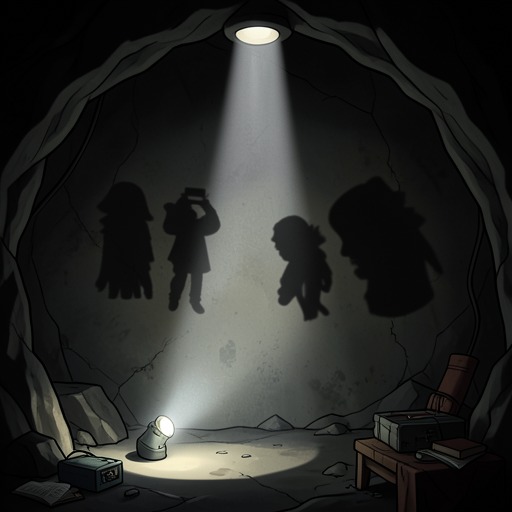
The camera and flashlight travel together across floors and ceilings, entering rooms, corners, and walls whose smooth surfaces offer no readable detail. Perspective promises a concluding point, but the corridor continues to generate further spaces instead of arriving at one. At last Navidson reaches an entrance much larger than the others: a high arch opening into blackness. The flashlight catches the floor but neither walls nor ceiling. Only at this point does the expedition disclose the scale of the house’s hidden interior.
Disorientation and Return
The immense arch functions as a threshold in the strongest physical sense. Navidson’s movement into it resembles deep-sea exploration, with the flashlight beam scratching at invariant blackness while the warm light of the living room recedes behind him. His attention shifts toward the floor, which no longer seems stable or self-evident; it becomes something that might conceal a fissure or open beneath him. When silence replaces the sounds that had briefly disturbed it, he is unsure whether he has heard a growl.
His attempt to turn back produces the expedition’s first full crisis. He can no longer see the arch or the wall and has walked beyond the flashlight’s useful range. Every direction appears equally oily and dark, while his sudden turn has erased his memory of the route behind him. He tests the space with his voice, shouting words that return as strange repetitions. The echoes become an improvised navigational system: one response arrives with less delay than the others, and Navidson chooses that direction, eventually finding a wall.
At the wall he faces another decision, left or right. This time he leaves a penny at his feet as a marker, travels left, and returns when a minute passes without revealing the entrance. He then goes right and finds a smaller doorway of a different shape, but not the original arch. After another minute he stops and tells himself to think. A second growl rolls through the darkness. When he turns back, the penny lies directly before him even though it should be at least a hundred feet away, and the doorway has become the arch he had been seeking. The passage has not merely confused him; it has altered the apparent relationship between distance, location, and identity.
The return route is no safer. Once Navidson steps through the arch, the corridor has become much narrower and ends quickly in a T-junction. A louder growl causes him to panic and run, but he soon recognizes that running is useless and dangerous. He stops, tries to regain control, and calls out. A child’s cry answers him, drawing him through a complicated series of turns, wrong choices, backtracking, and stretches of disturbing silence.
Rescue and Consequences
The voice gradually grows louder until Navidson rounds a corner and finds not an exit but more darkness and greater quiet. Then he moves through a low passageway and reaches a corridor terminating in warm yellow lamplight. A tiny silhouette stands in the doorway, and Daisy’s cry pulls him home. He emerges into the living room, immediately scoops Daisy into his arms, and hugs her. Daisy explains that she had been having a nightmare, a domestic statement that both restores the family scene and leaves the expedition’s reality unresolved.
Exploration A proves that the hidden space changes without visible cracks, fractures, or construction. A simple path can become a labyrinth within moments, while the walls remain perfectly smooth and provide no physical explanation for the transformation. Navidson is therefore the first person to discover not only the house’s magnitude but also its instability. The danger is not confined to getting lost in a large place; the place itself refuses to remain the same place.
The expedition also establishes the contrast between Navidson’s footage and that of the other participants. His camera rarely shakes, jerks, or loses its framing, even under extreme conditions. Holloway Roberts’s tape is described as tilted, unfocused, poorly lit, and finally overwhelmed by danger, while Karen and Tom Navidson’s recordings reflect their inexperience. Navidson’s photojournalist discipline gives him the ability not merely to face the otherness of the hallway but to shape it into images, making the expedition both an act of exploration and an act of aesthetic control.
Narrative and Thematic Significance
As a story event, Exploration A shifts the value at stake from domestic curiosity to survival and from confidence in the house to radical uncertainty. The opening hallway appears measurable, bounded, and temporary; the expedition reveals a space that exceeds fifty-six and a half feet, expands through new doorways, and defeats the simplest act of turning around. Navidson’s initial confidence is not simply disproved by a monster or an isolated attack. It is dissolved by a structure that makes ordinary categories unreliable.
The event also inaugurates a recurring threshold pattern in the book. A door leads away from the living room, an arch leads away from the first corridor, and the return itself becomes another passage through altered space. The house begins to resemble a place from which none who enter can easily return, a pattern later echoed by Navidson’s descent of the Spiral Staircase and by Karen Green’s final decision to cross into darkness. Yet Exploration A differs from those later passages because Navidson returns carrying knowledge, footage, and Daisy: the expedition ends in apparent safety, but the safety is already contaminated by what he has learned.
Most importantly, the expedition turns sound into a provisional substitute for vision. Navidson’s calls, the delayed echoes, the growls, and Daisy’s distant cry form a fragile acoustic map inside a space where sight cannot preserve orientation. The final movement toward warm light reverses the earlier movement into blackness, but it does not restore the house to normality. The living room remains the point of return, while the hallway has become an active, shifting presence whose dimensions and entrances cannot be trusted.