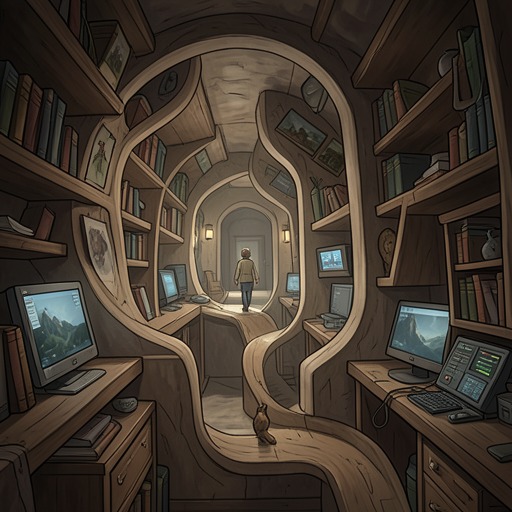
Holloway's First Three Explorations
House of LeavesHolloway's First Three Explorations are the first sustained attempt to measure, map, and dominate the impossible interior of the Navidson House. Across three expeditions, Holloway Roberts, Jed Leeder, and Kirby “Wax” Hook discover that the hallway is not merely an inexplicable extension of a domestic room but a vast, mutable architecture whose dimensions exceed ordinary perception. Their progress enlarges the physical mystery while simultaneously weakening the household's cohesion and displacing Will Navidson from the position of unquestioned leader.
Formation and Equipment
Holloway's team enters the passage after the earlier footage has established its impossible character: a doorway can be circled from outside, yet opening it reveals a cold hallway where no exterior structure exists. The initial expedition is therefore both an investigation and a threshold crossing. Holloway, Jed, and Wax carry Hi 8 cameras, down parkas, hats, Gore-Tex gloves, powerful halogen lamps, spare batteries, and a radio for communication with Will Navidson, Tom Navidson, and Billy Reston. Navidson ties one end of a fishing line to the hallway door and gives the spool to Holloway, warning him not to release it; the line is a practical tether to a house whose geometry cannot be trusted.
The household's improvised command center grows around the expeditions. Navidson installs monitors, video decks, a VHS machine, computers, printers, radio transmitters and receivers, cameras, flashlights, flares, rope, fishing line, tools, compasses, and sample jars in the living room. This accumulation makes the investigations appear methodical, but it also reveals the dependence of the explorers on instruments that repeatedly fail to make the space intelligible. The contrast is sharpest between Navidson's exceptionally steady camera work and Holloway's tilted, shaking, poorly lit footage: Navidson can shape terrifying material into an image, while Holloway's recordings more directly register physical danger and loss of control.
Exploration #1: The First Expansion
The first expedition begins with the team following the fishing line through a sequence of left turns. They reach an apparently endless corridor and then a huge opening into the space where Navidson had nearly been lost. The scale changes abruptly. Their powerful flashlights reveal a ceiling at least two hundred feet above them, and, roughly fifteen hundred feet farther on, an opposing wall. The discovery does not close the mystery; it replaces one impossible hallway with a larger chamber and then presents an even greater entrance leading into another void.
The team stops for two immediate reasons. Holloway runs out of fishing line and briefly considers abandoning the spool. Then he hears the growl that Navidson had already reported. The sound unsettles him enough to turn back. During the return, the walls have shifted, though not as dramatically as they had during Navidson's earlier passage. Because the changes have not severed the line, Holloway, Jed, and Wax can find their way back to the living room. The line thus functions as more than equipment: it is a fragile guarantee that departure remains possible.
Exploration #2: Mapping and Contesting Authority
The second expedition occurs the following day with a more elaborate plan. Holloway brings four spools of fishing line, flares, and neon markers. He largely ignores Navidson's direction, assigns Wax a 35mm camera, and instructs Jed to collect scratchings from the walls. Billy Reston supplies approximately a dozen sample jars. The expedition consequently shifts from simple survival toward systematic classification: the team marks routes, gathers physical traces, records images, and treats the house as an object that can be catalogued.
The attempt at control produces mixed results. The exploration lasts more than eight hours, yet the growl is heard only once, and the subsequent changes are negligible. The first hallway becomes somewhat narrower, the ceiling slightly lower, and some rooms appear larger, but most of the route remains stable. The apparent reduction in change suggests that continued use may deter the growl and preserve the path, although the expedition cannot turn that suggestion into a dependable rule.
While Holloway's team advances, Navidson listens over the radio and nearly loses control of himself. He is angered by what he regards as Holloway's performed authority, and the team's discoveries intensify the conflict. When Jed reports that they have crossed the Anteroom and entered what Holloway begins calling the Great Hall, Navidson finds it increasingly difficult to maintain even the appearance of encouragement. Holloway's exploration has become a struggle over who possesses the right to name and interpret the house.
The Great Hall makes that struggle spatially overwhelming. Holloway reports a ceiling at least five hundred feet high and a span that may approach a mile. At its center stands a staircase more than two hundred feet in diameter, spiraling downward into darkness. Jed later describes dropping flares that never seem to reach a bottom; in the cold, empty stillness, where even a small sound should carry, the darkness simply swallows them. Wax describes the depth as almost dreamlike. The expedition returns with knowledge that is more terrifying than the original anomaly: the house contains vertical distances that defeat ordinary measurement as decisively as its corridors defeat ordinary floor plans.
Exploration #3: Descent into Immensity
The third expedition lasts almost twenty hours. Holloway, Jed, and Wax take forty-five minutes merely to reach the Spiral Staircase, then spend seven hours walking downward. Even after that descent, a dropped flare fails to illuminate or audibly strike a bottom. The staircase has also expanded: its diameter, previously estimated at two hundred feet, now exceeds five hundred feet. The return takes more than eleven hours, turning exploration into an ordeal of endurance rather than a brief act of discovery.
The physical consequences are immediate. All three men return cold, depleted, aching, and stripped of their earlier enthusiasm. Jed admits that vertigo forced him to retreat from the edge and sit down, an unprecedented response for him. Wax claims not to have been afraid, yet he is more exhausted than the others. Holloway remains outwardly stoic and refuses to disclose comparable doubts, but he states that the experience cannot be photographed: no Hi 8 or 35mm camera can adequately capture what they saw.
That judgment exposes the central contradiction of the expeditions. The entire enterprise depends on recording devices, radio transmissions, physical samples, and measured distances, yet the most important discoveries exceed the capacities of those media. A photograph or video image remains two-dimensional; the staircase's depth requires light and spatial cues that the flares cannot provide. The flares themselves are extinguished or absorbed by the darkness they are meant to reveal. The recordings preserve evidence of an encounter without reproducing the encounter's scale, so documentation confirms the event while withholding its full reality.
Consequences and Narrative Significance
The three expeditions change the balance of power inside the Navidson household. Holloway's arrival and repeated descents make him the active authority in the darkness, while Navidson is left listening from the living room, increasingly frustrated by discoveries made under another man's command. The family's domestic space becomes a contested expeditionary site, and the invasions begin to erode the cohesion that had made the house a home.
The expeditions also establish a pattern that governs later events. Each attempt to know the house produces a larger unknown: the hallway opens into a chamber, the chamber into the Great Hall, and the Great Hall into a staircase whose scale continually increases. Each return is technically successful, but every return brings more exhaustion, uncertainty, and evidence that the architecture responds to human presence. The apparent stability of the second exploration gives way to the prolonged descent of the third, and the team's temporary mastery becomes a prelude to more dangerous incursions.
In this sense, Holloway's First Three Explorations are both a scientific sequence and a failed rite of passage. The men cross thresholds, establish routes, gather traces, and return to the household, but they do not convert the darkness into knowledge that can be safely possessed. Their fishing lines, flares, cameras, radios, and samples form a disciplined vocabulary of investigation; the shifting walls, the growl, the swallowed light, and the unphotographable depth answer in a language of negation. The expeditions make the house legible only as a place where measurement, leadership, and representation repeatedly reach their limit.