Hollywood
House of LeavesHollywood is both a physical district and the governing atmosphere of Johnny Truant’s early life: a place of tattoo-shop labor, late-night wandering, crowded bars, sexual performance, and unstable identities. Its significance lies in the contrast between its practiced familiarity and the unease that begins to surface there, turning an apparently ordinary urban environment into the threshold of the larger mystery of The Navidson Record.
Setting and Urban Texture
Hollywood appears as part of Johnny Truant’s movement through Los Angeles, after he has left an apartment whose landlord became convinced that he was Charles de Gaulle and subsequently burned the building down. During the weeks that follow, Johnny couches from Santa Monica to Silverlake before finding a studio in Hollywood and returning to a numbing routine as an apprentice at a tattoo shop. The district therefore enters the narrative as a provisional home rather than a settled one: Johnny reaches it while moving through eviction, temporary lodging, and uncertain work.
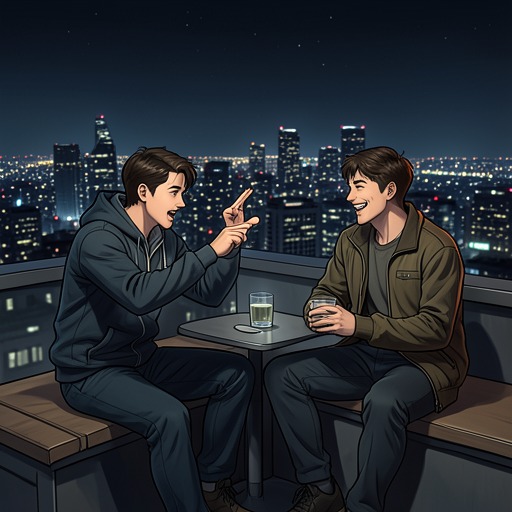
The city is defined less by landmarks than by its nocturnal circulation. Johnny and Lude spend the final hours of 1996 scouting new bars and new faces, driving recklessly through the canyons, and attempting to talk down the midnight heavens with empty talk. Hollywood is presented as a place where night extends social possibility while also revealing its exhaustion. The setting’s cold nights, bars, canyons, and late-hour mobility establish a world in which people remain in motion without necessarily knowing what they are seeking.
Social Knowledge and Nightlife
Lude is exceptionally adapted to Hollywood. He knows every bar, club, and gatekeeper, along with the drinks and addresses that organize the district’s nightlife. He can usually distinguish women who want conversation from those seeking something more immediate, a distinction that interests him. His knowledge is practical and bodily rather than reflective: Hollywood is described as something he knows instinctively, without needing to translate or interpret it.
This fluency contrasts with Johnny’s estrangement. The two men wander throughout the city together, sharing an appreciation for its sad taste and its late hours, yet their ambitions diverge. Lude wants more money, better parties, and prettier women, while Johnny senses a different desire that he cannot clearly name, imagining it as spacious, sunlit, weightless, and expensive. Hollywood consequently becomes a shared environment that does not produce a shared future. It accommodates their friendship while exposing the distance between Lude’s confident participation and Johnny’s unresolved search.
Lude’s position also connects Hollywood to surfaces and professional image. Despite a battered nose, he is regularly surrounded by attractive women, a circumstance associated with his work as a hair stylist and photographer. The district rewards men who can help others remain beautiful, and Lude’s social power derives partly from that economy of appearance. The bars and clubs thus function as informal institutions whose access depends on style, recognition, and the ability to read desire.
Work, Bodies, and Unease
Johnny’s Hollywood workplace is a tattoo shop on Sunset, where he answers phones, schedules consultations, and cleans up. The job is described as simple and low-status, but the shop’s objects become intensely conspicuous when Johnny begins to feel that something is wrong. Rows of tattoo inks range from rootbeer and midnight blue to cochineal, mauve, lilac, south sea green, maize, and pelican black; needles are arranged in numerous configurations, including singles, grouped needles, and a fourteen-round shader.
The precision of this inventory makes the shop a place of controlled surfaces and sharpened instruments. Johnny can identify the materials before he can identify his own need. Although the air is thick with sweat, isopropyl alcohol, cleaning solution, solder, and flux, he knows that these smells do not explain his difficulty breathing. Nothing outward has happened, yet he feels himself going terribly south. Hollywood’s familiar working environment therefore shifts from ordinary employment to a site of bodily alarm, where perception becomes more threatening than any visible event.
The Old Man and the Narrative Threshold
Hollywood also frames the approach to the old man whose death initiates the chain of discovery. Before the decisive evening, Lude tells Johnny about an elderly man living in a first-floor apartment that looks over a wide, overgrown courtyard. The old man has reportedly said that he will die soon. Johnny initially treats the story as one of Lude’s exaggerations, although it remains difficult to forget.
The old man then dies at the end of 1996. From what Johnny later gathers, he was American, though people who worked with him detected an accent without being able to identify its origin. The event is narrated retrospectively from Hollywood, California, and the dated framing places Johnny’s account alongside the title and presentation of The Navidson Record. In this structure, Hollywood is not merely where Johnny happens to live; it is the threshold from which an apparently local death opens onto an unknown document, a dead man’s work, and the disturbances that follow.
Narrative Significance
Hollywood’s narrative function depends on its doubleness. It is legible to Lude, who knows its social codes and routes, but increasingly opaque to Johnny, whose routine is interrupted by anxiety he cannot explain. It offers movement, company, erotic possibility, and professional identity, yet none of these provides stability. Even the city’s pleasures are shadowed by cold nights, reckless driving, exhaustion, and the failure to talk the heavens down.
The setting therefore supplies an urban counterpoint to the strange spaces associated with The Navidson Record. Before the narrative reaches architectural impossibility, it establishes a human environment already marked by displacement, performance, and incomplete knowledge. Hollywood’s bars, tattoo inks, rented rooms, and late-night roads form a recognizable world, but the old man’s death and Johnny’s unexplained physical distress show that recognition is not the same as safety. The district is the place where ordinary life first begins to lose its reliable boundaries.