Home and Homelessness
House of LeavesHome and Homelessness names the book’s deepest contradiction: a home is meant to make life inhabitable, but the house on Ash Tree Lane repeatedly makes inhabitation impossible. It is at once a refuge, a family project, a documentary subject, a labyrinth, and a threat. Its changing rooms expose how fragile the ideas of shelter and belonging become when family relationships are already marked by departure, resentment, fear, and competing needs for freedom.
Home as an Outpost
Will Navidson describes the family’s move as an attempt to settle into ordinary domestic life. He says that he wants to watch people move into a place, inhabit it, put down roots, interact, and understand one another better; he calls the house a “cozy little outpost” for himself and his family. The word outpost quietly transforms the home from a passive shelter into a defended position. An outpost is a base protected from hostile forces outside it, an oddly martial description of a small house in the Virginia countryside.
That language clarifies why Navidson fills the house with recording equipment. He mounts Hi 8 cameras throughout nearly every room, activates them with motion detectors, and keeps two 16mm Arriflexes and his usual collection of 35mm cameras ready for use. Photography gives him a way to preserve moments that otherwise disappear, but the effort is also a defense against impermanence. The house is supposed to hold the family still against a transient world, while the documentary attempts to hold the house still against time. Navidson’s professional identity therefore cannot be separated from his idea of home: abandoning photography feels to him like submitting to loss.
The domestic project is also a compromise made under pressure. After nearly eleven years of assignments abroad, brief returns, and increasing alienation, Karen Green makes clear that Navidson must give up his professional habits or lose his family. Unable to choose fully between work and family, he turns reconciliation itself into a subject for documentation. The house is thus established as a repair project before it becomes a supernatural one. It is meant to provide the stable setting in which a damaged relationship can be observed, preserved, and perhaps restored.
The House as Violation
The family’s return from a four-day trip to Seattle reveals that the house cannot guarantee continuity. Something has changed during their absence, but not through an ordinary intrusion such as fire, robbery, or vandalism. The alteration is spatial and therefore more difficult to name: an uncanny violation has entered the structure of home itself. Will Navidson appears almost amused, Karen Green covers her face as if praying, and Chad Navidson and Daisy Navidson run through the disturbance while laughing, unable to grasp its implications.
The first response is practical. Alicia Rosenbaum, the real-estate agent, can offer no explanation and suggests calling the police. The officers examine the closet, file a report, and admit that there is little more they can do. The failure of these ordinary authorities leaves Navidson with the building plans and a measuring tape. He compares the dimensions on the plans with the dimensions he takes himself, moving repeatedly between his 25-foot Stanley Power Lock and the blue pages on his bed before muttering that the problem may be bad mathematics.
The measurements turn that suspicion into an impossibility. The exterior distance from one end of the master bedroom to the far end of the children’s bedroom is 32 feet 9 3/4 inches, consistent with the plans. Internally, however, the lengths of the rooms and the widths of the walls cannot produce the same total. The house contains more space than its exterior allows. Home has ceased to be a stable container: its inside no longer belongs to the logic of its outside.
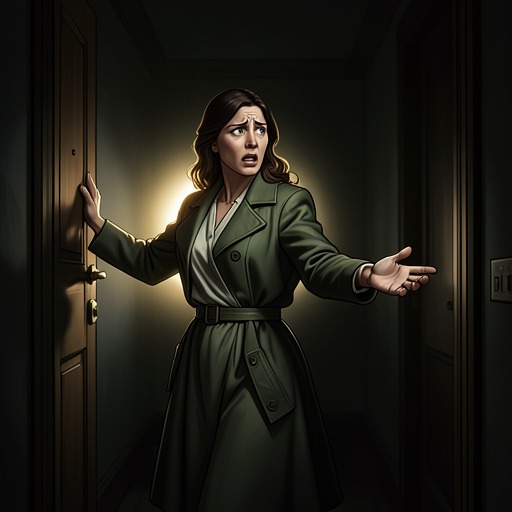
The contradiction becomes audible when Chad and Daisy’s cries echo through a space no ordinary room could contain. Each call receives a separate answer, although no room in the house is longer than twenty-five feet. A dark, doorless hallway appears in the west wall of the living room, and Navidson enters without hesitation. Karen freezes at the threshold, unable to follow him into the darkness, while he soon returns carrying one child in each arm; both children still clutch homemade candles. The scene makes the threshold literal. Navidson treats the impossible interior as a danger to be entered and crossed, whereas Karen experiences the boundary itself as a point at which movement becomes impossible.
Domestic Boundaries and Family Strain
The house’s spatial divisions intensify divisions already present between Will Navidson and Karen Green. Karen says that she does not want Navidson to enter the mysterious place because she loves him and recognizes that something is deeply wrong with it. Navidson answers that he wants to go in but refuses because he loves her, even as his restraint becomes intolerable. Each understands the other’s position as an expression of fear or disregard: Karen sees his attraction to the house as a threat to his life, while Navidson sees her resistance as evidence that his own concerns have not been considered.
Their conflict is not merely about exploration. The lack of physical intimacy and emotional understanding produces private ultimatums, making the house a stage on which a failing partnership becomes visible. The family came to Ash Tree Lane seeking a new beginning, but Navidson quickly takes refuge in his documentary, and his work remains present in every room. He plays with the children and occupies the household with his energy and authority, while Karen struggles to define a space of her own. The home does not simply shelter the family; it organizes who can move, who can decide, and whose fear determines the limits of the household.
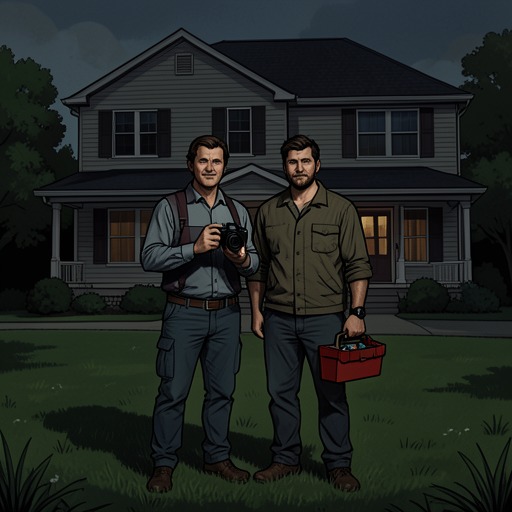
The brotherhood between Will Navidson and Tom Navidson further complicates the meaning of home. Tom is Will’s fraternal twin, but the brothers have spoken little for more than eight years. Karen explains that Will’s success and Tom’s failure have produced long-standing resentment, although they had once looked after each other when they lived at home. Their return to one another begins when Will calls Tom for tools. Tom arrives as an affable, overweight giant who immediately wins over Chad and Daisy with his laughter and McDonald’s french fries, bringing into the house a version of family warmth that the adult brothers have lost.
Tom’s estrangement is connected to the birth of Chad. One account speculates that Will’s attention moved from his brother to his son, leaving Tom feeling abandoned; Tom sometimes described himself as orphaned at forty, the age at which Chad was born. The house therefore gathers several forms of homelessness within one family: Will’s repeated absence, Tom’s sense of being displaced from his brother’s life, Karen’s inability to claim domestic authority, and the children’s innocence before the forces destabilizing their home.
The Labyrinth and the Loss of Orientation
As the impossible architecture expands, home becomes a place where direction, scale, and memory cannot be trusted. Karen Green consults a Feng Shui master in Manhattan and is advised to use a compass alongside the Pau Kua table, the I Ching, and the Lo Shu magic square. Yet when she brings a compass into the house, its needle refuses to settle. She exchanges it for another compass, tests that one in the store, and finds that it too becomes useless inside. The failure is significant because a compass should turn a dwelling into an oriented environment, a place related to north, south, east, and west. Here the home rejects even the instruments designed to locate it.
The labyrinth cannot be understood from outside because no one ever sees it in its entirety. Its comprehension must be derived from within, where movement is costly and perception is partial. The same condition governs The Navidson Record. The film leads viewers from one fragment to another, promising a center or a complete explanation while continually producing another sequence and another ambiguity. The house and the film become parallel structures: both invite exploration, restrict knowledge, and make the desire for a total view part of the trap.
Some spaces recur—the Infinite Corridor, the Anteroom, the Great Hall, and the Spiral Staircase—but their dimensions and layouts can change. Other areas never reproduce the same pattern twice. The house is therefore neither wholly subjective nor reliably objective. It exists for everyone, yet the terms of its existence shift according to location, experience, and encounter. The result is not homelessness in the simple sense of lacking a building; it is homelessness inside a building that cannot provide a consistent world.
Thresholds, Departure, and Aftermath
The ultimate test of home arrives after Navidson disappears down the Spiral Staircase. Karen finds herself caught between two thresholds, one leading into the house and the other leading out. She eventually leaves Ash Tree Lane and, in some respects, leaves Navidson as well, but departure does not restore ordinary freedom. In New York she avoids subways and elevators and cannot enter dark, enclosed spaces. The house has converted the threshold from a passage into a permanent psychological condition.
Karen’s history remains uncertain. Her estranged older sister Linda claims that their stepfather abused them at an old farmhouse and forced Karen into a well while assaulting Linda, then reversed the violence. Karen never confirms the account, and the pharmacotherapy study she participated in does not mention sexual abuse. The uncertainty matters because it prevents the house from being reduced to a single explanatory key. Whether the story is factual, imagined, or inaccessible, Karen’s fear is real in its consequences: green lawns, warm 100-watt bulbs, and sunny beaches feel safe, while elevators, poorly lit basements, and blackouts can paralyze her.
When Karen later returns to the house to search for Navidson, she first confronts the domestic evidence of restoration. The upstairs bookshelves are flush with the walls, the closet space has vanished, and the door on the north wall opens onto an ordinary closet barely a foot and a half deep. There is no infernal corridor, only white walls, molding, and daylight from the windows behind her. Karen laughs, but the laughter stops short. Her fear has been the obstacle to finding Navidson, yet when the feared space disappears she also loses the reason to hope. The home’s apparent return to normality is therefore not a recovery. It removes the visible threat without repairing the absence that threat had organized.
The book’s broader reflections on the home sharpen this reversal. One formulation holds that the personality of the mistress is what the home expresses, while men remain guests in their homes no matter how happy they may be there. Another describes the family house as a place for children and men, designed to contain their wandering and distract them from the ancient desire for adventure and escape. Ash Tree Lane exposes the strain in both ideas. It is meant to retain the family, but its men repeatedly seek danger beyond ordinary domestic limits, while Karen becomes the person most visibly confined by the house’s darkness. Home is consequently both an apparatus of attachment and a structure of captivity: it promises to keep people together, yet it can preserve neither love nor orientation by itself.