Impossible Architecture
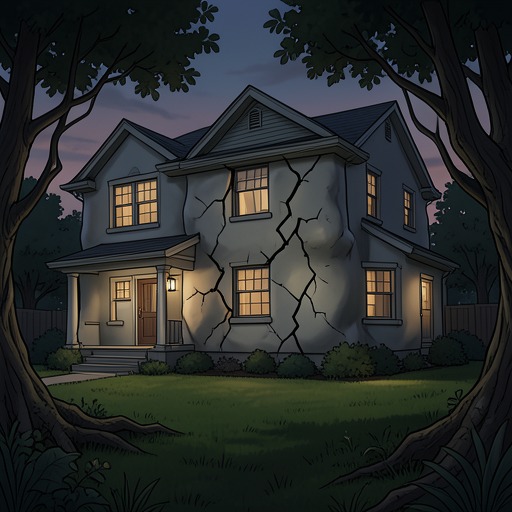
House of LeavesImpossible Architecture names the condition in which the house on Ash Tree Lane remains recognizably a house while violating the measurements, directions, boundaries, and perceptual expectations that make a house intelligible. Its decisive manifestation is the discrepancy between interior and exterior space, but the anomaly expands into appearing corridors, unstable rooms, impossible distances, changing layouts, and spaces that can no longer be mastered from outside. The result is not merely a puzzle in construction: it destroys the Navidsons’ sense of security and forces every observer to confront a physical reality that the mind and body cannot accept.
Definition and First Manifestation
Impossible Architecture first becomes visible when Will Navidson and Karen Green discover a plain white door with a glass knob in the master bedroom. The door opens not into the children’s room, as the wall should permit, but into a narrow space resembling a walk-in closet. The space is no more than five feet wide and four feet long, with perfectly smooth, almost black walls and none of the ordinary features that make a closet useful: no outlets, switches, shelves, hanging rod, or decorative molding. A second identical door opens from the far end into the children’s bedroom. Photographs confirm that the bedroom wall previously appeared without a door, turning the discovery into a challenge not only to the house’s plan but to the reliability of perception itself.
The family’s first responses remain practical. Alicia Rosenbaum, the real-estate agent who sold the house to the Navidsons, cannot explain the alteration and suggests calling the police. Two officers inspect the closet and offer no solution beyond filing a report. With ordinary explanations exhausted, Navidson returns to the building plans and compares them with measurements taken using a 25-foot Stanley Power Lock. His first suspicion is bad mathematics, but the act of measuring converts an eerie domestic irregularity into a contradiction embedded in the building’s physical structure.
The Quarter-Inch Anomaly
From outside the second story, Navidson measures the distance from the far end of the master bedroom to the far end of the children’s bedroom with a 100-foot Empire fiberglass tape. The exterior distance is 32 feet 9 3/4 inches, a figure corroborated by the plans within an inch. The internal measurement, however, is 32 feet 10 inches exactly. Once the width of the walls and the newly discovered space is included, the interior exceeds the exterior by one quarter of an inch.
Navidson tests the result repeatedly rather than accepting an error. He drills through the outer walls, runs fishing line across the master bedroom, the new space, and the children’s bedroom, and checks that the line is straight, level, and taut. The interior measurement remains 32 feet 10 inches. When the same line is taken outside, it is exactly a quarter of an inch too long. The anomaly therefore survives changes of instrument, method, and position. It is not an optical illusion or a defect in a single plan; it is a spatial fact that has no place within ordinary geometry.
The contradiction becomes more disturbing when Tom Navidson discovers that the difference is not one quarter of an inch but five sixteenths of an inch. The brothers fill legal pads, napkins, and newspaper margins with equations, searching for an error in technique or an unseen mitigating factor such as temperature, warped floors, or miscalibrated instruments. Their common assumption is that the interior and exterior must be equal because physical reality must add up. Impossible Architecture begins precisely where that equal sign fails.
Karen Green refuses the implications, telling Navidson to stop drilling holes in her walls, while Navidson continues measuring through six consecutive attempts. His frustration darkens the household atmosphere, and Chad Navidson and Daisy Navidson respond by hiding in other parts of the house. The anomaly thus produces consequences before anyone understands its mechanism: an abstract fraction becomes a pressure on marriage, parenthood, and domestic safety. Its effects are also delayed rather than theatrical. The impossible does not need to announce itself through immediate catastrophe; it persists patiently until ordinary confidence has been worn away.
Expansion into a Labyrinth
The quarter-inch discrepancy is only the first legible sign of a much larger spatial disorder. Chad and Daisy’s voices later echo through distances that should not exist. No room in the house is longer than twenty-five feet, yet each child’s call receives separate answers, suggesting corridors of fifty feet or even fifty-six and a half feet. Navidson finds the echoes coming from a dark, doorless hallway that has appeared in the living-room wall. He enters without hesitation and returns carrying both children, each still clutching a homemade candle. The house has transformed a familiar room into an entrance to an unrecorded depth.
Impossible Architecture also defeats orientation. While the men undertake Exploration #2, Karen Green consults a Feng Shui master in Manhattan and obtains a compass so that the house can be aligned with north, south, east, and west. The first compass will not settle inside the house; after she exchanges it for a new one, the replacement behaves identically. The failure is not simply a faulty instrument. The house refuses the directional framework on which navigation and spatial arrangement depend, making even the distinction between auspicious and inauspicious directions unusable.
Some structures remain recognizable but unstable. The Infinite Corridor, the Anteroom, the Great Hall, and the Spiral Staircase exist for everyone who encounters them, yet their size and layout may change. Other areas do not repeat the same pattern twice. The house therefore has both recurring landmarks and continuously mutating regions: enough continuity to invite mapping, but enough variation to defeat a final map. It remains a house, yet it cannot be reduced to a settled floor plan or a single coherent interior.
Spatial Experience and Physical Consequence
No observer sees the labyrinth in its entirety. Participants can enter it, but those outside cannot obtain a complete view, and comprehension must therefore be derived from within. The distinction between explorer and spectator collapses because neither position supplies mastery. The same problem governs The Navidson Record itself, whose cuts and sequences lead viewers from one apparent solution into another uncertainty. The film becomes architecturally labyrinthine: it grants movement while withholding a stable center.
The house’s constants are starkly minimal. Its temperature is recorded as 32 degrees Fahrenheit plus or minus 8 degrees, while light is absent. These details make the anomaly material rather than purely symbolic. The space imposes cold, darkness, and movement costs on bodies that attempt to inhabit or traverse it. Billy Reston’s nausea demonstrates that disorientation has physiological consequences, whether the disturbance acts upon the inner ear or upon what is described as the inner labyrinth of the psyche.
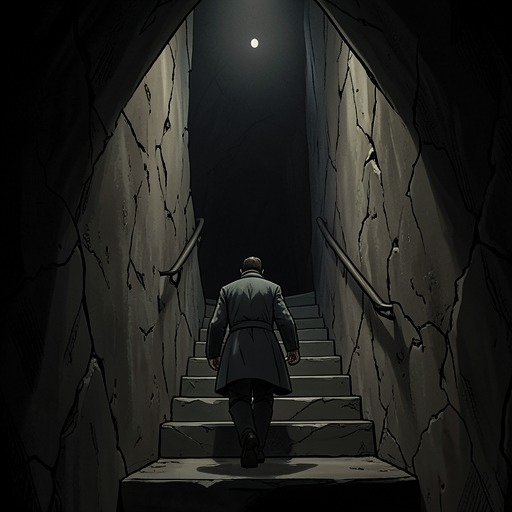
During the ascent in which Navidson raises Reston through a stairwell, the spatial system appears to act independently of human intention. Navidson draws more and more slack rope onto the floor, but halfway up, the excess rope begins to vanish while the portion in his hands slips rapidly enough to burn a gash across his palms. He must let go, yet Reston does not fall; his ascent accelerates under the green flare he carries. The event makes the house’s geometry an active force rather than a passive setting, though the narrative does not provide a stable explanation for what pulls him upward.
The falling quarter makes the same point on a greater scale. After waiting nearly an hour in the darkness, Navidson hears a coin clatter onto the floor. If Tom dropped it shortly after Reston reached the top, the coin has been falling for at least fifty minutes. Navidson concludes that he is an impossible distance down, with the duration of the fall exceeding any ordinary architectural depth. The object turns time into a measurement of the house’s vertical excess: what cannot be seen becomes calculable only as an absurd distance.
Reconfiguration and the Limits of Explanation
The house’s changes are not limited to extension. During Exploration #5, Navidson reaches a small structure resembling a bartizan at the brink of an abyss. Inside is a winding staircase lying horizontally through the wall toward the void. After he sleeps, the only door has vanished and the staircase is directly above him, rising through the ceiling as though the tiny house within the house has rotated onto its side. Later, a window appears to offer a view beyond the endless sequence of walls, rooms, and doors, but when Navidson turns back, the window and room have disappeared. He is left on an ash-black slab supported by nothing, with darkness below, above, and beyond.
These transformations make explanation perpetually provisional. The shifting doorways and walls prompt architectural theories about the house’s internal shape and the rules governing its changes, including the suggestion that unoccupied space continuously alters because nothing prevents it from doing so. Yet the house’s continued status as a house remains the one broad agreement. Its occupation is paradoxical: its configurations may change without limit, but the labyrinth is still understood as a dwelling, even when its dwelling-place has become impossible to inhabit securely.
Narrative and Thematic Significance
Impossible Architecture externalizes the collapse of ordinary certainty. A house conventionally promises enclosure, orientation, protection, and a measurable relation between inside and outside. Here, the home becomes alien and exposed; its altered interior destroys security without needing to appear simply sinister. The spatial anomaly is frightening because it attacks the conditions that allow familiarity to exist. A wall no longer guarantees a boundary, a corridor no longer guarantees a distance, and a door no longer guarantees a destination.
The concept also organizes the book’s relation between perception and reality. A reader may close a book on an Escher print and treat its contradiction as an intellectual conceit, but the house presents impossibility as a physical reality that cannot be escaped by changing one’s angle of thought. Measurements confirm what perception rejects, while perception records changes that measurement cannot stabilize. The resulting tension is maintained rather than resolved: natural explanations repeatedly fail, but the narrative never supplies a complete supernatural account.
Finally, the architecture governs the form of the story itself. The house and the film both draw explorers and viewers forward by promising a center, a solution, or a complete view, then replace each apparent answer with another passage, alteration, or blind space. Impossible Architecture is therefore not merely the subject represented by The Navidson Record; it is the principle by which the record is structured. It makes the home a labyrinth, the labyrinth a force, and interpretation another corridor whose end remains beyond sight.