Jamestown Colony
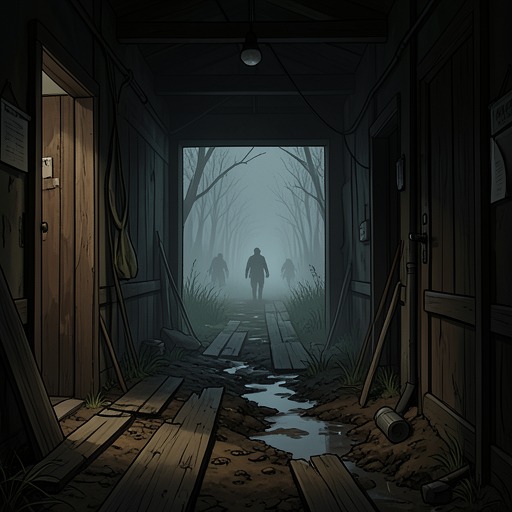
House of LeavesJamestown Colony matters not simply as a colonial landmark but as the historical ground beneath the house’s apparent present. Its history supplies a material ancestry of pestilence, starvation, massacre, fire, and decay, while the later visit to the site exposes how official preservation can display the colony without fully representing the suffering that made it possible.
Historical Foundation
The colony was established after The London Company deposited 105 colonists on a marshy peninsula on May 2, 1607. The settlement soon became known as Jamestown Colony, but survival was immediately shaped by disease, hunger, and repeated massacres carried out by native Indians. John Smith held the village together until an injury compelled his return to England, after which the winter of 1609–1610 brought the settlement close to annihilation. The arrival of Lord De Ia Wart with supplies prevented the remaining colonists from abandoning the site.
Jamestown Colony survived through a combination of political consolidation, economic change, and dynastic alliance. John Rolfe’s tobacco industry strengthened the settlement, his marriage to Pocahontas helped stabilize its position, and Jamestown’s designation as the capital of Virginia gave it institutional importance. That stability did not last. Nathaniel Bacon’s violent conflict with the tidewater aristocrat Sir William Berkeley left the village in flames, and the capital was eventually transferred to Williamsburg. Afterward, the settlement rapidly decayed.
Ruin and the House’s Older Past
When park excavations began in 1934, little remained of the original site. Park Warden Davis Manatok reported that the marshland had obscured, or perhaps entirely consumed, the colony’s monuments. The physical disappearance of Jamestown therefore becomes part of its meaning: the place survives less as an intact settlement than as a damaged, submerged record whose absences are historically significant.
Karen Green’s discussion of Virginia’s ghosts identifies Jamestown Colony as the only distinguished element in the history of the house’s surroundings, even though that history is also part of the broader past shared by everyone in the region. The text treats this reference as crucial despite The Navidson Record’s lack of interest in seventeenth-century history. Familiarity with the colony’s bloody and painful origins reveals how old the roots of the house really are, joining the contemporary architecture to a much deeper history of settlement, violence, and erasure.
The Visit and the Unowned Memory
During months of travel, a visit to Jamestown Colony becomes an episode of psychological dislocation. On the Jamestown-Scotland Wharf Ferry, the traveler looks down at the water and is suddenly filled with a memory of love’s ruin circumscribed by war and loss. The memory is explicitly not his own; he has no idea whose it is or where it came from. For an instant he feels stripped bare and balances between something terrible and something terribly sad, but the ferry reaches the colony before that sensation resolves.
The site itself offers no immediate secret. An afternoon spent circling the Pitch and Tar Swamp reveals nothing, and the view from Black Point across The Thorofare appears to contain only the idle words of a spring wind in the crests of small waves. The landscape is thus presented as a possible archive whose language remains unreadable. Jamestown Colony does not yield a clear answer, but it intensifies the sense that history can be encountered as an involuntary affect before it can be understood as knowledge.
Preservation and Historical Absence
At the visitor’s center, reconstructed ships, baskets, ancient weapons, dioramas, and glazed mannequin expressions offer a cheerful, orderly version of the settlement. Schoolchildren move through the exhibits as a bright, playful stream, quickly losing interest and urging their teachers outside toward the ships on which the settlers first arrived. Once they leave, the traveler remains alone with the dark glass cases and with everything the displays do not show.
That omission becomes the central force of the visit. The traveler asks where the starving time of 1610 has gone, where the 1622 Powhatan Indian Insurrection that left almost 400 dead is represented, and where the famine, disease, black and broken toes, gangrene, and night-rending pain can be found. A docent answers that the material is right there, but the reply does not dissolve the discrepancy between historical suffering and its curated display. Jamestown Colony is therefore both preserved and concealed: its objects remain visible, while the bodily violence and prolonged deprivation surrounding them are pushed toward the margins.
Narrative Significance
Jamestown Colony links the house’s supernatural or uncanny past to documented colonial history. The house is not given an isolated, timeless mystery; its roots extend into a settlement founded through precarious occupation and sustained amid disease, starvation, conflict, and disappearance. The colony’s marshy ground and consumed monuments provide a historical counterpart to the text’s recurring concern with spaces that conceal more than they reveal.
The location also exposes a conflict between official history and experienced memory. Public exhibits convert the colony into an accessible educational scene, whereas the traveler encounters it through an involuntary memory of war, loss, and love’s ruin. The contrast makes Jamestown Colony a site where the past is simultaneously exhibited, suppressed, and bodily reactivated. Its significance lies not only in what remains, but in the violence that the surviving record cannot comfortably contain.