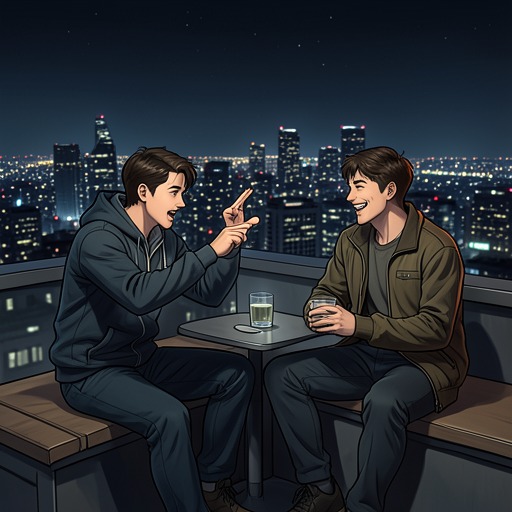
Johnny Truant–Lude friendship
House of LeavesThe Johnny Truant–Lude friendship is the decisive personal relationship at the threshold of Johnny Truant’s involvement with Zampanò and the manuscript. Lude’s late-night summons brings Johnny to the dead man’s apartment, where curiosity becomes entanglement; later, Lude remains one of the few people able to recognize that Johnny’s collapse is not simply drug use. His death transforms an energetic, abrasive friendship into one of the central sources of Johnny’s remorse.
Formation and Character of the Friendship
Johnny and Lude are close enough that a three-in-the-morning telephone call can overcome exhaustion and ordinary reluctance. Johnny says that he would have hung up on anyone else, but Lude is a good enough friend that he gets out of bed and goes to Franklin. Their intimacy is not presented as calm or conventionally reassuring. Lude is provocative, exaggerates, enjoys parties, and speaks with a rough familiarity that allows him to mock Johnny’s work and romantic fixation. He is also the person who can abruptly turn serious, using his fear of ending up alone to expose the insecurity beneath his bravado.
Lude’s own name may be Harry, but Johnny notes that no one he knows calls him that. The uncertainty suits a relationship built less on formal identity than on habit, shared slang, and immediate recognition. Lude calls Johnny “Hoss,” while Johnny accepts his interruptions and insults as part of the friendship’s rough grammar. Their bond is therefore intimate without being sentimental: affection appears through access, teasing, and the confidence that the other will respond.
The Call That Changes Johnny’s Life
Lude had already told Johnny about the old man in his building, a solitary resident who supposedly said that he would die soon. Johnny did not take the warning especially seriously because Lude liked to exaggerate, although the information remained difficult to forget. After Zampanò’s death, Lude waits outside the gate with an excited, ominous look and leads Johnny through the building toward the abandoned apartment.
Johnny later reconstructs the approach as a sequence of missed warnings. The rattling keys, shrieking hinges, dank hallway, shadows, and Lude’s whispers acquire the atmosphere of a crypt only in retrospect. The friendship is what carries Johnny past his hesitation: Lude’s invitation converts an otherwise private death into a shared excursion. Johnny’s most direct explanation is that Lude woke him at three in the morning to inspect a dead man’s belongings, but the event proves much larger than that apparently simple motive. Lude supplies the impulse; Johnny supplies the attention that will make the discovery impossible to leave behind.
Shared Discovery and Divergent Responses
At the Viper, Johnny and Amber Rightacre discover that their conversations about Zampanò have created a deeper connection. Lude is present and repeatedly reminds them that he was the one who found the material, called Johnny, and had even seen Amber around his building. Yet because he never took the time to read the text, he cannot participate in the particulars of their discussion. The scene establishes an important asymmetry within the friendship: Lude opens the door to the mystery, but Johnny becomes absorbed in its language and consequences.
Lude responds to being excluded from that deeper exchange by ordering a drink on Johnny’s tab and looking for other entertainment. The gesture is comic, but it also reveals how the friends occupy different positions toward the discovery. Lude treats the event as an adventure and a source of social possibility; Johnny increasingly experiences it as an obligation that reorganizes his life. Their friendship can accommodate this difference for a time, because it is founded on companionship rather than intellectual agreement, but the manuscript gradually becomes a private burden that Lude cannot fully share.
Recognition, Intervention, and Conflict
Months later, Lude visits Johnny after not seeing him since June. Johnny has been fired from the tattoo shop and has become gaunt, withdrawn, and physically unkempt. Others, including Johnny’s former boss, assume that he is using heroin, but Lude looks at the room and understands that drugs are not the central problem. He sees the books, sketches, collages, piles of paper, measuring tapes fixed from floor to ceiling, and the large black trunk at the center of the disorder. Lude recognizes these objects as evidence of an obsession rather than merely the signs of addiction.
His response is blunt: he tells Johnny to throw it away and moves toward the desk to inspect the work more closely. Johnny reacts instinctively, placing himself between Lude and the papers, the trunk, and the project that has become indistinguishable from his own identity. The moment reverses their usual physical and social dynamic. Lude, normally fearless and domineering, backs away for the first time, calling Johnny weird and scary. The withdrawal is not a clean break; it is a frightened acknowledgment that Johnny has become inaccessible even to a trusted friend.
Illness, Death, and Aftermath
Lude’s later decline gives the friendship a tragic counterpoint. After being released from the hospital, he becomes deeply familiar with painkillers and increasingly unable to resist their effects. His condition is linked to the injuries inflicted by Gdansk Man, but the aftermath expands into a broader collapse: by summer, he is using hypodermic needles, pills, and other substances, while Johnny wonders what pain the drugs are addressing and whether even Lude recognizes it.
Johnny describes Lude as someone who never knew how to retreat. He refuses rehabilitation, counseling, introspection, or any attempt to alter the paths he has been following. The military imagery Johnny uses for this stubbornness culminates in an image of bourbon, bundles of pills, and a charge led on a Triumph. The metaphor does not make Lude’s death heroic; it shows how Johnny struggles to understand a friend whose bravado and self-destructive momentum were difficult to interrupt.
On October 25, 1998, Johnny records the fact with devastating brevity: Lude is dead. Lude has taken enough chemicals to impair him severely, leaves a gathering in the Hills around four in the morning, and rides west toward Sunset. He makes it down the hill alive, but is killed outside Union. The location’s accidental relation to the word “Union” intensifies the loss: the friendship that once joined Johnny to the world ends in a scene marked by separation and irreversible consequence.
Lude’s death also alters the meaning of the earlier call. What once seemed like an ordinary act of friendship—answering the phone, leaving bed, meeting at the gate—becomes the first link in a chain that Johnny cannot mentally escape. His repeated return to the night, his reconstruction of signs he failed to read, and his question about whether he could have made a difference after Lude’s injury all show grief operating through delayed recognition. The friendship survives in narration as both evidence of companionship and a measure of Johnny’s helplessness before events he understood only afterward.
Narrative and Thematic Significance
The Johnny Truant–Lude friendship joins two forms of vulnerability. Lude hides pain beneath speed, jokes, chemicals, and aggressive momentum; Johnny hides fixation inside reading, collecting, measuring, and writing. Each can recognize something in the other, but neither can finally rescue the other. Lude detects that Johnny’s room is organized around a problem deeper than drugs, while Johnny perceives that Lude’s substance use may be answering an unshared pain at the center of his life.
The relationship also provides the book’s most concrete model of how a story is transmitted. Lude finds the abandoned material, tells Johnny about it, wakes him, and brings him to the door. Johnny then becomes the witness who reads, assembles, and suffers the consequences of reading. The friendship is therefore not merely background to the manuscript’s discovery. It is the human mechanism by which the text enters Johnny’s life, and Lude’s death leaves that transmission charged with guilt: the friend who initiated the journey is no longer present to see what it became.