Karen Green
House of LeavesKaren Green is Will Navidson’s longtime companion and the mother of Chad Navidson and Daisy Navidson. Her decisive importance lies in the contradiction she embodies: she is terrified of the altered house on Ash Tree Lane and repeatedly tries to keep her family away from it, yet ultimately enters its darkness to reach Will. The trajectory makes her fear neither a simple weakness nor an obstacle to the plot, but the condition through which her commitments, unresolved history, and capacity for restorative action become visible.
Identity and Background
Karen and Will have lived together for nearly eleven years without marrying. Their arrangement has not been presented as a lack of attachment; rather, both have been content to avoid marriage, while Will’s constant professional assignments abroad have produced repeated departures, brief returns, alienation, and mounting personal difficulty. When Karen makes clear that Will must either abandon his professional habits or lose his family, he cannot choose between those alternatives. Instead, he turns reconciliation itself into the subject of documentation, making the family’s attempt at repair inseparable from the camera and from the house.
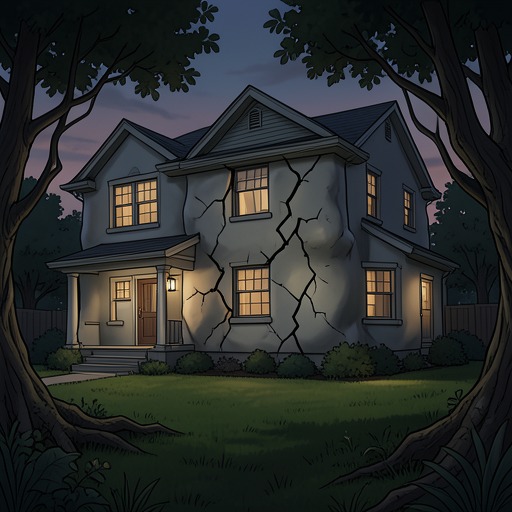
The move to Ash Tree Lane is therefore supposed to be a new beginning. Will gives up assignments abroad, and Karen promises to concentrate on raising their family. Yet the arrangement quickly reproduces the imbalance it was meant to correct. Will retreats into the documentary, remains surrounded by the authority and energy of his work, and fills the house with the force of his presence. Karen, unable to establish a space of her own, needs help even though the family’s relocation was intended to provide stability.
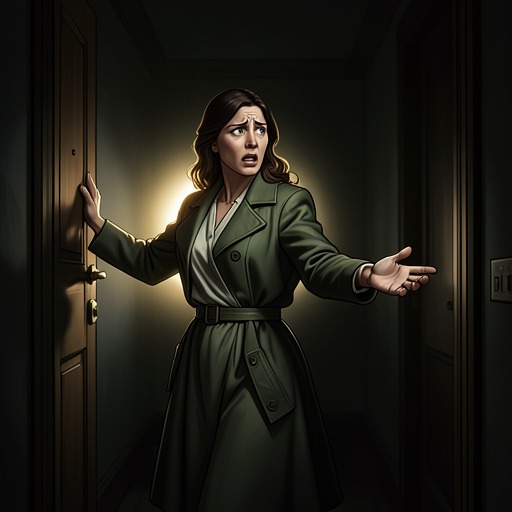
Karen’s claustrophobia is not initially announced. It first becomes unmistakable when a dark, doorless hallway appears in the living room and Will follows its echoes while carrying Chad and Daisy back from the darkness. Karen freezes at the threshold, becomes drenched in sweat, and clings to the children and then to Will. Her fear is so intense that Will temporarily declares the new part of the house off limits. She spends the night holding his hand and asks him not to enter again, making the house’s spatial alteration immediately into a crisis of intimacy and protection.
Relationship with Will Navidson
Karen’s opposition to the house is inseparable from her love for Will. She does not merely regard the darkness as unpleasant or irrational; she recognizes it as something dangerous and wants Will to understand that her prohibition is an attempt to preserve him. Her position is that he should not go in because she loves him, while Will is consumed by the desire to investigate precisely because he understands that the place is bound up with her fears and anxieties. Their conflict thus becomes a pursuit-and-withdrawal loop: Will moves toward the forbidden space, Karen tries to hold him back, and each interprets the other’s response as evidence of an emotional failure.
The division between them soon becomes physical as well as emotional. Will describes Karen as having changed from someone open to intimacy into someone who refuses to be touched and nearly cries when he kisses her, with the change beginning after their return from Seattle. Karen’s fear of the house and her withdrawal from Will are not identical, but the narrative places them in the same field of damaged trust. The altered rooms expose a relationship already weakened by years of absence; the documentary records reconciliation while also recording the conditions that make reconciliation difficult.
Karen also refuses the idea that Will’s investigation can be separated from the family’s danger. When Tom Navidson suggests that Will should lead the next exploration, Karen answers that nothing is stopping him, but insists that she will go too because that is their agreement. Her anger is directed toward the apparent freedom granted to Will and the consequences imposed on everyone else. Looking at Chad and Daisy, she argues that Will has had a lifetime of wandering and danger and can let someone else take over, whereas losing him would destroy the children and herself. Her stated desire is not heroic glory but the ordinary future of growing old with him.
Motherhood and Family Crisis
Karen’s protective role becomes especially strained when the children’s drawings begin to show a monstrous black square growing larger and darker. She recognizes that Chad and Daisy are in trouble and tells them that, once their father returns, she will take them to their grandmother’s house. But when Will, Tom, and Billy Reston disappear down the hallway, separation from Will proves more painful than leaving the radios. Karen remains at her post, torn between monitoring the expedition and caring for the children.
Her vigilance has a cost. Chad and Daisy try to persuade her to leave the radios even briefly, but her inability to concentrate on them drives them away. Daisy retreats to her room with her Spanish doll and the dollhouse Tom has finished for her. Chad escapes outside into the woods, sometimes with Hillary and increasingly without her, beyond the reach of the cameras. Karen’s attention is therefore caught in a destructive triangle: the absent explorer, the threatening house, and children whose growing isolation she can see but cannot adequately interrupt.
The family structure also carries the older fracture between Will and his fraternal twin, Tom. Their estrangement began after the birth of Chad, when Tom may have experienced Will’s devotion to his son as abandonment by the brother who had once been his only supporter. Karen is not the cause of that history, but she stands at its center as partner and mother, the person around whom the brothers’ competing claims on Will’s attention become visible. The house intensifies these preexisting bonds rather than creating them from nothing.
Trauma and the Meaning of Claustrophobia
Karen’s later avoidance of subways and elevators, even after leaving Ash Tree Lane and moving to New York, shows that her fear extends beyond the particular house. She describes bright lawns, warm bulbs, and sunny beaches as heavenly, while elevators, poorly lit basements, and blackouts can provoke an incapacitating reaction. She has participated in a pharmacotherapy study, but the drugs made her gain weight, and the study does not record a history of sexual abuse.
That history is supplied by Karen’s estranged older sister, Linda, who claims that their stepfather abused both girls at an old farmhouse. According to Linda, when Karen was fourteen, he forced her into a well while raping Linda, then reversed the situation and did the same to Karen. The account offers a possible source for Karen’s terror of enclosed darkness, but it remains unconfirmed: Karen refuses to comment when reporters ask her about it, and the narrative leaves open whether the memory is factual, fantasized, or some combination of trauma and uncertainty.
The possible well trauma gives the house’s spaces a disturbing historical resonance. Karen’s fear is not reduced to a diagnosis, because the story connects it to questions of memory, secrecy, bodily vulnerability, and the difficulty of distinguishing a remembered event from a buried psychic construction. Will acknowledges the severity of her claustrophobia but does not claim to know its origin. The absence of a final explanation preserves the force of the fear rather than resolving it into a single biographical cause.
Final Descent and Aftermath
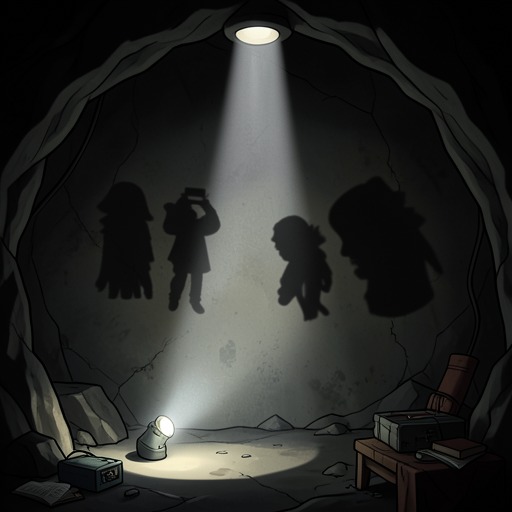
Karen’s most important action occurs after Will vanishes down the Spiral Staircase. She finds herself caught between two thresholds, one leading into the house and the other leading out. Although she has already managed to leave Ash Tree Lane, she remains unable to enter any dark enclosed place. When she turns and discovers the emptiness behind her, she does not scream. She returns with a halogen flashlight, stands at the edge for several minutes, points the beam into the darkness, and calls for Will.
She then crosses the threshold without a deep breath or announcement, simply stepping forward until she disappears behind the black curtain. The cold hollow vanishes a second later and is replaced by the wall as it had been before, except that all the children’s drawings are gone. The scene is presented as an action rather than an explanation: Karen does not defeat fear by proving the darkness harmless, but enters while its danger and meaning remain unresolved.
Her love for Will is identified as the primary catalyst. The desire to embrace him overcomes memories associated with the dark well, the alleged abuse by her stepfather, and whatever concealed shadows shape her childhood. In this sense, her final descent is both a rescue attempt and a transformation of the relational pattern that has governed the story. Earlier, Karen tried to protect Will by preventing his entry; at the end, she protects the bond by entering herself.
Karen remains beside Will after he is recovered. His core temperature has fallen to 83.7 degrees Fahrenheit, and doctors treat him through abdominal irrigation with warm fluid after a cardiopulmonary bypass machine proves unavailable. He survives, but frostbite takes his right hand and part of one ear, patches of facial skin, and his left eye; his hip is shattered and replaced, and he will need a crutch for the rest of his life. Karen stays at his side through the following nights and days, reading to him, singing, and sleeping on the hospital floor when exhaustion overtakes her.
Narrative Role and Significance
Karen’s story gives the house’s impossible architecture a human scale. The new door, the black hallway, the vanished rooms, and the abyss are not merely puzzles for Will’s documentary; they become pressures placed on a family already shaped by absence, resentment, fear, and attempted repair. Karen’s reactions reveal what the camera cannot fully contain: the cost of turning private reconciliation into public evidence.
Her final movement also reverses the expected image of the frightened threshold guardian. At first she is the person who cannot enter and who asks Will to promise that he will stay away. Later she becomes the only person willing to cross the boundary when love requires an action that no argument can replace. The ending does not erase her disability or provide certainty about its origin. Instead, it shows courage as a passage through fear, and love as a form of rescue that becomes credible only when Karen accepts the same darkness she has spent the story trying to keep away.