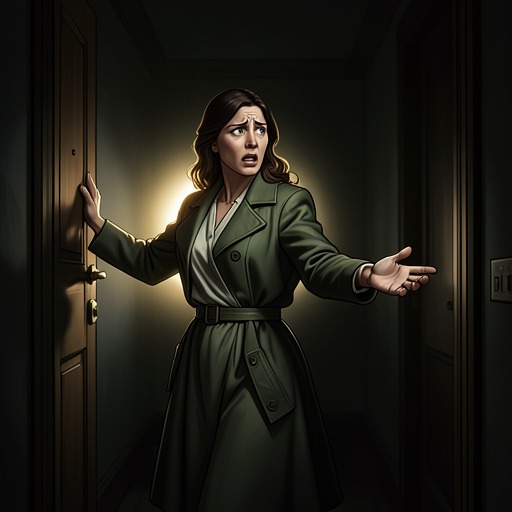
Karen's Rescue of Navidson
House of LeavesKaren's Rescue of Navidson is the climactic act in which Karen Green crosses into the black space of the house and finds Will Navidson collapsed in the darkness. The event reverses the apparent logic of the abyss: the space has erased sound, orientation, and even the children's drawings, yet Karen's love enables her to enter it, locate Navidson, and emerge with him alive. Her return is not a simple victory, however. Navidson survives profound physical damage, while the house's disappearance remains as inexplicable as Karen's account of it is emotionally exact.
Causes and Threshold
The immediate setting is one of radical absence. The tape is blank, leaving nothing more than darkness, and when Karen turns around she finds real emptiness behind her. She does not scream. Her chest heaves as though her body temporarily cannot take in or release air, but instead of fleeing permanently she notices something and returns a few minutes later with a halogen flashlight. The movement is important because it begins not with confidence but with fear that has been interrupted by attention.
Karen stands at the brink for several minutes, directing the flashlight into the darkness and calling for Navidson. When she finally crosses the threshold, she makes no announcement and takes no deep breath; she simply steps forward and disappears behind the black curtain. A second later, the cold hollow is gone and the wall has returned to its former condition. Only one visible alteration remains: all the children's drawings have vanished. The event therefore joins a physical rescue to an uncanny rearrangement of the house, making the return of ordinary architecture feel less like a restoration than another transformation.
The Crossing and Discovery
The only surviving account of what happens after Karen disappears comes from a short interview conducted by a college journalist from William & Mary. Karen describes entering a place that was cold and dark enough to make her shiver. When she turned to look back, the route by which she had entered was gone. She began hyperventilating and thought she was going to die, yet continued by placing one foot in front of the other. Her movement is consequently both deliberate and nearly automatic: she has no secure map, no visible exit, and no certainty that Navidson is present.
Karen did not know that Navidson was there, but she was thinking that he must be. She eventually found him at her feet, naked and curled up, with one hand white as ice. His condition makes the rescue an encounter with a nearly lifeless body rather than a conventional reunion. Karen reports that, on seeing him, the location ceased to matter. The abyss still exists, but its power over her is displaced by the immediate fact of Navidson's vulnerability.
She held him and heard him make a sound when she cradled his head. At first she could not understand what he was saying; then she realized that the flashlight hurt his eyes. She turned it off and continued holding him in darkness. This gesture reverses the expected function of illumination. The flashlight had helped Karen approach the void, but it became an affliction to the injured man, and darkness becomes the condition in which physical contact and care can continue.
Dissolution and Return
Karen's explanation of their escape is deliberately difficult to translate into ordinary physical terms. When asked how she got Navidson out of the house, she answers that it simply dissolved. She compares the experience to a bad dream: she and Navidson were in pitch-blackness, then she felt warm, sweet air on her face, opened her eyes, and saw trees and grass. For a moment she believed they had died and that this was the place reached after death, but the setting turned out to be their front yard. The transition collapses the distinction between supernatural passage, dream logic, and return home without explaining which description is correct.
The interview ends without confirmation when the journalist asks whether the house dissolved. Karen gives no response. Her silence preserves the event's central uncertainty. The rescue is witnessed through bodily sensations, pauses, and incomplete statements rather than through a stable account of architecture. What can be affirmed is that Karen entered, found Navidson, held him, and returned with him; what cannot be affirmed is how the house permitted that return.
Medical Aftermath
A neighbor saw Karen forty-nine minutes after she disappeared, crying on the front lawn with a pink ribbon in her hair and Navidson cradled in her lap. The image combines domestic detail with extreme physical danger. The front lawn marks a return to the familiar world, while Karen's posture shows that the rescue is still being enacted through her body as she carries and protects the man she has found.
An ambulance took them to the hospital, where Billy Reston caught up with them. Navidson's core temperature had fallen to 83.7 degrees Fahrenheit. Because the doctors lacked a cardiopulmonary bypass machine capable of removing his cold blood and replacing it with warm, oxygenated blood, they cut into his abdominal cavity, inserted catheters, and irrigated his internal organs with warm fluid. His temperature rose only to 85.3 degrees, and the EKG continued to show the peculiar J wave associated with hypothermia. After additional liters of saline were added to the IV, the doctors watched him through another hour that many believed he would not survive. He did survive.
Recovery exacted a permanent price. Frostbite destroyed Navidson's right hand and the upper portion of one ear; patches of facial skin were removed, his left eye was lost, and his hip had inexplicably shattered and required replacement. Doctors said he would need a crutch for the rest of his life. The rescue therefore changes the value at stake from immediate death to compromised survival: Karen brings Navidson back, but neither his body nor his former life emerges intact. The film and tapes he made during the journey nevertheless survive, preserving the evidence of the ordeal even as the rescued body bears its lasting marks.
Love, Fear, and Narrative Significance
The event is presented as a value reversal from paralysis and mortal isolation to connection and life. Karen's fear does not disappear before the crossing; she enters while shivering, hyperventilating, and expecting death. What changes is the force governing her action. The account identifies her love for Navidson as the primary catalyst, strong enough to defeat memories of the dark well, abuse by a stepfather, and whatever remains concealed in her childhood. Her courage is thus not abstract bravery but a decision to let attachment outweigh accumulated terror.
The rescue also gives physical form to the story's concern with seeing and misseeing. Karen first points a light into an emptiness that offers no confirming sound or visible answer. She then discovers that light can hurt the person she has come to save, and that turning it off is necessary for care. Perception is not presented as a neutral instrument: the blank tape, the imagined sound, the vanished entrance, and the final unexplained dissolution all show the mind struggling to impose continuity on an abyss. Yet Karen's bodily knowledge remains decisive where interpretation fails. She may not know where Navidson is, how the space works, or how they escape, but she recognizes him by touch and refuses to abandon him.
As an event in the narrative, Karen's Rescue of Navidson is both a rescue and a threshold-crossing into an altered form of life. Karen returns carrying a survivor, not restoring the past; Navidson returns maimed, dependent on a crutch, and marked by hypothermia and frostbite. The house's drawings are gone, the tape offers no usable record of the crucial passage, and Karen refuses to explain whether the house dissolved. The result is a form of survival founded on love but surrounded by irreducible uncertainty: the darkness cannot be mastered or narrated completely, yet it can be entered for the sake of another person.