Love as Rescue
House of LeavesLove as Rescue names a pattern in which love becomes more than an emotion: it supplies a direction through darkness, interrupts isolation, and makes survival imaginable after ordinary language and familiar identity have failed. The pattern is set against the uncanny, where everyday familiarity collapses and existence becomes a condition of not being at home. In that exposed state, attachment can function as a counterforce to the void, although the book also shows that rescue is costly, incomplete, and vulnerable to trauma.
Love Against Uncanniness
In the philosophical framework surrounding the house, anxiety produces an experience of the uncanny in which the familiar world loses its reassuring structure. The self becomes individualized but remains trapped in the world, entering an existential mode of not-being-at-home. Love matters in this context because it offers a relational form of orientation when space, language, and habit no longer do so. It does not restore the old world automatically; instead, it gives a person a reason to move through the world after its apparent coherence has broken apart.
The contrast is especially sharp in the treatment of Ash Tree Lane. The house is characterized by darkness, cold, emptiness, endless corridors, rooms, and stairs, while Karen Green’s film is described through its contrary qualities: light, love, color, and fullness. The film contains only 8,160 frames, yet its finite, assembled form becomes a counterpoint to the apparently infinite interior. This opposition makes love a formal principle as well as a plot motive. Where the house erases orientation and expands without limit, Karen’s work gathers fragments into a pattern that can be seen, remembered, and shared.
Karen Green and Will Navidson
The clearest instance of love as rescue occurs in Karen Green’s decision to enter the darkness in search of Will Navidson. Her fear is connected to severe claustrophobia and to a traumatic account given by her estranged older sister Linda: as an adolescent, Karen was allegedly forced into a well by her stepfather while he abused Linda, and the sisters were then made to exchange places. Karen refuses to confirm the account, and the text leaves open whether it is a remembered reality, a fantasy, or a concealed childhood history. What remains certain is that enclosed darkness has become charged with terror.
Karen’s fear does not disappear through explanation. It is transformed through a renewed way of seeing Navidson. The painstaking work of editing her film, which contains more than a hundred edits, allows her to perceive him as something beyond the projection of her own fears. She recognizes his tenderness toward her and their children, his reverence for perseverance, and the guarded meaning of his photographic obsession. Her film includes his Pulitzer Prize-winning image of a starving Sudanese child watched by a vulture, as well as the back of the print marked with the name Delial. By looking closely at the images that had previously separated Navidson from her, Karen discovers a person whose relation to suffering is central to his identity.
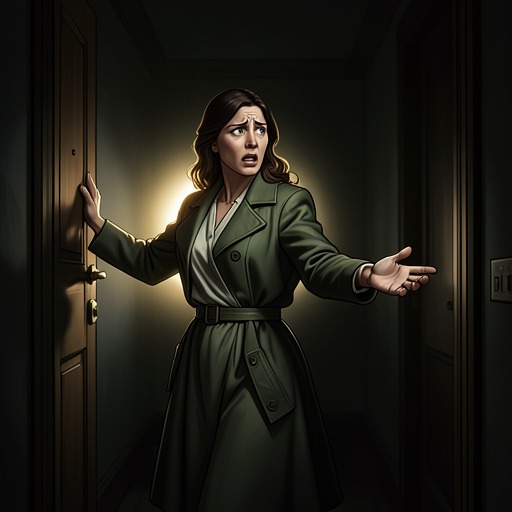
That recognition prepares the final act of rescue. Karen stands at the threshold for several minutes, points her flashlight into the darkness, and calls for Navidson. She then steps forward without announcement and disappears behind the black curtain; immediately afterward, the hollow space is gone and the wall appears as it had before, except that the children’s drawings have vanished. The action is not presented as a triumph over fear by willpower alone. Love for Navidson is identified as the primary catalyst, overcoming the memories of the well, the alleged abuse, and whatever remains hidden in Karen’s childhood. Her courage is relational: she enters because embracing him has become more urgent than preserving herself from the darkness.
The visual logic of this act is emphasized by the claim that Karen could not have crossed the line without first making her two films, What Some Have Thought and A Brief History Of Who I Love. By relearning how to see Navidson, she sees what he is not, and consequently begins to see herself more clearly. Love therefore rescues through recognition rather than idealization. It restores a distinction between the person she fears, the house she fears, and the self that has been organized around fear.
Repair, Care, and Survival
The same principle appears earlier in a quieter form. After Karen angrily tells Navidson that the house frightens her, she apologizes and asks him to return to bed. That night, after weeks of estrangement, they make love again; their separate video accounts describe the encounter as gentle, comforting, familiar, and satisfying. Their bodies repair what their words have not attempted to repair. The moment does not solve the house or eliminate their conflicts, but it restores closeness long enough for ordinary life to become possible again.
The following morning, Navidson still cannot tell Karen about his visit into the house. Nearly becoming lost inside his own home has temporarily reduced his appetite for its darkness, and he proposes turning the investigation over to Billy Reston before notifying the press and moving away. Karen answers with kisses and by holding his hand, as a provisional stability returns. Yet the compromise remains incomplete: she agrees to stay for the first look inside while arranging to leave as soon as possible. Love here is neither sentimental resolution nor complete safety. It produces a temporary shelter inside a relationship that remains under pressure.
Care also appears in parental responsibility. When Karen realizes that Chad and Daisy are in trouble, a Hi 8 recording captures her saying that she will take them to their grandmother when their father returns. But when Navidson, Tom Navidson, and Billy Reston disappear down the hallway, she remains beside the radios, torn between monitoring the expedition and looking after the children. Her inability to leave the radios drives the children apart: Daisy retreats to her room with her Spanish doll and the dollhouse Tom completed for her, while Chad escapes into the woods, sometimes accompanied by Hillary and often beyond the camera’s reach. The episode complicates rescue by showing how love can divide attention. The desire to save one beloved person may expose another to neglect.
Survival after the rescue is equally physical and demanding. When Navidson is recovered, his core temperature has fallen to 83.7 degrees Fahrenheit. Doctors raise it only to 85.3 degrees while the EKG continues to show the J wave associated with hypothermia, and he survives despite expectations that he will not last another hour. Karen remains with him through the following nights and days, reading to him, singing to him, and sleeping on the hospital floor when exhaustion overtakes her. His survival leaves permanent bodily consequences: frostbite destroys his right hand and part of one ear, skin is removed from his face, his left eye is lost, and a shattered hip must be replaced. He will require a crutch for the rest of his life. Love rescues him from death, but it does not return him unchanged.
Loss, Trauma, and the Limits of Rescue
The book refuses to make love an uncomplicated cure. Tom Navidson’s death nearly destroys Navidson because it removes both his brother and a fundamental part of his past. Tom’s final action, carrying Daisy out of danger before falling to his death, reveals unexpected determination and heroism, while leaving Navidson consumed by guilt. He repeatedly tells Karen that he was his brother’s keeper and that he should have died instead. In this form, love becomes a burden of substitution: the survivor imagines that the beloved’s death could have been prevented if the survivor had occupied the same place.
Navidson’s grief also creates a dangerous attraction to darkness. The Bister-Frieden-Josephson argument suggests that he begins to believe darkness may offer something beyond itself. Earlier reflections describe darkness as impossible to remember and therefore addictive, drawing explorers back toward unseen depths; other commentators connect the cave to craving and to yearnings remembered in sorrow. After Tom’s death, the house can appear not only as a threat but as a place where loss might be revisited, mastered, or answered. Love does not simply pull Navidson outward. It can also intensify the desire to follow what has taken someone away.
The familial history of Johnny Truant and Pelafina Heather Lièvre extends this tension across generations. Pelafina’s letters once offered Johnny advice, encouragement, and faith after his father was killed, and Johnny credits them with helping him survive Raymond. Later, however, she apologizes for trying to choke him when he was seven, an act interrupted by his father before she was taken to the Three Attic Whalestoe Institute for his safety. In another letter she recalls that his father stopped her and took her to the institution, marking the last time she saw Johnny before years of separation. Maternal love is therefore shown as both sustaining and dangerous: it can arrive as written faith, but it can also be overwhelmed by mental deterioration and become a threat requiring removal.
Meaning and Narrative Function
Love as Rescue gives the book a counter-image to the house’s appetite for disappearance. The house removes drawings, separates families, consumes explorers, and turns familiar domestic space into an unbounded elsewhere. Against that movement, love creates acts of return: bodies reconnect after speech fails, a caregiver stays beside a hospital bed, a mother’s remembered letters preserve a bond across institutional separation, and Karen crosses the threshold because Navidson has become more important than the fear guarding it.
Yet rescue never restores an untouched past. Karen leaves with fear still shaping her life; even after leaving Ash Tree Lane, she avoids subways and elevators in New York. Navidson survives with lasting impairments. Johnny’s relationship with Pelafina remains marked by silence, uncertainty, and the memory of harm. The concept is therefore strongest when understood not as redemption that cancels suffering, but as a force that makes continued life possible within its consequences. Love supplies light, memory, and motion, but the darkness remains part of what must be carried.