Mallory
House of LeavesMallory is the Navidson family’s tabby cat and one of the house’s earliest nonhuman witnesses. His movements through the impossible hallway briefly interrupt the family’s rational routines, while his later disappearance remains unexplained, making him a small but decisive figure in the story’s uncertainty about what the house can take and what evidence can recover.
Identity and Domestic Setting
Mallory lives at the Navidson house alongside Hillary, the Siberian husky, and the children Chad and Daisy. During the restless night after the new interior space is discovered, Mallory lies beside the 24-inch Sony television, apparently undisturbed by the new closet, the flickering screen, or the broadcast noise. His placement near the television contrasts the ordinary circulation of information from the outside world with the darkness newly opened inside the home.
The cat is also part of the house’s wider domestic texture rather than an abstract symbol introduced from outside. Like the animals associated with Zampanò’s apartment, Mallory belongs to a human environment while retaining forms of attention and movement that the human occupants cannot fully control. The narrative repeatedly uses such animal presences to test whether the house’s disturbance is merely perceived by people or has material consequences for other living beings.
Encounter with the Hallway
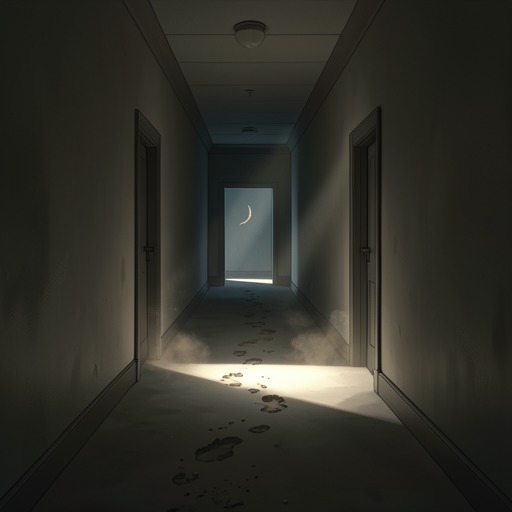
On August 11, 1990, while Will Navidson and Tom Navidson were photographing the hallway with a strobe, Mallory became involved in what initially appeared to be a familiar household chase. A loud yowl and bark sounded somewhere in the house; Mallory then rushed into the living room with Hillary nipping at his tail. The two animals had engaged in similar pursuits before, so the immediate action seemed routine.
The crucial difference came when both animals ran directly toward the hallway and disappeared into its darkness. Mallory’s passage is not presented as an intentional exploration or as a human decision imposed upon him. He follows the momentum of the chase, entering the space before the adults can interpret what is happening. His bodily response therefore precedes explanation: the hallway is encountered as a route, a lure, or an opening within ordinary domestic movement.
Will Navidson nearly follows, but he is diverted by barking outside and by Karen Green’s accusation that he has let the animals out on a day when they were supposed to remain indoors. The interruption produces a sharp reversal. What might have become an immediate investigation is displaced by an apparently mundane concern, and the unexplained interior space is temporarily folded back into the language of escaped pets and household disorder.
Return and Disappearance
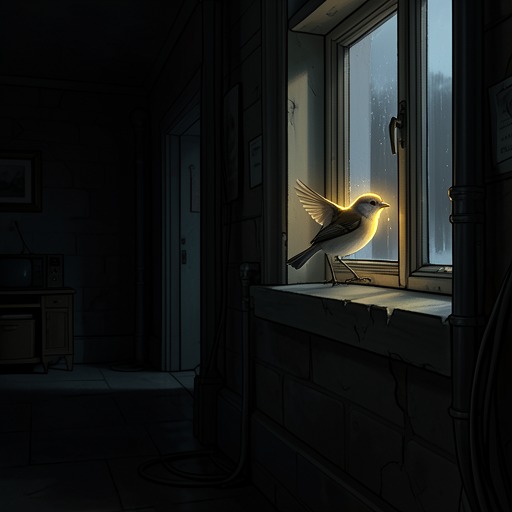
Mallory and Hillary are soon found in the backyard. Mallory is up a tree, while Hillary howls below him, apparently celebrating or reacting to the cat’s achievement. The return restores the animals to visible space and seems, for the moment, to cancel the more alarming possibility that they have entered the darkness and failed to come back.
That reassurance does not last. At the end of The Navidson Record, Mallory has vanished completely, and no account explains what happened to him. The text gives no confirmed death, recovery, or direct connection between the hallway and his disappearance. The uncertainty is therefore not resolved by later evidence; it is preserved as a gap in the record.
The contrast with Hillary is especially important. Hillary survives to appear later as an older, watchful dog whose growl warns strangers away, while Mallory receives no comparable concluding image. One animal’s altered presence can be observed; the other is reduced to absence. The house thus leaves different traces on the animals, or perhaps leaves no trace that human narration can securely distinguish from ordinary loss.
Narrative and Thematic Significance
Mallory’s role depends on the tension between evidence and unknowability. His dash into the hallway is witnessed, his return to the backyard is established, and his ultimate disappearance is stated, but the links among those facts remain unavailable. The sequence creates a compact version of the book’s larger structure: an apparently ordinary event opens onto an impossible space, a visible explanation briefly reasserts itself, and the final consequence survives only as an unanswered question.
As an animal, Mallory also exposes the limits of human interpretation. The people in the house debate plans, recordings, architecture, and intention, but Mallory acts without supplying an explanation of the space he enters. His movement cannot be translated into testimony. Even so, it has narrative force: the cat’s body registers the hallway as something through which life can move, while his disappearance suggests that the house’s threat cannot be measured solely by what human explorers choose to investigate.
Mallory is consequently more than a background pet, but less than a fully explained supernatural victim. His importance lies in the narrow interval between those positions. He is present in the domestic frame, crosses into darkness, returns to the ordinary world, and then becomes an absence that the record cannot account for. That unresolved trajectory intensifies the house’s uncanniness precisely because it refuses to turn the cat’s fate into a complete, knowable incident.