Memory and Forgetting
House of LeavesMemory and Forgetting is not merely a theme in House of Leaves but one of its central operating principles. People, images, rooms, letters, and manuscripts persist only through unstable acts of recollection, while forgetting can erase facts, protect the self, or expose truths that ordinary consciousness has refused. The book repeatedly makes remembrance belated, fragmented, and material: memory survives in damaged documents, recurring images, delayed recognition, and the fear that the past is changing even as it is recovered.
Memory as Fragmented Archive
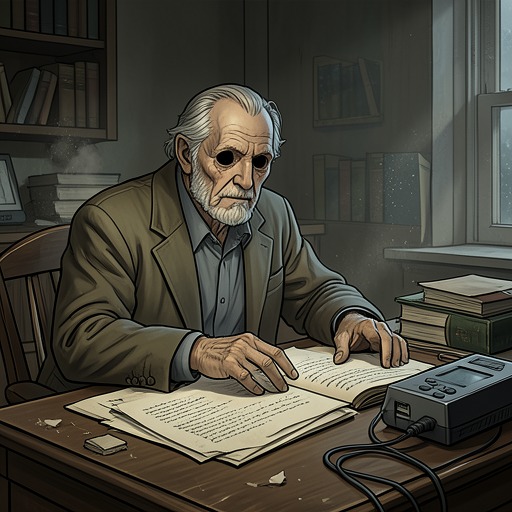
Memory first appears through the enormous, unruly body of material surrounding Zampanò’s manuscript. Johnny Truant encounters reams of writing scattered across napkins, envelope edges, a postage stamp, and other scraps. The fragments are handwritten or typed, legible or illegible, crisp or faded, burned, stained, folded, crossed out, amended, and repeatedly taped together. Their physical condition makes memory inseparable from preservation and decay. No document offers a pure original: every surviving piece bears the marks of revision, damage, omission, or uncertain transmission.
This archive also refuses to settle what it preserves. The accumulated writing may designate truth, deceit, prophecy, lunacy, or nothing at all, and its branching structure continually sends the reader toward further fragments. Memory therefore does not restore a finished past. It produces an expanding field of possible meanings in which evidence and interpretation cannot be cleanly separated. The publication history intensifies that uncertainty: the editors explain that Mr. Truant’s notes and Zampanò’s notes are distinguished typographically, while also admitting that they never actually met Johnny and handled publication through letters and occasional phone calls. Even the apparatus meant to clarify the record becomes another layer in the record.
Belated Recognition and the Changing Self
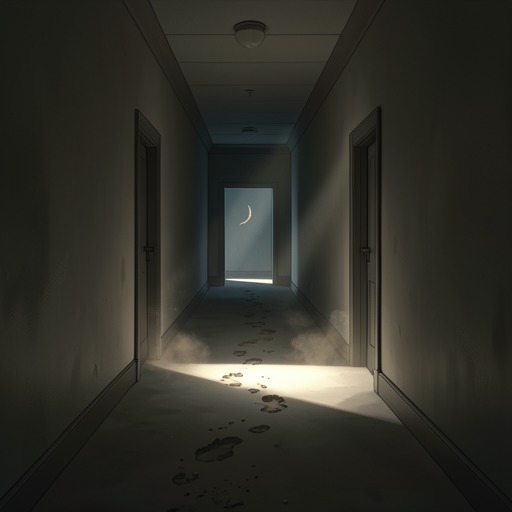
The book describes memory as an experience that may remain dormant until long after reading or witnessing has ended. A person may finish the work and continue ordinary life for months or years before suddenly realizing that perception, identity, and the surrounding world have shifted. The shelters once provided by television, magazines, and movies no longer protect; familiar walls become untrustworthy, hallways seem longer, and shadows deepen. The crucial knowledge is not simply remembered as a fact. It arrives as a transformation of the person who remembers, while the original source of that awareness may itself be forgotten.
This pattern gives memory the structure of delayed trauma. The past does not necessarily return as a complete scene or an intelligible explanation. It returns as altered perception, bodily fear, compulsive attention, or an inability to sleep. The remembered world becomes difficult to distinguish from the self that encounters it. The image of someone watching darkness for hours or years, afraid to look away, turns recollection into a form of vigilance: the subject tries to keep the feared thing at bay by preserving it in sight, yet the act of watching also allows it to dominate consciousness.
Johnny’s encounter with an echo dramatizes the same process. Hearing a girl’s voice carried across a dining hall, he first understands the voice as belonging to a ghostly seventeen-year-old who might restore a lost former self. Only afterward does he recognize that the “ghost” is the domed ceiling transmitting a confession he can never answer in the original moment. Memory here is neither simple recall nor supernatural return. It is a delayed reconstruction in which sound, architecture, desire, and loss combine to produce a meaning unavailable when the event first occurred.
Family Trauma and the Limits of Recall
The relation between memory and trauma becomes explicit in Johnny’s history with Pelafina Heather Lièvre. He recalls that her handwritten letters began after his father’s death and contained advice, encouragement, and faith. He believes they helped him survive Raymond, but he also remembers that her words eventually soured as her mental condition deteriorated. Her letters preserve intimacy while simultaneously recording the breakdown of the person who wrote them.
One letter changes Johnny’s understanding of his own scars. He initially assumes that Pelafina’s apology concerns an accident involving a pan of oil when he was four, but she is confessing to a later attempt to choke him. When Johnny was seven, his father intervened and took Pelafina to The Three Attic Whalestoe Institute for his safety. Johnny cannot fully remember the event; what remains is partial and blurred, including the shape of his father leading his mother away. The letter does not simply fill a gap. It makes the gap newly consequential, turning bodily marks into signs of suspicion and forcing Johnny to reconsider what his childhood memory had concealed.
The later letters continue to work against forgetting. Pelafina reminds Johnny that his father stopped her and took her to The Whalestoe, while acknowledging that he may or may not remember because he was seven. In another letter she admits that the institution’s director discouraged her correspondence and that Johnny needed to build a new life rather than remain troubled by his “mad mother.” Her writing thus oscillates between preserving a bond and recognizing that communication may itself burden the recipient. The archive of letters is an act of love, but it is also a record of separation, illness, and the unequal power to remember.
Pelafina’s death confirms the finality that the letters had resisted. The Three Attic Whalestoe Institute reports that she died in her room on May 4, 1989, at approximately 8:45 P.M., from self-inflicted asphyxiation using bed linen hung from a closet hook. She was fifty-nine. The institution adds that attendants said she often spoke fondly of her only son. Her death therefore leaves memory as the remaining form of contact: the institutional document records the mechanism and time of death, while the letters preserve affection that official language cannot contain.
Memory, Witnessing, and Representation
Karen Green’s work with Navidson’s film shows memory being deliberately constructed rather than passively retrieved. Through painstaking research and more than a hundred edits, she comes to see Will Navidson as more than a projection of her fears. The process allows her to recognize his tenderness toward her and their children, his respect for human perseverance, and the meaning of an obsession he had kept private. Editing becomes a method of re-seeing a relationship whose emotional truth had been obscured by fear and conflict.
Karen’s film also confronts the ethics of remembered images. She includes Navidson’s Pulitzer Prize-winning photograph of a starving Sudanese child stalked by a vulture, then holds on the image for twenty seconds before showing the back of the print for ten more. The photograph connects memory to witness: suffering becomes something preserved, circulated, and interpreted, but also something that can accuse the person who records it. By placing the image within a film about Navidson’s life and defeat, Karen remembers not only what he saw but what his act of seeing demanded of him and of those who later examine his archive.
Memory likewise shapes the children’s experience of the house. Karen recognizes that Chad and Daisy are in trouble and tells them that she will take them to their grandmother when their father returns. Yet when Navidson, Tom Navidson, and Billy Reston disappear into the hallway, Karen chooses to remain by the radios rather than leave her post to care for the children. Daisy withdraws to her room with her Spanish doll and dollhouse; Chad goes outside toward the woods, sometimes with Hillary and increasingly beyond the reach of the cameras. Their separation from Karen is not only physical. It creates a field of unrecorded experience in which childhood fear and anger pass beyond the archive’s ability to witness them.
Forgetting, Death, and Narrative Survival
At the furthest edge of the house, memory fails as a condition of life itself. Navidson’s words, tunes, and shivering murmurs gradually diminish into a painful rasp. He understands that his voice cannot warm the world, and memories cease to surface. The narration then states the progression with stark compression: Navidson is forgetting; Navidson is dying. Forgetting is not presented as an abstract opposite to memory but as a physical and existential depletion, a loss of the inner resources by which a person remains connected to the past and to others.
Navidson survives the immediate crisis, but survival does not restore him unchanged. His core temperature falls to 83.7 degrees Fahrenheit, and doctors must warm his internal organs with irrigating fluid because a cardiopulmonary bypass machine is unavailable. Afterward, frostbite takes his right hand and part of one ear; skin is removed from his face, his left eye is lost, and a shattered hip requires replacement. He will need a crutch for the rest of his life. Karen remains beside him, reading, singing, and sleeping on the hospital floor. Her care becomes a counterforce to the forgetting that threatened him: memory is sustained through repeated presence, voice, and bodily proximity rather than through documents alone.
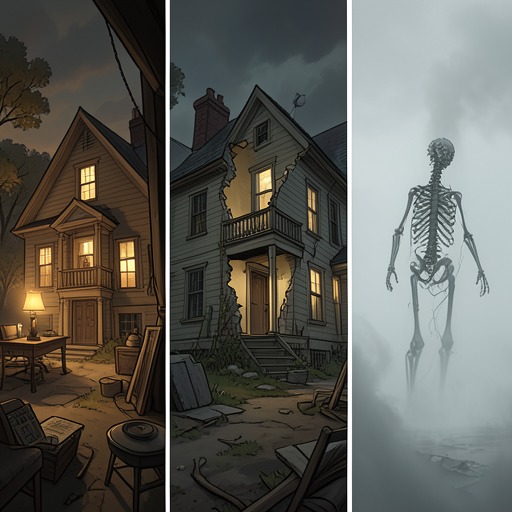
The book’s closing references place memory within a larger symbolic tradition. The Mother of the Muses is identified as Memory, yet she has left the speaker; Lethe is imagined as a slow river of oblivion whose waters run through a labyrinth. These images join remembrance to abandonment and forgetting to architecture. To remember is to navigate a maze whose passages may be lost, altered, or inaccessible; to forget is to drink from a river that offers release at the cost of identity. House of Leaves finally survives because its damaged voices continue to be recopied and reread, but that survival never abolishes loss. It preserves the evidence of disappearance as much as it preserves what disappeared.