Perception and Seeing
House of LeavesPerception and Seeing is one of the central organizing concepts of House of Leaves: it concerns not only the physical act of looking, but also the conditions under which light, space, images, memory, and interpretation become meaningful. The concept gains its sharpest force through the contrast between Zampanò, who writes incessantly about vision while having been blind since the mid-1950s, and Will Navidson, whose photographic discipline confronts a darkness that ordinary visual representation cannot contain.
Seeing, Light, and Blindness
Zampanò’s commentary repeatedly returns to light, space, shape, line, color, focus, tone, contrast, movement, rhythm, perspective, and composition. This sustained vocabulary of visual analysis is directed toward The Navidson Record, a documentary film made by a Pulitzer Prize-winning photojournalist attempting to capture darkness itself. The apparent subject is therefore not merely what can be seen, but the boundary at which vision fails and representation must find another method.
That concern becomes an irony embedded in Zampanò’s physical circumstances. His apartment contains unused candles, no clocks, very few light bulbs, and pale books, many of them in Braille. He had not seen anything since the mid-1950s and was described bluntly as blind. Readers and volunteers from community centers, the Braille Institute, the University of Southern California, the University of California, Los Angeles, and Santa Monica College came to read to him, yet none of those consulted claimed to know him well. His blindness thus does not cancel his authority on seeing; instead, it makes the relation between knowledge and sensory access one of the concept’s defining tensions.
The discussion of echolocation develops an alternative model of perception. Bats and dolphins use sound to create highly accurate acoustic images, effectively seeing the shape of sound without an intermediary screen. Human beings lack that neural sophistication, and the blind must rely on more precarious forms of contact: the tapping of a cane, the modulation of sound, the painful shape of a cracked shin, or a word sent down empty hallways long past midnight. Vision is consequently treated not as an isolated faculty but as one form of bodily orientation among others.
Acoustic Touch and Embodied Perception
The text proposes the formula “Sound + Time = Acoustic Touch,” shifting perception away from the assumption that seeing requires an image. Sound becomes a means of locating surfaces, distances, and threats; time supplies the duration through which those sounds can be interpreted. The formula also gives physical weight to perception, making it less like detached observation than a form of contact.
This argument is condensed in Gloucester’s line, “I see it feelingly.” The phrase joins sight and touch without allowing either sense to remain pure. To see can mean to feel one’s way toward an object, while feeling can become a mode of apprehending what the eyes cannot secure. In the context of Zampanò’s blindness and the house’s darkness, perception is therefore represented as an active, vulnerable negotiation with the world rather than a transparent window onto it.
The Camera and the Ethics of Looking
Will Navidson’s footage demonstrates how technical seeing depends on bodily and artistic control. In the material he shoots himself, the camera is rarely shaken, poorly framed, or visibly confused. Even in the house, it maintains remarkable steadiness and a refined aesthetic sensibility. By contrast, Holloway Roberts’s tape is tilted, unfocused, badly lit, and unstable before collapsing into oblivion when danger becomes unavoidable. Karen Green’s and Tom Navidson’s recordings are similarly inexperienced and useful chiefly for their content.
Navidson’s advantage is not simply courage or professional skill. He can face an alarming subject and shape it into an original visual form. His camera does more than record the otherness of the house; it makes that otherness perceptible as composition. This distinction separates looking from merely possessing visual information. The image is constructed through framing, focus, lighting, and position, and those formal choices determine how the viewer is placed in relation to what is shown.
The ethical stakes become explicit in Navidson’s earlier photographs. His thousands of images contain people but no scenery without people. He photographs soldiers, lepers, medics, newlyweds, families, victims, and survivors; the surrounding world matters because human beings inhabit it and sometimes manage to triumph despite suffering. His work repeatedly places him in opposition to mortality, yet he traditionally avoids photographing death without placing another person between himself and the threat. The human subject functions both as the object of attention and as a moral intermediary.
Delial and the Problem of the Empty Frame
The Delial photograph exposes the structure of Navidson’s seeing with unusual clarity. Delial crouches near the center of the image, sharply focused, holding a bone, while a vulture occupies the left side behind her, slightly out of focus and preparing to fly. The composition leaves the entire right side of the frame empty. That emptiness is not neutral: it represents Navidson’s unseen presence and influence, placing the photographer within the ethical and visual field even though he does not physically appear.
The arrangement prevents the viewer from becoming a comfortably detached spectator. Had Delial and the vulture been positioned in a more balanced, conventional manner, the audience might feel seated outside the scene, watching history through a safe proscenium. Instead, the empty area implicates the observer. What appears to be vacant space is understood as occupied by a pressure or presence, and the viewer becomes a participant in the act of looking.
The photograph therefore refuses to make subject matter the sole explanation for emotional response. Its effect comes from the balance of objects, the direction of attention, and the way composition draws the beholder into the image. Perception is shown to be relational: the viewer does not simply receive Delial’s suffering but enters a structure that includes the photographer, the subject, the predator, and the space left open for the viewer’s own position.
Perception and the Navidson House
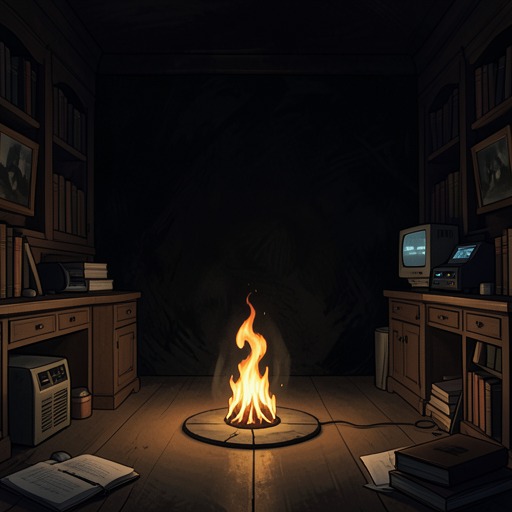
The house turns the theory of perception into an architectural crisis. At one point, Will Navidson reaches an entrance much larger than the others, arching above him into undisturbed blackness. His flashlight finds the floor but no walls and, for the first time, no ceiling. Only then does the scale of the house become apparent. Darkness is not merely an absence of illumination; it conceals dimensions that visual instruments cannot stabilize.
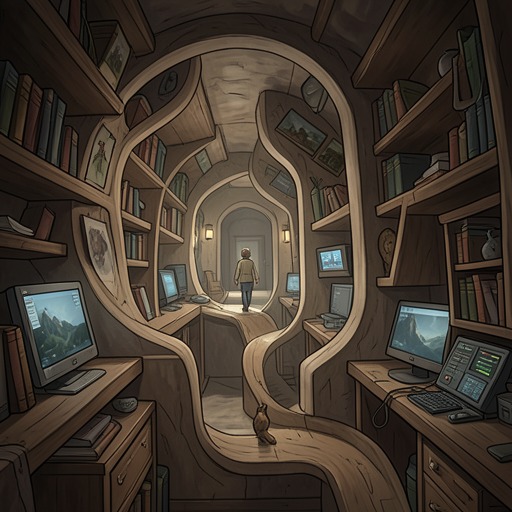
The house also unsettles the idea that architecture exists independently of experience. The concept of “experienced or concrete space” places the perceiving human being at the center of orientation, while Christian Norberg-Schulz argues that architectural space has its own centers and directions apart from any casual perceiver. The Navidson house makes those positions difficult to maintain. Its apparent structure changes according to who enters it, and each person encounters a vision almost completely, though pointedly not completely, different from everyone else’s.
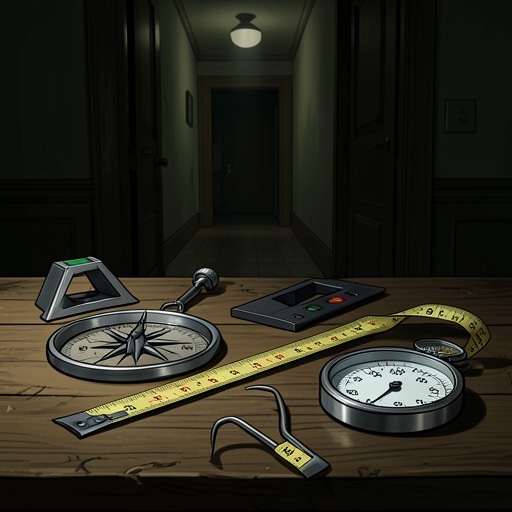
The resulting question is whether the house can exist without experiencing itself through human perception, or whether it is shaped by the perceptions brought into it. In this setting, architecture is neither a stable container nor a passive object. The observer’s movement, fear, expectations, and instruments participate in producing the space that the observer then attempts to understand. Perception becomes both the means of investigation and one of the forces making the investigated world unstable.
Memory, Selection, and the Limits of Vision
Karen Green’s filmic account of Navidson’s past expands perception beyond immediate sight into the organization of memory. The sequence moves from a sunlit backyard through a high-school prom, a grandmother’s funeral, Tom covering his eyes at a barbecue, a dive into a swimming hole, college graduation, and the brothers’ farewell before Vietnam. The family archive then breaks open into photographs of Cambodia, Thailand, Israel, Angola, and other sites marked by war, illness, violence, and deprivation.
These images do not offer a complete history. They are fragments selected from the late twentieth century, sometimes suggesting a larger whole without claiming to contain it. Navidson studies people rather than scenery, and his photographs make private memory collide with cultural catastrophe. The act of seeing is therefore also an act of choosing: what enters the frame, what remains outside it, and what sequence gives isolated images their apparent meaning.
Navidson’s own account reveals the psychological cost of that selection. In an intoxicated letter, he says that Delial is the name he gave to the girl in the photograph that brought him fame and admits that he can no longer understand why he kept her secret. He distinguishes the girl from the photograph while acknowledging that the image continues to haunt him. Perception here becomes inseparable from guilt, memory, and the unresolved question of whether recording suffering can constitute responsibility, evasion, or both.
The Concept’s Final Reversal
The deepest reversal occurs when Navidson returns to Ash Tree Lane. His established practice had been to photograph people, especially people threatened by death, thereby placing a human subject between himself and mortality. The house removes that intermediary. It is a place without population and without participants, one that threatens no one else’s existence but his own.
This change forces Navidson to photograph something unlike anything he had previously encountered: not a person in danger, but an unpopulated darkness that cannot be ethically contained by the familiar conventions of documentary photography. Perception and Seeing consequently becomes a study of exposure. The camera may steady the frame, but it cannot guarantee mastery; the eye may organize experience, but it cannot ensure that the world will remain organized. In House of Leaves, to see is to frame, interpret, and enter—and sometimes to discover that the act of looking has helped create the darkness it was meant to reveal.