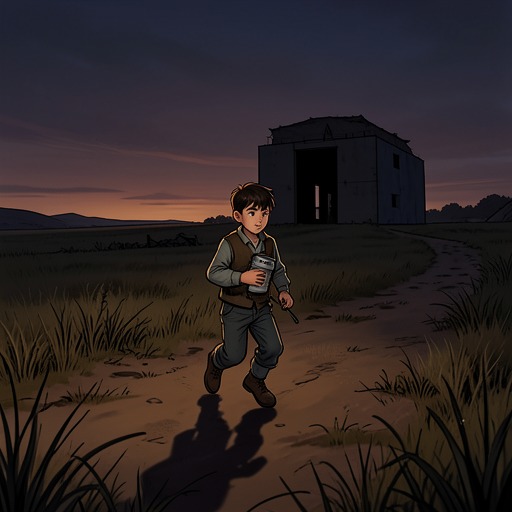
Raymond
House of LeavesRaymond is the former Marine who becomes Johnny Truant’s foster father and one of the most formative forces in his childhood. Defined by physical severity, obsessive control, and sudden violence, he turns domestic life into a regime of threat; yet his later death from cancer also marks the point at which Johnny’s persecutory past becomes irreversible memory rather than an immediate danger.
Identity and Household Authority
Raymond enters Johnny’s history after Johnny’s father dies and Johnny is moved through several foster homes. Johnny describes himself as troublesome wherever he went and says that no one knew what to do with him until he was placed with Raymond and his family. Raymond is physically imposing, with a beard rougher than horse hide and hands harder than horn, but his defining trait is not merely strength. He is a total control freak who intends to remain in command regardless of the means or cost, and everyone around him understands that he might die for that control as readily as he might kill for it.
Johnny is twelve when he arrives in Raymond’s household, too young to understand the structure of power into which he has been placed but old enough to resist it. His repeated insistence that he pushed, and pushed all the time, presents the conflict as reciprocal only in the narrowest sense: Johnny provokes authority, while Raymond possesses the adult power to enforce it. Their household therefore becomes an early training ground for the evasive intelligence Johnny will later use elsewhere.
Violence and the Formation of Escape
One winter night, closer to dawn than dusk, Raymond wakes Johnny by squatting on his bed in black, dirt-covered boots, chewing beef jerky, and jabbing him in the face until sleep is completely destroyed. He calls Johnny “Beast” and demands an understanding of what Johnny’s place is in the household, emphasizing that the boy is not truly part of the family even though he has lived with them for nearly a year. The scene combines familial language with deliberate exclusion: Raymond claims authority over Johnny while denying him secure belonging.
The violence becomes explicit when Johnny escapes after a confrontation. During an earlier incident, a rusty bar taught him the taste of teeth. The next time, he flees the house, scrambles over the back brick wall, crosses an overgrown lot, and hides in the stairwell of a nearby shop, identified uncertainly as Gallow & Sons, a chimney-sweep business. Raymond eventually finds him, though time has dulled the immediate force of his rage. He still strikes Johnny with an open-handed slap to the left ear, leaving pain and a deafening quiet before Johnny’s forehead skids against the concrete wall, while shouting about Johnny’s school fights, attitude, wandering, and the possibility of killing him if he does not stop.
Johnny responds not by confronting Raymond directly but by developing methods of survival. The next morning he lies about the injuries, claiming they came from another schoolyard fight. He begins to flatter Raymond, use self-deprecating invented stories, and acquire a vocabulary of bending, hiding, dodging, and ducking. Beyond everyone else’s gaze, he meticulously plans his flight. Raymond’s control thus produces the very guile that allows Johnny to escape it.
Illness, Death, and Retrospective Power
By the time Johnny manages to flee first to Alaska and then to a boarding school, Raymond is already dying. Cancer has settled into Raymond’s bones and riddled his liver and pancreas, leaving him with nowhere to run as the disease consumes him. Raymond is dead by the time Johnny turns sixteen. The coincidence gives Johnny’s escape a grim counterpoint: he leaves the household, but Raymond’s body is already undergoing its own inescapable imprisonment.
Raymond’s death does not resolve the emotional structure of the relationship. Johnny’s later recollection remains organized around the techniques Raymond forced him to learn—concealment, misdirection, and flight—and around the fear that violence can erupt inside a supposedly protective home. The danger has ended physically, but its methods continue within Johnny’s memory and self-understanding.
Relation to Johnny’s Family History
Raymond’s household stands between two disrupted parental histories. Johnny has already lost his father before entering foster care, while his mother, Pelafina Heather Lièvre, is absent and institutionalized. Her handwritten letters later become a source of advice, encouragement, and faith, and Johnny says he might not have survived Raymond without them. The contrast is stark: Raymond exerts control through proximity and intimidation, whereas Pelafina reaches Johnny across separation through language, even though her own mental deterioration eventually complicates that correspondence.
Pelafina’s letters also disclose an earlier family trauma that changes how Johnny understands his scars and childhood. She apologizes for trying to choke him when he was seven, an act that led Johnny’s father to take her away to The Three Attic Whalestoe Institute for his safety. Raymond is therefore not the origin of every threat in Johnny’s childhood, but the foster father who inherits and intensifies a life already marked by parental death, maternal illness, forced separation, and unstable care.
Narrative Function
Raymond is recalled through Johnny’s unstable, self-questioning narration rather than presented as an independently documented figure. That mediation matters: Raymond is both a person with a specific history—a former Marine, foster father, controller, abuser, and cancer victim—and a pressure point in the story of how Johnny becomes someone who survives by turning experience into guarded narrative. The remembered scenes do not offer sentimental reconciliation. They preserve Raymond’s boots on the bed, his fingers in Johnny’s face, the slap against the ear, the flight over the wall, and the cancer that kills him, making domestic authority appear as both immediate violence and a long afterlife of fear.