Representation and Reality
House of LeavesRepresentation and Reality names the book’s governing paradox: the difference between an event and the forms that make the event available to others can never be safely erased. The Navidson Record is declared nonexistent, many of its authorities are invented, and even its apparently documentary images are vulnerable to manipulation; yet the fiction does not become harmless. Its consequences remain real within the lives, judgments, fears, and interpretations organized around it.
A Documentary Without an Original
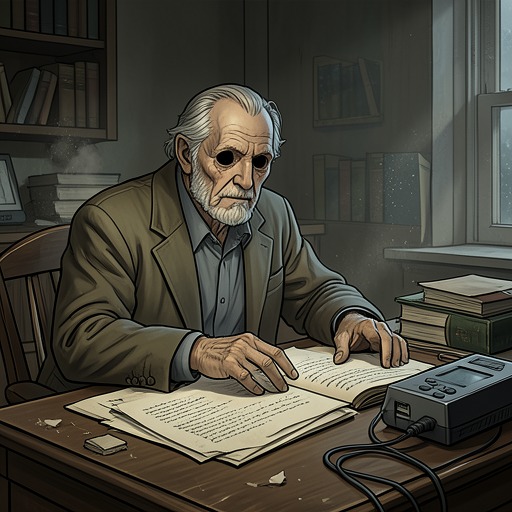
The problem first appears through the status of The Navidson Record itself. Johnny Truant reports that Zampanò’s entire project concerns a film that cannot be found in theaters or video stores. He searched for it, contacted the famous people supposedly connected with it, and found that they had never heard of Will Navidson or Zampanò. The documentary therefore has no verifiable original behind the critical apparatus built around it.
The instability extends to the written record surrounding the film. Several books cited in the footnotes are fictitious, including Gavin Young’s Shots In The Dark and The Works of Hubert Howe Bancroft, Volume XXVIII, while other references point to genuinely existing publications. The mixture of authentic and invented sources prevents a simple division between reliable scholarship and deliberate fabrication. Johnny also accepts responsibility for his own mistakes and for errors by Zampanò that he failed to detect or correct, making the document’s authority uncertain at every level.
Yet the book insists that the documentary’s fictional status does not settle the matter. The irony is that whether the film is real or unreal makes no difference to what follows, because the consequences are the same. Representation is thus not treated as a transparent window whose value depends only on whether an original object can be authenticated. A nonexistent film can still generate belief, fear, argument, testimony, and ethical response.
The Image as Evidence and Threat
The discussion of photography and film develops this paradox through the history of documentary credibility. Recreated scenes in Nanook and accusations surrounding televised footage show that apparently spontaneous images may contain construction. Digital manipulation intensifies the danger by making it increasingly difficult to distinguish a genuine image from one altered electronically. The predicted result is not merely that some photographs will be false, but that the credibility of reproduced images will be diminished more generally: even unmanipulated pictures will be received in a climate of reduced expectations.
The same technology that teaches viewers to mistrust images also supplies techniques for accrediting them. Digital imaging can expose the assumptions behind photographic objectivity and closure, but it can also create new effects of authenticity. The book therefore refuses a clean opposition between natural images and artificial ones. A polished image may look suspicious, while a damaged, grainy, or apparently accidental image may persuade precisely because its defects resemble the marks of unfiltered reality.
This is the logic of grit. Seemingly functionless detail can signal that an image is a sample of the real, even though such detail may itself be produced or selected. The debate over The Navidson Record turns on this tension: critics are impressed by its roughness and physical particulars, yet the impossible architecture of the house remains difficult to accept. Grit may make a representation feel true without proving that it is true.
The Recorded Moment and Its Rupture
The death of Jed provides the most severe test of representation. The footage initially records a sudden transformation in Jed’s emotional state: terror becomes laughter and sobs of relief when he learns that he will live. The sequence seems to preserve the miraculous instant in which a thirty-three-year-old man from Vineland, New Jersey, engaged to be married and fond of Seattle coffee and Lyle Lovett, believes that his sentence has been remitted.
A fraction of a second later, the same recorded event reverses that apparent deliverance. One bullet pierces Jed’s upper lip, passes through the maxillary bone, and destroys the back of his head. The film preserves the trajectory of fragments and blood across successive frames, but the abundance of visual information cannot reassemble what has been shattered. The record can isolate the instant of destruction without restoring the person destroyed by it.
The spacing of the account makes the rupture material. The aftermath is said to be completed between two frames, so that the event exists simultaneously as a continuous catastrophe and as a gap in the medium that records it. The camera captures what happened, but its precision does not provide comprehension or recovery. Frame-by-frame analysis may establish sequence and trajectory; it cannot undo the irreversible split between before and after.
The sequence is then falsely authenticated through a fabricated critical response attributed to Ken Burns, who supposedly praises its lack of anticipation and its painful immediacy. The passage presents the image as real because it appears unprepared, yet immediately reveals that Burns never made the comment and had never heard of The Navidson Record or Zampanò. The supposed witness to documentary authenticity is itself invented, turning critical endorsement into another layer of representation rather than independent confirmation.
Inadequate Images and Human Witness
The escape from the house exposes a different limit. Navidson later reflects that the darkness on the recording does not look dark and that the leap appears easy, because the images fail to convey hollowness and cold. His judgment is not that the cameras contain no information, but that they fail to record what matters. Numerous Hi 8 cameras are mounted throughout the house, yet the resulting footage remains inadequate.
The cameras behave like a cheap surveillance system: they render spaces impartially, fail to adjust when action leaves the frame, and cannot follow the significance of an event. Their mechanical neutrality becomes a form of blindness. What is visible is not necessarily what is important, and the absence of a camera in Navidson’s hands prevents the sequence from acquiring a guiding human perspective.
Only the interviews supply the emotional dimension of the escape. They show how the moments bruise and bleed, adding human memory and interpretation to images that cannot themselves follow, understand, or care. Representation therefore requires more than visual capture. The recorded image preserves surfaces and intervals, while testimony supplies consequence, vulnerability, and the felt weight of what the image misses.
Consequences Beyond Verification
Representation and Reality finally shifts the question from whether a document is authentic to what the document does. A fictitious documentary, forged citations, invented authorities, manipulated images, and inadequate footage all undermine the promise that representation can simply deliver reality intact. But their failure does not empty the represented world of force. The false film still structures inquiry; the fabricated commentary still imitates the language of expertise; the recording of Jed’s death still confronts viewers with an event that cannot be made whole; and the failed images of the escape still require witnesses to articulate what the machines could not show.
The book’s deepest irony is therefore not that images lie. It is that even truth-bearing forms remain powerful after their authority has been compromised. Representation cannot guarantee reality, but it can alter how reality is remembered, judged, feared, and believed. The gap between the two is not a defect that the narrative resolves. It is the condition under which the entire work operates.