SOS Distress Signal
House of LeavesSOS Distress Signal is the emergency code that converts an unseen danger inside the Navidson House into an unmistakable demand for intervention. In the narrative, it operates simultaneously as a practical maritime signal, a sound produced by Holloway Roberts’s missing expedition, and a formal pattern through which Will Navidson turns waiting, estrangement, and the desire to rescue into the structure of his film.
Definition and Conventional Form
SOS is defined as a wireless code signal summoning assistance in extreme distress, especially one used by ships at sea. Its letters were chosen arbitrarily because they were easy to transmit and distinguish; the signal was recommended at the Radio Telegraph Conference in 1906 and officially adopted by the Radio Telegraph Convention in 1908. Its meaning therefore depends not on any natural connection between the letters and danger, but on shared convention and reliable repetition.
In the narrative, that convention is rendered acoustically as three quick knocks, three slow knocks, and three more quick knocks, represented as three short signals, three long signals, and three short signals. The form is simple enough to be recognized even when its source cannot be located. That recognizability gives the signal force: the hearers do not need to understand the surrounding noise in order to understand that someone, or something, is asking for help.
The Signal from the House
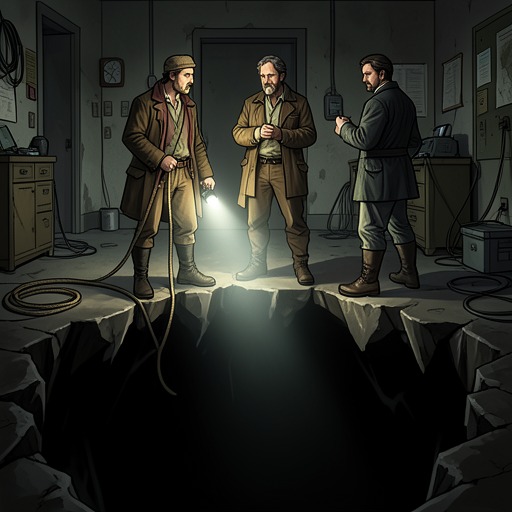
The signal becomes decisive after Holloway Roberts’s team has disappeared into the house. On the seventh day there is still no sign of the expedition. By the seventh night Billy Reston fears the worst, and during the early morning hours of the eighth day the radio continues to produce only incomprehensible static while a faint knocking rises from somewhere inside the house. Chad Navidson and Daisy Navidson detect it first; by the time they reach their parents’ bedroom, Karen Green is already awake and listening.
The sound resembles knuckles rapping against a wall: three quick knocks, three slow knocks, and three more quick knocks, repeated over and over. The family searches both upstairs and downstairs but cannot find its source, although every room seems to resonate with the distress signal. Tom Navidson eventually presses his ear against the living-room wall and reports that the sound is coming from within it, at one point seeming to originate directly on the other side. The signal thus supplies a location without supplying access. It points toward an immediate presence while preserving the house’s deeper uncertainty.
From Emergency to Rescue Attempt
The signal changes the emotional and visual organization of the household. Before it arrives, the waiting sequence is marked by separation: Navidson, Tom, Reston, and Karen occupy isolated images, and the expedition’s absence turns the house into a field of private strain. Once the knocking is heard, the distress call eliminates the jump cuts and reunites everyone in a single frame. A message that announces separation paradoxically produces temporary reintegration.
It also gives Navidson the opportunity he has been waiting for. He declares his intention to lead a rescue attempt, and the sequence begins to resolve its visual tensions as he assumes command. Karen, however, is furious and asks why the police cannot be called and why the rescue must be undertaken by the celebrated Will Navidson. Her objection exposes the conflict between public heroism and domestic responsibility. She has already insisted that if Navidson enters the place, she will go too, because that is their agreement; at the same time, she wants him to accept that his children need him alive and that she wants to grow old with him.
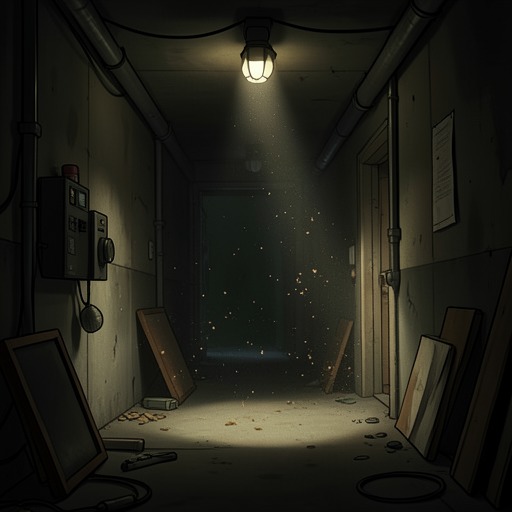
The rescue preparation makes the code operational rather than merely symbolic. Reston is assigned to handle the radios and relay communications between the living-room command post and Navidson and Tom, who will continue down the stairs. Each participant wears a Hi 8 camera in a chest harness. Navidson also carries a Nikon with a powerful Metz strobe, while Reston volunteers to carry a 16mm Arriflex. Karen unhappily takes over the radios and watches the men disappear into the darkened hallway, later calling her mother to report Navidson’s departure and his mention of Delial. The signal therefore initiates a chain of action, redistributes responsibilities, and forces the family’s private dispute into a rescue operation.
Navidson’s Formal Encoding
Navidson names the sequence SOS not only because it records the distress signal from Holloway’s team, but because he incorporates the signal’s rhythm into the editing itself. Tasha K. Wheelston identifies a pattern in which three shots of short duration alternate with three shots of longer duration. The sequence begins with three quick angles of Reston, followed by three long shots of the living room, then returns to three short shots and continues in that cadence. Although the filmed content occasionally interrupts the rhythm, the three-short, three-long, three-short structure remains unmistakable.
This construction turns a conventional signal into a cinematic grammar. The emergency is not merely shown; it determines the duration and arrangement of what is shown. Short shots create pressure and interruption, while the longer shots stretch the viewer through the same suspended interval that torments those waiting for the expedition. The form binds external danger to the domestic atmosphere surrounding it: Reston listens to the radio, Karen watches from the house, and Navidson paces in frustration, but the editing makes their separate anxieties part of one repeated signal.
A Belated and Personal Cry for Help
The irony of the sequence lies in its chronology. Navidson fashions SOS long after the Holloway disaster has occurred but before his final plunge into the place. The film therefore presents a call that is temporally displaced: it comes too late to save Holloway’s team and too early to provide help for Navidson’s own impending ordeal. Its urgency is real, yet its placement deprives it of ordinary hope.
The sequence also transforms the distress call into an indirect expression of Navidson’s personal crisis. His relationship with Karen has been deteriorating after years of assignments abroad, brief returns, and increasing alienation. Their move was supposed to begin a reconciliation, but Navidson takes refuge in documentary work, converting the attempt to repair their relationship into a subject for documentation. Karen sees the house as a danger that may take him from the family; Navidson experiences his inability to enter it as an unbearable frustration and believes that her fears have displaced any recognition of what he cares about. SOS gives those opposing positions a common form: Karen calls for protection by resisting the descent, while Navidson answers the house’s call by preparing to enter it.
The final shots make the doubleness explicit. The last two short shots show Karen on the telephone, adding an acoustic message to the established visual pattern: three busy signals followed by three rings. The emergency code has migrated from the wall to the edit, and from the edit to the telephone. In that movement, SOS ceases to be only the signal of Holloway’s trapped team. It becomes the film’s recurring figure for delayed communication, divided loyalties, and a family trying to make itself heard before rescue becomes impossible.