Storytelling as Protection
House of LeavesStorytelling as Protection names one of the central survival mechanisms in House of Leaves: narrative does not simply represent experience but intervenes between a person and what that person cannot yet bear to see. Johnny Truant turns improbable stories into a screen for his scars and memories, while the manuscript’s larger structure repeatedly shows that changing, withholding, and revising the past can both defend the self and destabilize any secure distinction between truth and invention.
Stories as Social Deflection
Johnny and Lude’s friendship is partly organized around performance. Lude enjoys Johnny’s readiness for whatever misstep he has planned, and he is especially impressed by Johnny’s disjointed history: working in Alaska at thirteen, sleeping in a whorehouse in Rome by eighteen, and possessing a seemingly inexhaustible supply of stories. Johnny’s scars provide the most effective material. He offers women a fabricated account of having spent two years in a Japanese martial-arts cult made entirely of Koreans living in Idaho, where an initiation ritual supposedly required him to lift a scalding metal wok with his bare forearms. The story changes in its details, sometimes replacing a kiln-heated wok with one filled with red-hot coals, but its function remains stable: it converts a frightening bodily fact into an entertaining anecdote.
The joke, the escalating embellishments, and the correction from one version of the location to Idaho make the performance visibly artificial. Johnny knows that many women probably recognize the story as false, yet the fiction still succeeds because it gives them something safer to attend to than the scars themselves. The narrative does not erase the evidence on his arms; it redirects the gaze. By supplying an absurd explanation, Johnny offers other people a way to look away without having to ask what actually happened.
Protection from the Past
Johnny explicitly recognizes that the invented stories may be useful not only to his audience but also to himself. Looking at the horror extending from his wrists to his elbows requires a person to decide whether the truth is worth knowing, and Johnny observes that most people prefer not to know. His stories therefore function as a form of mutual avoidance: they let listeners withdraw from his body, and they let Johnny withdraw from the memory attached to it. The fiction becomes a narrative bandage, not because it heals the wound, but because it covers the moment at which the wound would demand testimony.
The principle expands beyond Johnny’s scars. He concludes that everyone creates stories to protect themselves, presenting narrative defense as a general human practice rather than a private eccentricity. The statement also changes the status of the surrounding book. Stories told by Johnny, Zampanò, and the documentary materials associated with The Navidson Record cannot be treated as neutral containers for facts; each may be shaped by fear, shame, desire, or the need to keep an unbearable reality at a manageable distance.
Evasion, Revision, and Delayed Disclosure
Johnny’s defensive storytelling appears most clearly when he approaches the story behind his broken tooth. An editorial note identifies his tendency to alter details or change the subject as a form of refusal, and Johnny accepts the charge. He describes smoothing edges, removing corners, recoloring or decoloring events, and even inserting cartoonish interruptions to turn what happened into something theatrically false. He has already avoided the subject through a fictive tooth improvisation and through a diversion involving Santa Cruz and a girl he barely knows. The evasions are not random digressions: they are repeated maneuvers around a specific memory.
When Johnny finally approaches that memory, he does not present disclosure as simple or complete. He considers stopping, smoking, drinking, or doing virtually anything else that would prevent him from relating the real story. At the same time, he believes that writing at least part of it might help him see its truth, details, taste, and time, and perhaps reevaluate or re-understand what occurred. The possibility of burning the pages afterward preserves an escape route. Writing becomes both exposure and retreat: a controlled encounter with the past that can still be destroyed if recognition becomes intolerable.
The recovered memory places this mechanism in a biographical context. After his father’s death, Johnny was moved through several foster homes and was considered trouble wherever he went before eventually reaching Raymond and his family. Raymond, a former marine described as fiercely controlling, represents part of the coercive world Johnny has tried to approach indirectly. The broken tooth is therefore not an isolated anecdote but a point where bodily injury, childhood displacement, and the long habit of altering details converge.
When the Story Begins to Create the Self
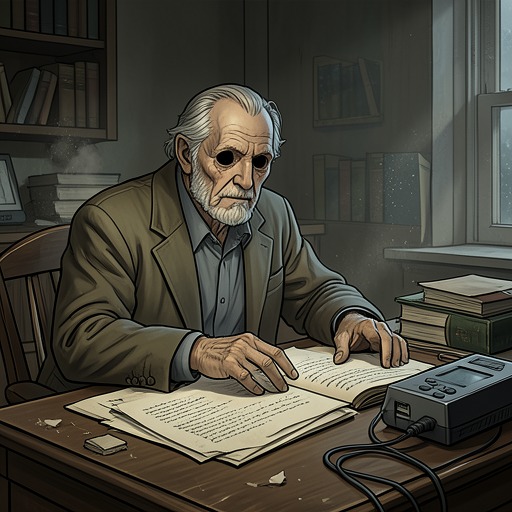
The protective function of narrative becomes more disturbing as Johnny works on Zampanò’s manuscript. He describes the pages spread across a table as bloodless and still but not dead, dependent on him for paper, ink, and reproduction. In this formulation, Johnny is the source who feeds and animates the work. Without him, the manuscript would perish. Yet the apparent hierarchy soon reverses. Johnny increasingly feels that he has everything turned around: perhaps the manuscript has created him rather than the other way around.
This reversal reaches into his sense of identity. During episodes of derealization and depersonalization, Johnny imagines himself as merely the material of another voice, a voice that possesses him with histories he does not recognize as his own, invents him, defines him, and directs him. His associations with Raymond, Thumper, Kyrie, Ashley, the women in his life, the Shop, and his studio all risk being reduced to nothing. Storytelling has crossed from defense into authorship of the defended subject. The narrative that once protected Johnny from his past may now be producing the very self that experiences that past.
Fragmentation and the Limits of Truth
The book’s final reflections refuse to resolve the conflict between what is remembered, invented, written, found, lost, done, and left undone. In an entry dated October 31, 1998, Johnny describes the pages as stuck together with honey from making tea and with blood, then asks what separates what is read from what is left, and what is invented from what is remembered. These material stains make the manuscript’s instability physical: the archive is not cleanly separated from the body that handles it.
Storytelling as Protection therefore carries a double consequence. It allows Johnny to approach experiences that direct statement might make unbearable, and it gives other people a socially acceptable way to avoid intimate knowledge. But the same process multiplies versions, interrupts chronology, and makes the narrator uncertain whether he is preserving a self or receiving one from the text. Protection is thus neither simple deception nor straightforward healing. It is a precarious form of survival whose shelter can become another enclosure, leaving truth present but continually displaced by the stories built around it.