Suicidal ideation
House of LeavesSuicidal ideation is not treated as a single private thought but as a recurring pressure shaping the lives of Holloway Roberts and Will Navidson. In Holloway’s case it appears as a documented, chronic condition that turns perceived failure into self-destructive action; in Will Navidson’s case it becomes a persistent shadow accompanying achievement, artistic ambition, and physical entrapment. The novel finally renders it as a condition of consciousness itself: when Navidson is dying in the darkness, the possibility of death becomes the only certainty left to him.
Clinical Record and Holloway Roberts
The clearest early formulation appears in the psychiatric notes attributed to Nancy Tobe, who treated Holloway Roberts for depression. The first page of her notes contains only the capitalized phrase “CONSIDERING SUICIDE.” The starkness of the entry reduces a complex life to an immediate danger, while the nearly illegible pages that follow intermittently preserve the words “family,” “father,” “loyalty,” and “the old home.” Suicidal ideation therefore enters the narrative beside damaged memory and unresolved obligation rather than as an isolated symptom.
Tobe’s typed summary describes a striking contradiction between Holloway’s accomplishments and his self-assessment. He had led scuba-diving expeditions in the Gulf of Aqaba, guided climbers up the Matterhorn, and organized expeditions to both the North and South Pole, yet he remained unable to recognize what he had achieved. He experienced himself as inadequate, suffered acute and chronic depression, and repeatedly dwelt on suicide. Tobe considered antidepressant treatment and recommended daily counseling, establishing suicidal ideation as both clinically recognized and resistant to the ordinary evidence of competence.
The account of Holloway’s first love supplies an earlier image of this inadequacy. At seventeen he met Elizabeth, whom he described as beautiful like a doe, and briefly became her partner. The relationship ended after he failed to make the varsity football squad; Elizabeth’s interest faded, and she began dating the starting tackle. Holloway was left heartbroken, with his sense of inadequacy intensified. Later interpretation connects his killing of a doe with Elizabeth, but the text refuses certainty about the direction of that association. He may have called Elizabeth doe-like before the hunting incident, or he may have adopted the image afterward to enlarge his guilt, making the animal’s death stand for the death of love as well.
Failure, Violence, and the House
Holloway’s suicidal impulse becomes especially dangerous during the exploration of the house. When Kirby “Wax” Hook and Jed Leeder insist on turning back, Holloway interprets their decision as an admission of failure, though that interpretation is explicitly presented as mistaken. Their retreat activates the inadequacy that has governed him for years. The psychic defenses he had developed to prevent self-destructive consequences no longer hold, and his first violent act against Wax becomes the beginning of what the narrative characterizes as a nearly operatic suicide.
The house intensifies this collapse by functioning like an immense isolation tank. Its lack of light, changing temperature, and reliable sense of time deprives an individual of ordinary sensory coordinates. As isolation continues, the explorer begins to generate sensation internally and to project more of his personality onto bare walls and vacant hallways. Holloway’s violence thus cannot be separated from the architecture that surrounds him: the house does not simply contain his despair, but magnifies and externalizes it.
The psychological interpretation surrounding Holloway also places suicide near aggression. Wilhelm Stekel is cited as arguing that a person who kills himself may also wish to kill another person or desire another’s death, while later psychiatric formulations describe suicide as arising from murderous hatred or an urgent need to escape suffering. Robert Jean Campbell similarly presents suicide or attempted suicide as an aggressive attack against a loved one or society, a bid for attention, or a possible attempt to reunite with an ideal love-object or mother. These theories are not allowed to settle Holloway’s meaning completely. The text counters that a person with comparable self-destructive urges, placed under comparable conditions, need not attempt to murder two people. The proximity between self-destruction and violence is therefore a problem for interpretation, not a universal explanation.
Will Navidson’s Persistent Shadow
Will Navidson openly acknowledges suicidal thinking. In a recorded comment, he says, “I think too often too seriously about killing myself.” He describes the thought as present before sleep, upon waking, and at many points in between, recalling Nietzsche’s idea that the thought of suicide can serve as a consolation capable of carrying someone through a bad night. Unlike Holloway, however, Navidson has converted much of his despair into art. He regards his achievements with disdain, considers his direction vague, and assumes that life will never satisfy his desires, but he relies on his eye and his film to give meaning to nearly everything he encounters.
That artistic conversion distinguishes Navidson’s suicidal ideation from Holloway’s more explosive trajectory without making it less serious. Navidson’s camera produces “little windows” of beauty, yet the same practice exacts the price of lost interaction. Film becomes both a defense against despair and a way of remaining at a remove from ordinary human contact. His work gives form to experience, but it does not remove the thought of death that remains beside him.
The contrast between the two men is consequently ethical as well as psychological. Holloway reads withdrawal as failure and turns the resulting shame outward and inward at once. Navidson repeatedly turns despair into representation, making images where Holloway makes an attack. Yet the difference narrows inside the house, where isolation strips away the stabilizing power of accomplishment, relationship, and artistic control. Both men confront a space in which the self becomes its own most dangerous environment.
Falling Toward the End
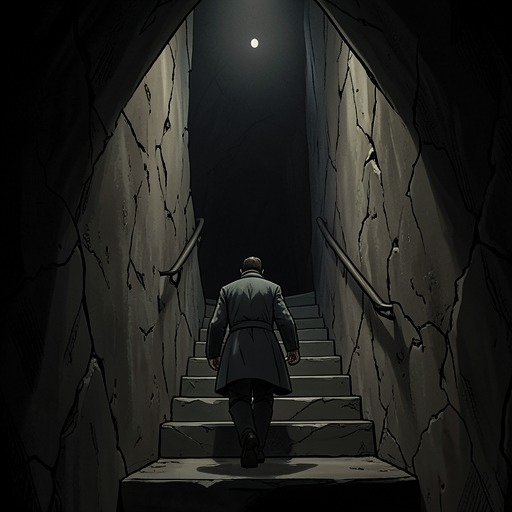
During Navidson’s final descent, suicidal ideation becomes inseparable from the immediate fact of dying. He says, “I have no sense of anything other than myself,” then describes the sensation of falling toward a bottom that he expects to strike. Soon he recognizes that he will be dead before he can know whether he has hit anything. From this realization he reaches the conclusion that there is no bottom for him, only his end. The darkness does not provide a final object or destination; it reduces existence to the anticipation of termination.
Navidson records his own sobs and groans, preserving evidence of suffering even as his ability to orient himself disappears. A brief joke about having fallen so long that falling feels like floating up offers momentary amusement, but the relief does not last. He becomes less concerned with location and increasingly occupied by the people he has known and loved. He calls out to Tom Navidson, remembers Delial and his children, and turns repeatedly toward Karen Green, saying, “I’ve you. I’ve lost you.” The movement of his thought is from spatial uncertainty to relational loss.
The progression ends not in a triumphant insight but in cognitive and physical extinction. His words, tunes, and shivering murmurs trail into a rasp; the voice that once recorded and interpreted experience can no longer warm the world around him. The narrative states the final condition with blunt repetition: Navidson is forgetting, and Navidson is dying. Suicidal ideation has therefore developed from a thought that accompanies life into a terminal awareness in which the end is the only thing that remains fully certain.
Narrative and Thematic Significance
Across these episodes, suicidal ideation links depression, perceived inadequacy, isolation, aggression, artistic representation, and the limits of knowledge. The clinical phrase in Tobe’s notes, Holloway’s misrecognition of retreat as failure, Navidson’s description of suicide as consolation, and his final conviction that only his end exists form a sequence of increasingly stripped-down statements. Each removes another support: achievement cannot secure worth, defense mechanisms cannot contain violence, art cannot guarantee connection, and perception cannot survive death.
The novel also treats the language surrounding suicide as unstable. Holloway’s history is mediated through damaged notes, speculation, inked-out passages, and competing interpretations, so the reader encounters his impulse through gaps as much as through declarations. Navidson’s recordings seem more immediate, but his final speech likewise breaks apart under physical extremity. In both cases, suicidal ideation appears where narration is least able to provide mastery. The desire for an ending may be stated, analyzed, displaced, or recorded, but the text’s recurring silences show that no account finally contains it.