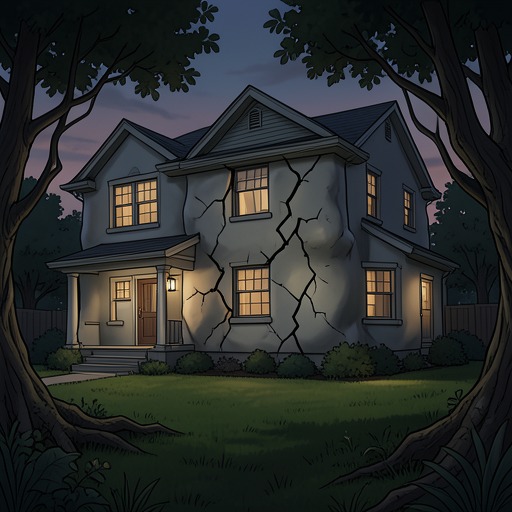
The Anteroom
House of LeavesThe Anteroom is the threshold zone through which the Navidson house first makes its impossible interior perceptible. It is neither simply a room nor merely a passage. Connected to the house’s doorless hallways, the Great Hall, and the Spiral Staircase, it turns entry into an encounter with shifting dimensions, unstable orientation, and darkness that cannot be mastered from outside.
Definition and Appearance
The Anteroom emerges when Navidson discovers that the house’s measured interior cannot be reconciled with its architectural plans. After comparing the plans with measurements taken using a 25’ Stanley Power Lock, he recognizes that something is physically wrong and hopes the discrepancy is only “a case of bad math.” The subsequent appearance of a dark, doorless hallway in the west wall gives that contradiction spatial form. The children’s voices travel through it with separate echoes, although no ordinary room in the house is long enough to produce them.
The space is therefore defined less by stable dimensions than by its relation to thresholds. It opens from a familiar domestic room into darkness, yet its position is not secure: the narrative notes that the hallway was initially placed on the north wall and later appears on the west wall. This relocation makes the Anteroom an architectural contradiction as well as a physical entrance. The house does not merely contain an impossible space; it changes the terms by which containment, location, and adjacency can be judged.
Entry, Exploration, and Scale
Navidson enters the newly appeared passage without hesitation when Chad and Daisy’s cries lead him toward it. Karen cannot follow. She freezes at the threshold, overwhelmed by the darkness and by the claustrophobia that the scene reveals as a chronic disability. Navidson returns carrying both children, who still hold their homemade candle and seem eager to go back, while Karen’s terror leads the family to make the addition temporarily off limits.
Later, Holloway, Jed, and Wax explore the passage with nearly two miles of fishing line. Their recorded route proceeds through a series of left turns toward the apparently endless corridor and then into the vast space where Navidson had nearly become lost. Their stronger flashlights reveal a ceiling at least two hundred feet high and, approximately fifteen hundred feet away, an opposing wall. The apparent Anteroom thus functions as an approach to spaces whose scale exceeds the house’s visible exterior and ordinary architectural categories.
The exploration also establishes the limits of navigation. Holloway stops when the fishing line runs out and when he hears the growl previously reported by Navidson. On the return journey, the walls have shifted, though not as drastically as during Navidson’s earlier expedition. The line remains intact, allowing the explorers to find their way back, but the altered walls confirm that the threshold does not lead into a fixed interior. It leads into a space whose topology can change during the act of investigating it.
Orientation and Unstable Boundaries
The Anteroom cannot be mastered through ordinary directional tools. Karen consults a Feng Shui master, obtains a compass, and tests a replacement after the first instrument fails to settle. Both compasses prove useless inside the house. The problem is not simply that Karen lacks a reliable map; the house refuses the directional assumptions on which maps depend. North, south, east, and west cease to function as stable coordinates.
This instability affects both explorers and observers. The Infinite Corridor, the Anteroom, the Great Hall, and the Spiral Staircase exist for everyone, yet their size and layout sometimes change. Other areas fail to reproduce the same pattern twice. No one sees the labyrinth in its entirety, so comprehension must be derived from within, through partial movement and incomplete records. The Anteroom consequently marks the point at which the distinction between participant and spectator breaks down: even those watching from outside can understand the space only through traces produced by those who enter it.
The house’s changing architecture also gives disorientation bodily consequences. Reston experiences nausea, suggesting that the instability operates not only as an abstract puzzle but as a disturbance of the inner ear and the psyche. The Anteroom makes perception itself precarious, forcing characters to construct space gradually rather than receive it as a ready-made, objective environment.
Reappearance and Final Threshold
The Anteroom’s most decisive recurrence occurs after the explorers have left and Navidson has disappeared. Karen returns to the house and first finds the upstairs bookshelves flush with the walls and the closet space gone. When she opens the door on the north wall, however, she encounters neither an infernal corridor nor a lightless void, but a closet barely a foot and a half deep, with white walls, molding, and daylight entering through the windows behind her. The impossible entrance has collapsed back into an ordinary domestic recess.
That disappearance is cruelly ambiguous. Karen laughs, but the laughter stops because the vanishing of the terrifying space also removes her apparent route to Navidson. The threshold had been the object of her fear; once it becomes harmless, it also becomes the loss of hope. The ordinary closet is therefore not a restoration of safety. It is evidence that the house can withhold access as easily as it can produce danger.
Later, another opening appears beyond the children’s bedroom. Karen stands at its edge for several minutes, directing her flashlight into the darkness and calling for Navidson. She finally crosses without announcement and disappears behind the black interior. A moment later the hollow space vanishes, leaving the wall as it had been, except that the children’s drawings are gone. The Anteroom’s final function is thus a passage of commitment: Karen enters the darkness that once immobilized her, and the house closes behind her.
Narrative and Thematic Significance
The Anteroom embodies the house’s refusal to separate inside from outside, reality from representation, or observer from participant. The film appears to offer access through measurements, Hi 8 recordings, plans, fishing line, flashlights, and testimony, yet every method produces only a partial and unstable account. Like the labyrinth itself, the film leads viewers from one sequence toward another while withholding a complete center or overview.
Its threshold character also gives the space an emotional meaning. Karen’s inability to enter during the children’s rescue exposes the force of her claustrophobia; her later crossing expresses the extent to which her attachment to Navidson can overcome, though not erase, the memories and fears associated with enclosed darkness. Forty-nine minutes after she enters, a neighbor sees her crying on the front lawn with Navidson cradled in her lap. The passage therefore becomes the site of a reversal: the doorway that once separated Karen from the danger inside becomes the route by which she reaches Navidson and brings him back into the world.
The Anteroom also recalls the ancient image of a house from which no one returns. Its darkness resembles the mythic dwelling of Irkalla, described as a place from which none who enters ever comes back, where its inhabitants sit without light and eat dust and clay. Yet Karen’s return prevents the Anteroom from functioning as an absolute underworld. It remains a space of deathlike absence, but it also permits rescue, making the threshold both tomb and passage, enclosure and possible return.