The Creature in the House
House of LeavesThe Creature in the House is the name given to an elusive presence that turns the Navidson house from an anomalous structure into an active, threatening environment. It is never securely presented as a visible animal or conventional monster. Instead, it is inferred through absence, sound, pursuit, fear, and the destruction of human bodies. The uncertainty surrounding it is not a temporary puzzle awaiting resolution: the narrative makes that uncertainty one of its defining powers.
Emergence Through Absence
The earliest signs of the creature are indirect. In the courtyard of Zampanò’s apartment, the old man’s daily walks among knee-high weeds and more than eighty stray cats establish a world organized by repetitive human and animal habits. Zampanò would circle the courtyard morning and evening, sometimes resting on a sun-beaten bench, while the cats rubbed against his legs and returned to the dusty center. When he failed to appear, Lude and a single mother noticed the absence because his routine had been so reliable. The episode does not identify the creature as the cause, but later images of the courtyard transform that ordinary absence into an ominous pattern: the old man is gone, the cats are gone, and something else has taken their place, something the narrator cannot see.
The language attached to this replacement gives the presence an appetite and a temporal scale beyond ordinary life. It is described as hungry and immortal, and as possessing no sense of whim. Those qualities distinguish it from both the stray animals and the eccentric old man. The creature is not merely another inhabitant of the courtyard; it is imagined as a patient, purposive force that has displaced a visible community without explaining what became of it. The unseen quality matters as much as the disappearance itself. Fear arises not from a body in view but from the conviction that an unseen intelligence is waiting.
The Growl and the House’s Agency
Within the Navidson house, the creature is first approached through the recurring growl. During the exploration of the hallways branching from the staircase, Holloway Roberts hears the sound as something like a distant natural disturbance, comparable to calving glaciers or a high mountain wind moving through trees. The sound seems to approach, surround the explorers, pass over them, and recede, yet it cannot be followed to a source. Jed Leeder and Kirby “Wax” Hook recognize that moving farther from the staircase does not bring them closer to it, so they insist on turning back.
Holloway Roberts refuses to leave the growl as an impersonal property of the architecture. The torn marker and the loss of their water encourage him to convert the sound into an utterance made by a definite creature, something concrete that can be hunted. He pursues it through successive doorways, while Jed’s flashlight and the barrel of his Weatherby rifle lead into corners that reveal only more corners and ashen walls. His interpretation therefore changes the expedition’s stakes: an impossible space becomes, in his mind, a wilderness containing prey and predator. When Jed and Wax refuse to continue, Holloway tries to shame them into following him, but their decision rests on a perception the narrative repeatedly validates: the sound does not behave like a creature occupying a normal location.
The creature’s agency consequently remains entangled with the house itself. The growl may be a beast’s voice, but it may also be a reconfiguration of absurd space or the product of peculiar physics. The distinction cannot be settled by the explorers’ equipment. The house seems able to erase distance, defeat orientation, and make a sound present without making its source locatable. In this sense, the creature is not simply inside the building as an ordinary occupant. It is also the house’s capacity to withhold, rearrange, and attack the assumptions by which its human visitors attempt to map it.
Pursuit of Holloway Roberts
The strongest apparent encounter occurs through The Holloway Tape. The darkness of the house largely eludes the camera and exists on the tape chiefly through the deterioration of Holloway Roberts’s face. Fear sinks deeper into his features, and the narration states that the creature he hunts has already begun to feed on him. The tape repeatedly records Holloway asserting his identity, as though naming himself might preserve a stable human subject against the pressure of the surrounding darkness.
That defense progressively fails. In brief fragments, Holloway says that he is not alone, that something is there, and that it is following and stalking him. He describes it as waiting nearby, although he cannot determine what it is waiting for or why it does not strike. These statements present the creature as both immediate and withheld. It is close enough to produce terror, yet distant enough to resist confirmation; it appears to possess intention, but not an intention intelligible to the person it pursues.
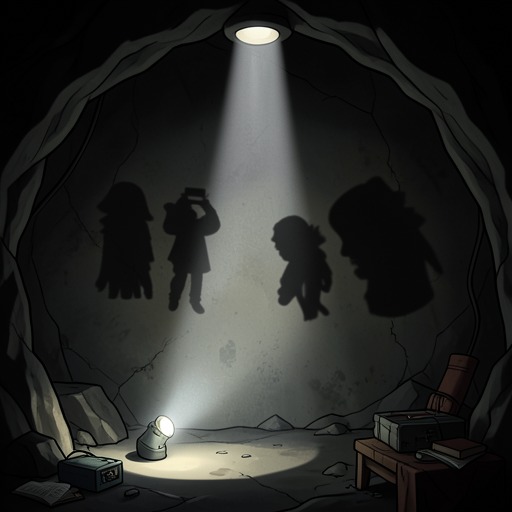
At the end of the tape, Holloway Roberts props up his camera, lights a magnesium flare, crosses the room, and waits in a corner. He alternates between muttering and screaming obscenities into the void, then admits that he does not want to die. He shoots himself with his rifle, but the shot does not provide an immediate ending. For two minutes and twenty-eight seconds he groans and twitches in his own blood before apparently slipping into shock. The tape then records fingers of blackness crossing the illuminated wall and consuming him. Even after the image is lost, the growl continues, now unmistakably inside the room. The creature therefore appears to complete an act that Holloway began: suicide initiates his death, but the darkness removes what remains and makes the final sound inseparable from the house.
Competing Explanations
The narrative refuses to resolve whether Holloway Roberts encountered an actual creature. One critical position favors a real monster, while another offers a rational explanation, but neither interpretation achieves a definitive account. The debate is not merely about missing visual evidence. It concerns whether the house’s effects should be understood through empirical causality or through myth, and whether disbelief can protect anyone from a force that may not depend on being believed.
The text repeatedly dismantles the expectation that a monster must have a recognizable anatomy. It questions the idea that the presence possessed teeth and claws of flesh, suggesting instead that any claws would have been made of shadow and any teeth of darkness. This formulation preserves the creature’s violence while denying it a stable biological body. It can stalk Holloway at every corner and devour him without becoming an animal that can be catalogued. The result is a figure that receives less ontological certainty than a conventional beast but more practical power: it acts, pursues, consumes, and leaves consequences even when its body remains unreadable.
The creature is also linked to the Minotaur, but the comparison is deliberately unstable. Myth supplies a vocabulary for the labyrinth and for the beast imagined at its center, while the house supplies a modern space in which the same structure becomes newly opaque. The Creature in the House is thus both a mythic inheritance and a refusal of myth’s familiar outlines. It is not securely half human and half bull, nor does the story grant the reassuring symmetry of a monster placed at the center of a bounded maze. The darkness has no dependable face, and the house offers no reliable center from which it can be understood.
Psychological and Unnatural Dimensions
The creature’s threat extends beyond the explorers’ recorded experiences. In a later nightmare, Johnny Truant confronts a deformed figure whose body is covered in hair, scars, lumps, and a massive bulge on the forehead. Within the dream, he suddenly understands that he is deformed because an old, dead man who called him son placed him there, although that man was not his father. The dream does not identify this figure simply as the house’s monster, but it gives the creature’s imagery a psychic extension: deformation, paternal secrecy, imprisonment, and violent recognition converge in a body that cannot be separated from the narratives surrounding Zampanò and the house.
Johnny also discovers, for the first time in the dream, that he has a choice. He can remain a victim or kill the attacker, using abnormal strength, sharp teeth, and powerful nails. Yet the possible assailant changes from a drunken frat boy into Kyrie, Ashley, and finally Thumper, without settling into any single identity. The shifting face makes violence inseparable from desire, recognition, and betrayal. The creature’s form is therefore not only an external predator; it also marks the unstable boundary where fear and aggression become interchangeable, and where the threatened subject discovers monstrous capacities within himself.
The final reflections return the creature to a larger and more uncertain field. Johnny senses something stronger than imagination, something terrifying that has retained him despite being free, powerful, and extremely patient. He wonders whether darkness was really nothingness, whether that was the discovery of Will Navidson or Zampanò, or whether something obvious remains undiscovered within and outside him. This ending does not confirm a creature waiting in a physical chamber. It instead preserves the possibility that the house’s darkness has become a condition of perception, memory, and selfhood—an external presence whose most disturbing residence may be wherever the characters try to place it.